


Japanese Yen bounces as Tokyo stops telegraphing its punches
- USD/JPY is on track to snap an eight-week winning streak, sliding from fresh four-decade lows for the Yen after a soft US jobs report.
- Intervention fear has jumped sharply, with wire reports suggesting Tokyo may stop flagging its moves in advance and Friday's US holiday thinning liquidity into a familiar ambush window.
- The Bank of Japan's slow tightening still cannot dent a rate gap of roughly 275 basis points, leaving the Finance Ministry, not monetary policy, to defend the currency.
The Yen rebounded from four-decade lows on Thursday, a move that owed nothing to the Bank of Japan (BoJ). A soft June Nonfarm Payrolls (NFP) print knocked the Dollar, while fear of a fresh intervention jumped hard enough to push USD/JPY toward its first weekly loss in eight weeks. The bounce is borrowed rather than earned, with one unsettling wrinkle: Tokyo now looks willing to act without telling anyone first.
The warning shot that never came
As recently as Wednesday, traders met the same lows with something close to boredom, shrugging off the boilerplate warnings from Finance Minister Satsuki Katayama on the comfortable assumption that authorities always fire a warning shot before spending reserves. That assumption cracked on Thursday, when wire reports suggested Japan may abandon advance signalling entirely and simply strike, stripping the market of its early-warning system. The approaching US Independence Day holiday sharpens the threat, because thinner liquidity magnifies the impact of any operation. The spring rounds that dragged the pair from above 160.00 toward 155.00 were launched into exactly those conditions.
A rate gap the Bank cannot close
The awkward truth for Tokyo is that its own tightening has not helped. The BoJ has lifted its policy rate to 1.00%, the highest since 1995, and the Yen has weakened anyway, because a gap of roughly 275 basis points against the Federal Reserve (Fed) keeps the carry trade alive and well. Intervention is a circuit breaker rather than a cure; the spring operations knocked USD/JPY lower for a handful of sessions before the pair not only recovered but printed fresh highs near 163.00. That leaves the Finance Ministry, rather than monetary policy, carrying the entire burden of defending the Yen, at a higher and more uncomfortable level than in the spring.
The Dollar loses its excuse
The US side of the trade is fraying at the worst possible moment for anyone still long. June payrolls came in at just 57K against expectations near 110K, while the headline unemployment rate only fell to 4.2% because the participation rate slipped to 61.5%, a decline that flatters the number rather than reflecting real strength. The Fed's own chair has already signalled little urgency to tighten further, so next week's Federal Open Market Committee (FOMC) minutes will read from the hawkish June meeting as stale against softer data. A cracking labour market and a fraying rate tailwind, arriving just as intervention risk peaks, make chasing the highs a poor bet.
The docket turns American
Friday brings the US Independence Day holiday and the thin, jumpy liquidity that comes with it, which is precisely the window Tokyo has favoured before. Next week's calendar is decidedly US-based, with the Institute for Supply Management (ISM) services survey due Monday at 14:00 GMT, the FOMC minutes on Wednesday at 18:00 GMT, and weekly jobless claims on Thursday. Japanese releases, Labor Cash Earnings on Monday and the Current Account on Tuesday, sit well down the running order, so the pair's direction rests on the US data and on whether Tokyo finally pulls the trigger.
Levels to watch
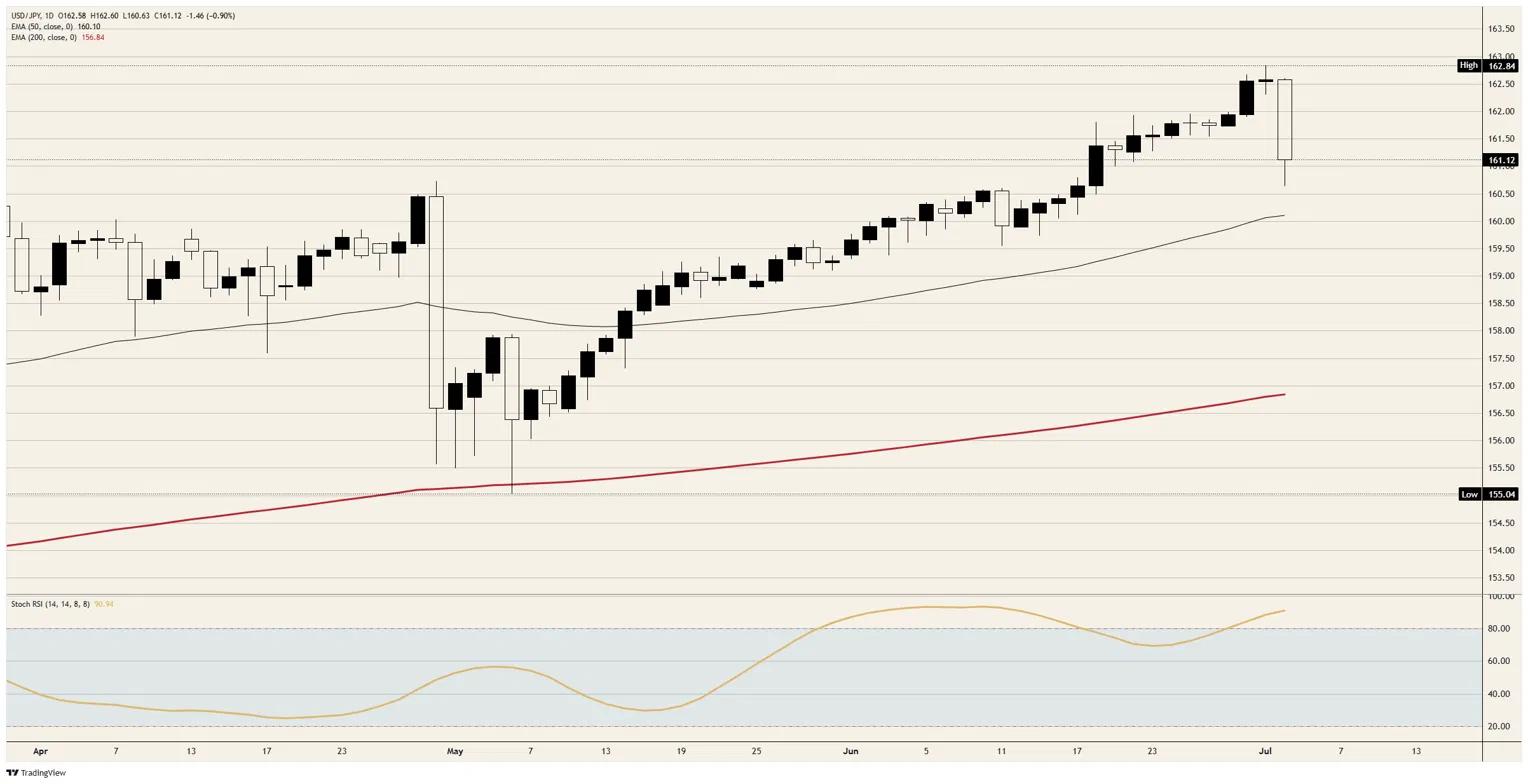
Resistance: The 162.50 area caps the first attempt to rebuild the uptrend, with the pair's four-decade high near 163.00 sitting above it. A daily close back above that zone would signal the intervention scare has been shrugged off and the carry grind is resuming.
Support: The 160.00 handle is the level that matters, reinforced by the 50-period Exponential Moving Average (EMA) just above it, doubling as the psychological threshold Tokyo has defended before. Below there, support near 158.50 marks the prior consolidation shelf, with the 200 EMA close to 157.00 as the deeper backstop.
Bias: The path of least resistance has flipped lower for now, with the eight-week grind posting its first weekly loss, the Stochastic Relative Strength Index (Stoch RSI) rolling over from above 90, and the asymmetric threat of an unannounced intervention arguing against fresh longs; a reclaim of 162.50 would be needed to restore the carry trend, while 160.00 decides whether this is a dip or a genuine turn.
USD/JPY daily chart
Japanese Yen FAQs
The Japanese Yen (JPY) is one of the world’s most traded currencies. Its value is broadly determined by the performance of the Japanese economy, but more specifically by the Bank of Japan’s policy, the differential between Japanese and US bond yields, or risk sentiment among traders, among other factors.
One of the Bank of Japan’s mandates is currency control, so its moves are key for the Yen. The BoJ has directly intervened in currency markets sometimes, generally to lower the value of the Yen, although it refrains from doing it often due to political concerns of its main trading partners. The BoJ ultra-loose monetary policy between 2013 and 2024 caused the Yen to depreciate against its main currency peers due to an increasing policy divergence between the Bank of Japan and other main central banks. More recently, the gradually unwinding of this ultra-loose policy has given some support to the Yen.
Over the last decade, the BoJ’s stance of sticking to ultra-loose monetary policy has led to a widening policy divergence with other central banks, particularly with the US Federal Reserve. This supported a widening of the differential between the 10-year US and Japanese bonds, which favored the US Dollar against the Japanese Yen. The BoJ decision in 2024 to gradually abandon the ultra-loose policy, coupled with interest-rate cuts in other major central banks, is narrowing this differential.
The Japanese Yen is often seen as a safe-haven investment. This means that in times of market stress, investors are more likely to put their money in the Japanese currency due to its supposed reliability and stability. Turbulent times are likely to strengthen the Yen’s value against other currencies seen as more risky to invest in.
추천 기사


