


CoreWeave Stock Surges 9%, Eyes $60 Resistance as Nvidia Pledges Continued Support for AI Financing
TradingKey - Nvidia (NVDA)'s third-quarter results and strong guidance reignited the AI trade. Nvidia shares rose nearly 5% after hours, while neo-cloud providers delivered even stronger gains, with CoreWeave (CRWV) up about 9% after hours, IREN (IREN) jumping roughly 10%, and Nebius (NBIS) gaining 11%. Prior to this, all three companies had each seen their share prices pull back by more than half over the past three months.
Neo-cloud companies such as CoreWeave, IREN, and Nebius primarily generate revenue by building data centers, purchasing Nvidia GPUs, and leasing computing power to customers. Compared with tech giants that have mature cloud businesses, such as Microsoft, Amazon, and Google, these firms have smaller balance sheets and rely more heavily on bonds, loans, and external equity financing for expansion.
As data center construction costs and borrowing rates rise, the market has begun to worry that neo-cloud companies' growth could outpace their financing capacity. Investors are also concerned that following Jensen Huang's departure, Nvidia's new management could cut investments, credit guarantees, and purchase commitments to related companies, thereby leading to data center delays and a slowdown in GPU orders.
Kress's comments on the earnings call eased this concern. She noted that neo-cloud providers have become an increasingly vital part of the global AI infrastructure ecosystem, helping startups, model developers, sovereign clients, and traditional enterprises access Nvidia computing power while expanding the reach of the Nvidia platform.
Nvidia's Financing Standards to Tighten
However, Nvidia's support for the AI ecosystem is not unconditional. Kress acknowledged that neo-cloud companies and frontier model labs face exceptionally strong compute demand, but the expansion pace of some firms has already outpaced their balance sheets and long-term credit capacity.
To prevent land, power, and data center capacity from becoming bottlenecks to AI development, Nvidia has helped certain customers advance infrastructure projects through investments, procurement commitments, and credit support. However, the company will evaluate counterparties more rigorously in the future and will not provide indiscriminate funding across the entire industry.
Nvidia's latest filings show that certain commitments will take effect only after partners secure project financing, complete data center construction, operationalize the relevant compute capacity, and pass acceptance checks. If partners fail to meet these conditions, the actual amounts and timing assumed by Nvidia will be adjusted accordingly. The company will prioritize data center projects with high demand visibility that can support multiple generations of computing platforms.
This means Nvidia's policy is not an across-the-board tightening of financing, but rather a gradual shift from previously aggressive ecosystem expansion toward capital allocation that places greater weight on returns and credit quality. As the AI financing market matures, the company will also reexamine future investments, guarantees, and other long-term commitments.
For neo-cloud companies, the financing window remains open, but eligibility requirements will become stricter. Firms with long-term customer contracts, power resources, and stable funding sources may continue to receive support, whereas projects heavily reliant on short-term borrowings, facing high customer concentration, or with yet-to-be-delivered data centers could face greater pressure.
Evercore ISI analyst Amit Daryanani believes that Nvidia's assistance in resolving land, power, and financing constraints helps the neo-cloud ecosystem continue to expand. The market's real concern had been a complete withdrawal by Nvidia from related financing, and Kress's comments clearly did not go that far.
CoreWeave Stock Price Technical Analysis
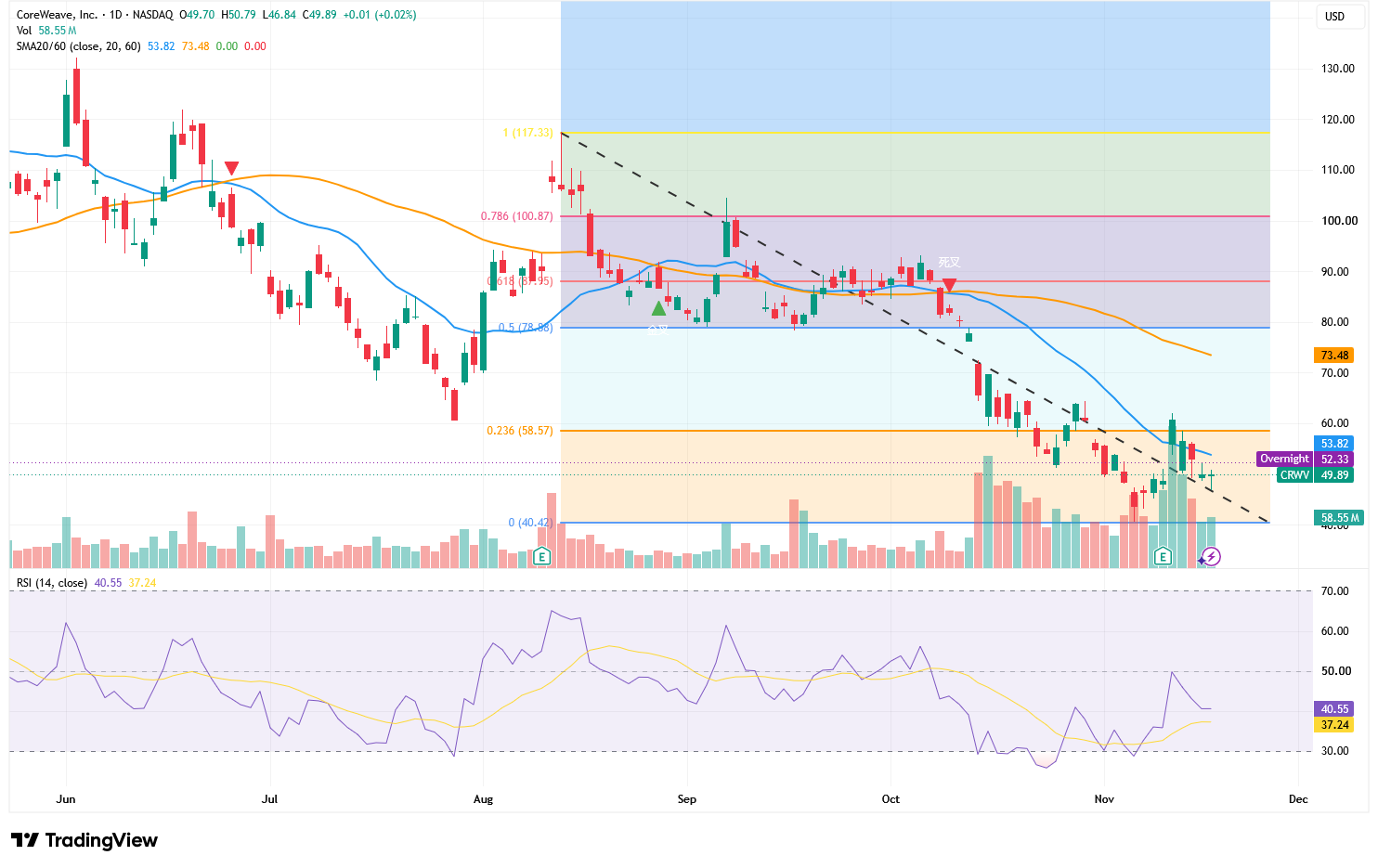
Source: TradingView
From a technical perspective, CoreWeave closed at $49.89 in regular trading, and a 9% post-market gain brought the stock to around $54.40, indicating a brief return above its 20-day moving average of $53.82. If the stock can hold firmly between $54 and $55 on heavy volume in the next trading session and break out of the multi-month downtrend line, a short-term bottoming structure could be preliminarily confirmed. Conversely, if it opens higher but falls back below $50, this rally may still be merely a news-driven oversold rebound.
On the upside, the first major resistance level is at $58.57, corresponding to the 23.6% Fibonacci retracement level, which, together with the $60 mark, forms a resistance zone. If the stock effectively breaks through $59 to $60, rebound targets could shift sequentially higher toward $65 and the 60-day moving average near $73.48. However, before reclaiming $73, the medium-term trend cannot be considered to have completed a reversal.
In terms of momentum, the 14-day RSI has recovered from oversold territory to 40.55 and crossed above its signal line at 37.24, indicating that downward momentum is waning. However, the RSI remains below the 50 neutral line, and buyers have not yet gained full control. On the downside, initial focus should be on the $48 to $50 range; if it is lost again, the stock could retest $45 and subsequently test its prior low of $40.42.
Recommended Articles


