


Nvidia Q3 Earnings Preview: AI Chip Deliveries and CEO Transition in Focus, Wall Street's Highest Target at $515
TradingKey - Nvidia (NVDA) will report its fiscal 2027 third-quarter financial results after the market close on November 17, Eastern Time, and host an earnings conference call at 5:00 p.m.
Jensen Huang's departure has sparked market concerns regarding the stability of the company's management. Nvidia shares fell approximately 12.75% last week, closing at $162.85 on November 13.
This is the first quarterly earnings report since Jensen Huang's departure. In addition to AI chip sales and forward guidance, investors will also focus on commentary from interim CEO and CFO Colette Kress regarding the business outlook and the management transition.
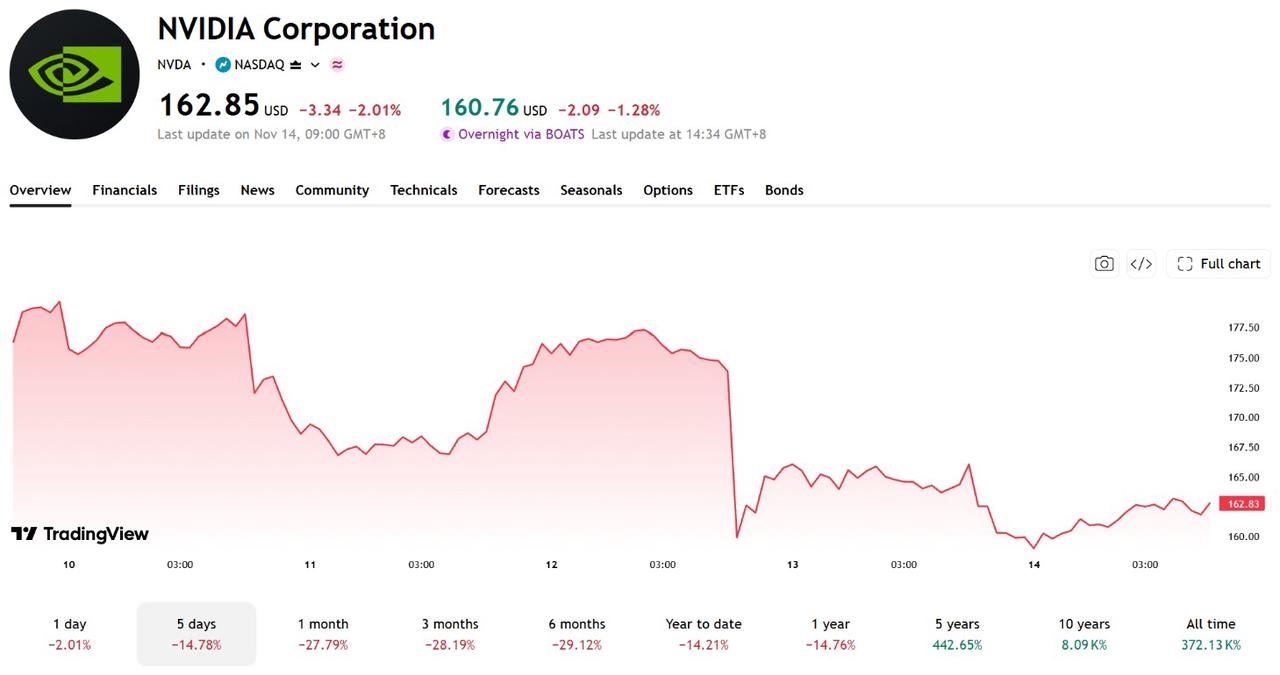
[Source: TradingView]
Market Expectations and Second-Quarter Results
According to Visible Alpha forecasts, Nvidia's fiscal 2027 third-quarter revenue is expected to reach $109.3 billion, up approximately 92% year over year; of that, data center revenue is projected to be $101.8 billion.
The company previously provided revenue guidance of $108 billion, plus or minus 2%, with market expectations $1.3 billion above the midpoint of the guidance. Non-GAAP gross margin guidance was 74%, plus or minus 0.5 percentage points. This guidance excludes data center compute revenue from the Chinese market.
Looking back at the second quarter, Nvidia reported revenue of $96.2 billion, up 106% year over year; data center revenue was $89 billion, up 117% year over year, and the non-GAAP gross margin was 75%.
The midpoint of the third-quarter gross margin guidance is 1 percentage point below the previous quarter's actual level. The market will focus on whether AI chip sales can continue to exceed expectations and how gross margin changes will affect profitability.
Key Earnings Focus: AI Chip Shipments, Q4 Guidance and Management Transition
The data center business remains the primary driver of Nvidia's revenue growth. The market will focus on the delivery status of Blackwell chips, as well as shipment volumes and customer deployment progress for the Vera Rubin platform. The company previously projected that Vera Rubin would account for approximately 20% of third-quarter data center revenue.
Fourth-quarter guidance is equally important. The market will focus on whether demand for AI chips can sustain growth, as well as the impact of rising component costs such as memory on gross margins. If revenue guidance beats expectations but gross margins continue to decline, it could weigh on market sentiment regarding future earnings growth.
In addition, uncertainty remains over U.S. chip export curbs on China, and related policy changes along with their impact on future sales also warrant attention.
On the management front, Jensen Huang has resigned as chief executive officer, president, and director, with Chief Financial Officer Colette Kress serving as interim CEO while the board searches for a permanent successor.
According to the Financial Times, Huang has discussed the possibility of returning to the CEO role with people close to him, but the board has yet to announce any decision. The market will be watching the potential impact of the leadership transition on business operations and customer partnerships.
Regarding financial disclosures, prominent U.S. investor Michael Burry, who inspired the movie "The Big Short," recently questioned Nvidia's adjustments to its geographic revenue reporting methodology, focusing in particular on the reclassification of revenue related to China and Singapore.
According to filings submitted by Nvidia to the U.S. Securities and Exchange Commission, starting in the third quarter of fiscal 2026, the company changed its geographic revenue reporting basis from customer billing address to direct customer headquarters location, and restated historical comparable data. This adjustment does not affect total revenue, but alters the geographic attribution of certain revenue.
Burry contended that the historical data restatement effectively increased China revenue for fiscal 2024 and fiscal 2025, eliminating the previously observed downward trend in revenue prior to the implementation of export controls while making the decline during the restriction period appear more pronounced.
He also questioned how revenue previously attributed to Singapore is being reclassified, and whether the location of a customer's headquarters truly reflects where the chips are actually used.
However, the adjustment in reporting methodology and the related questions do not in themselves constitute a determination of financial wrongdoing. Investors still need to watch for further clarifications from the company regarding geographic revenue allocation, the ultimate destination of its chips, and the impact of export controls.
Institutions Cut Nvidia Price Targets After Jensen Huang's Departure, Highest Still at $515
Following Jensen Huang's departure, several Wall Street firms lowered their price targets on Nvidia. According to forecasts from 61 analysts compiled by StockAnalysis, Nvidia's average 12-month price target is approximately $273, implying a 67.86% upside from its current share price, with the highest target at $515.
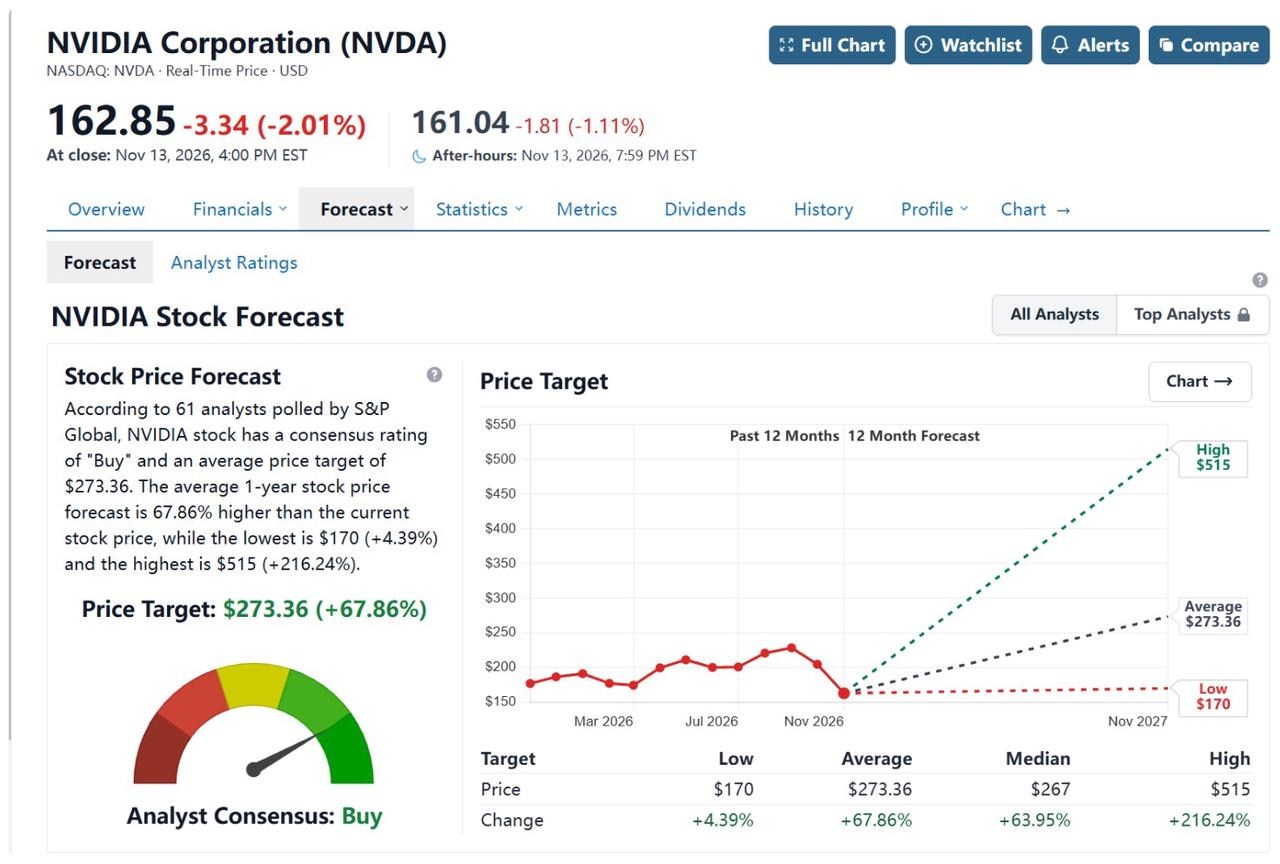
[Source: StockAnalysis]
Raymond James raised its price target on Nvidia to $515 in August and reiterated a "Strong Buy" rating on November 12, maintaining its price target on the view that recent management controversies will likely have a limited impact on the company's fundamentals.
By contrast, several firms cut their price targets. On November 13, Morgan Stanley lowered its target from $300 to $267, primarily over concerns that Jensen Huang's departure could affect strategic execution and customer partnerships, though it remains bullish on the long-term growth of the AI chip business. Barclays trimmed its target from $275 to $210, with both firms maintaining an "Overweight" rating; HSBC downgraded the stock to "Hold" with a price target of $170, arguing that succession uncertainties and U.S. chip export restrictions could weigh on future profitability.
Despite divergent institutional views on Nvidia's valuation, the broader market continues to maintain a "Buy" rating. The upcoming third-quarter earnings report and fourth-quarter guidance will serve as critical benchmarks for assessing the company's growth outlook.
If data center revenue beats expectations, gross margin aligns with guidance, and the fourth-quarter outlook is robust, market concerns may ease. However, if forward guidance is weak or management succession remains unclear, the stock could still come under pressure even if quarterly results meet expectations.
Recommended Articles


