


Nvidia CEO Jensen Huang Resigns as Stock Tanks. Here Are the Next Steps for Investors.
Key Points
Nvidia CEO Jensen Huang resigned on Thursday.
CFO Colette Kress was named interim CEO.
Here are the next steps for investors.
- Motley Fool Issues Rare "Total Conviction" Buy Alert ›
Nvidia (NASDAQ:NVDA) stock was plummeting this past Thursday, down about 5% in morning trading after CEO Jensen Huang abruptly resigned following reports in The New York Times of extramarital affairs.
The S&P 500, Dow Jones Industrial Average, and the Nasdaq Composite were all down on Nov. 12, but all by less than 1% in morning trading, as the move was likely already priced in by investors. Nvidia stock is down about 11% over the past five days and 29% over the past month.
Missed AI’s "Act 1"? Act 2 Could Be 15x Bigger. Most investors think they missed the AI boat because they didn't buy Nvidia in 2005. But according to our analysts, we’re only at the end of "Act 1"—the R&D phase. "Act 2" is the global rollout. Continue »
It is an unprecedented development at the world's second-largest company, one that may leave many investors wondering what the next steps are.
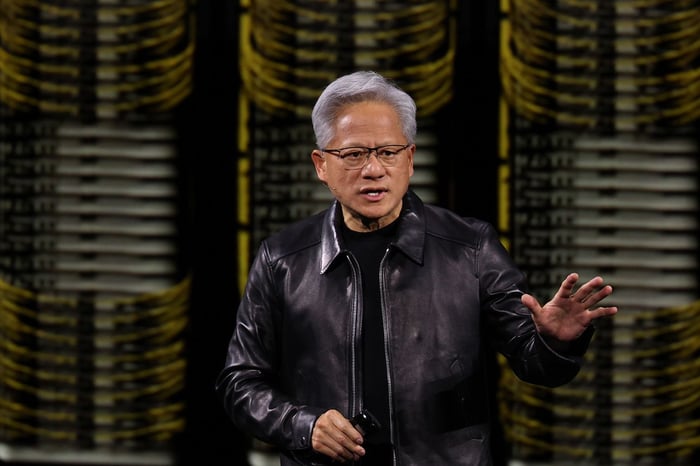
Jensen Huang. Image source: Getty Images.
Kress takes over
One of Huang's affairs was with a Chinese businesswoman who was reportedly recruited by Chinese intelligence to gather information on Nvidia. It led the Nvidia board to conduct an investigation into the matter. The New York Times also reported on Nov. 11 that Huang had an affair with an Nvidia employee.
Huang apologized on Nov. 8, stating in a letter to employees: "I owe my family and all of you an apology. I was unfaithful to my wife. My actions hurt her and our children. There is no excuse for what I did. I am deeply sorry."
Four days later, on Nov. 12, Huang resigned from the company that he co-founded in 1993 and has led as CEO for 33 years. He built Nvidia into the largest company in the world in November 2024. It is currently second only to Apple, with a market capitalization of $4 trillion. Nvidia, which makes graphics processing units (GPUs) for AI data centers, became the driving force in the AI boom and Huang became the face of the AI revolution.
Colette Kress, Nvidia's longtime chief financial officer, was named the interim CEO, effective immediately. "The Board has full confidence in Colette and the leadership team, and we expect the company's operations, customer commitments and product roadmap to continue without interruption," Harvey Jones, chair of the Nvidia board, said.
Kress has been with Nvidia since 2013 when she joined as CFO. "We will continue advancing the work that has made Nvidia a leader in accelerated computing and AI, and execute on the opportunities ahead. Our focus remains on serving our customers, partners, developers, and shareholders," Kress said.
Next steps for investors
The resignation of the CEO of one of the largest public companies in the world is not unprecedented, but rarely, if ever, have the markets seen such an abrupt exit at a massive company over personal conduct and not due to performance issues or as part of a planned succession.
While there have been other personal conduct ousters among CEOs, none of them in recent history have been at a company as large, as influential, and as important to the stock market as Nvidia.
In that sense, it is somewhat uncharted territory. But the key for investors is not to make any rash moves and maintain a long-term investing mindset.
The first step should be to pore over the various Wall Street analysts' reports on Nvidia following the transition. In recent days, Nvidia stock has received a slew of price target downgrades. RBC Capital recently lowered its target by $100 to $230 per share but maintained its buy rating. Cantor Fitzgerald also lowered it by $100 to $250 per share but kept a buy rating.
Others, like Baird and Keybanc, lowered Nvidia's rating from buy to hold or neutral, and reduced its price target. Overall, Nvidia stock has a median price target of $262 per share, which would suggest 57% upside over the next 12 months -- and this includes recently updated projections. Further, 28 analysts still rate it as a buy, with only 8 calling it a hold, and 0 rating it as a sell.
Next, investors should tune in for Nvidia's third-quarter earnings on Tuesday, Nov. 17, after the market closes. Nvidia is expected to generate $108 billion in revenue in its Q3. That would be up 12% from Q2 and 89% year-over-year. While robust, it is slightly slower growth than in Q2. The consensus among analysts is about $109.4 billion in revenue.
But investors should also be watching for news on the leadership transition, the hiring of a new CEO, any news of the Huang investigation, and anything else that can provide some visibility into where the company is headed following this major and abrupt transition.
Historically cheap
Finally, investors should take note that Nvidia stock is trading at a valuation it has not seen in years. It is trading at just 21 times earnings and 11 times forward earnings. The last time its P/E ratio was this low was in 2019. Since that time in 2019, Nvidia stock has grown about 3,200%.
Also, its five-year PEG ratio, which gauges its valuation relative to its long-term earnings expectations, is just 0.22. Anything under 1.0 is considered a value, so the 0.22 PEG ratio would suggest it is a value relative to its earnings potential.
While the upheaval is concerning and worth a cautious eye, Nvidia remains the dominant player in its field, and its AI chips sit at the center of the AI boom and massive hyperscaler build-out.
Should you buy stock in Nvidia right now?
Before you buy stock in Nvidia, consider this:
The Motley Fool Stock Advisor analyst team just identified what they believe are the 10 best stocks for investors to buy now… and Nvidia wasn’t one of them. The 10 stocks that made the cut could produce monster returns in the coming years.
Consider when Netflix made this list on December 17, 2004... if you invested $1,000 at the time of our recommendation, you’d have $335,171!* Or when Nvidia made this list on April 15, 2005... if you invested $1,000 at the time of our recommendation, you’d have $1,000,640!*
Now, it’s worth noting Stock Advisor’s total average return is 823% — a market-crushing outperformance compared to 208% for the S&P 500. Don't miss the latest top 10 list, available with Stock Advisor, and join an investing community built by individual investors for individual investors.
See the 10 stocks »
*Stock Advisor returns as of November 15, 2026.
Dave Kovaleski has no position in any of the stocks mentioned. The Motley Fool has positions in and recommends Apple and Nvidia. The Motley Fool has a disclosure policy.
Recommended Articles


