


Nvidia Fell While AMD and Broadcom Jumped. Here’s What History Says Happens Next to All 3 Stocks.
Key Points
Nvidia will likely be fine as a company, even without co-founder Jensen Huang as CEO.
AMD's stock trades at a pricey premium.
Broadcom may be the safest investment of these three chipmakers.
- Motley Fool Issues Rare "Total Conviction" Buy Alert ›
Nvidia (NASDAQ:NVDA) shareholders have had a rough few weeks. Nvidia's stock was a bit weak heading into November amid a marketwide AI sell-off, but in the days since news broke that its CEO, Jensen Huang, had an affair with an alleged Chinese spy, the stock has taken a beating. That weakness has continued after Huang’s announcement on Thursday that he was stepping down from the CEO role. CFO Colette Kress has been tapped to lead the company on an interim basis while the board searches for the next CEO.
Some companies' losses are others' gains, and while Nvidia is down 21% so far this month, AMD (NASDAQ:AMD) has risen by around 4% and Broadcom (NASDAQ:AVGO) is up about 6%. That's a major mismatch, but the question is: What happens next with this trio of chipmakers?
Missed Nvidia in 2009? This Rare Signal Is Flashing Again. In 2009, a "Double Down" signal flashed for a little-known chipmaker called Nvidia. For the first time in years, that same "Total Conviction" signal is flashing for a company 1/100th the size of Nvidia. Continue »
Let's take a look at what history has to say about what's going on, and consider which stock may be the best to buy of this trio right now.

Image source: Getty Images.
Nvidia is a major wild card
These three companies are all competitors in the data center computing world. Nvidia and AMD design GPUs, which are broad-purpose computing units that excel at handling a wide range of computationally heavy workloads. However, that flexibility comes at a cost. GPUs are more expensive to manufacture, buy, and operate than chips that are purpose-built for narrow types of AI workloads. That's where Broadcom's application-specific integrated circuits (ASICs) come in — those custom AI chips are becoming quite popular with data center operators.
Nvidia has by far the largest data center segment of the three. During its most recently reported quarter, its data center revenue rose 117% year over year to $89 billion. Broadcom's AI semiconductor division is far smaller, with quarterly revenue of $16.7 billion. However, it was growing at a much faster 221% year-over-year pace.
AMD is in last place among the three. Its data center revenues grew at a "slower" 97% year-over-year pace to $8.5 billion.
However, if Nvidia's market leadership slips, AMD would likely have the most to gain. Broadcom's chips are becoming increasingly popular, but they can't do everything a GPU can.
Huang has resigned, and the question now is: How well can Nvidia survive without him? While he was deeply involved in the details of the operation and the loss of his leadership will be a blow to the company, there are likely numerous people who could succeed him and keep Nvidia on track. Companies go through CEO transitions all the time without getting derailed — even when (as in this case) there’s no clear succession plan in place.
I think that will be the case for Nvidia, and I'm not worried, as I think its products speak for themselves.
With that in mind, where could these three stocks go from here?
AMD is incredibly expensive
I think the best way to value these stocks is to look at their prices relative to next year's earnings projections. Starting with Broadcom, it's already in fiscal year 2027, and it trades at 17 times forward earnings.
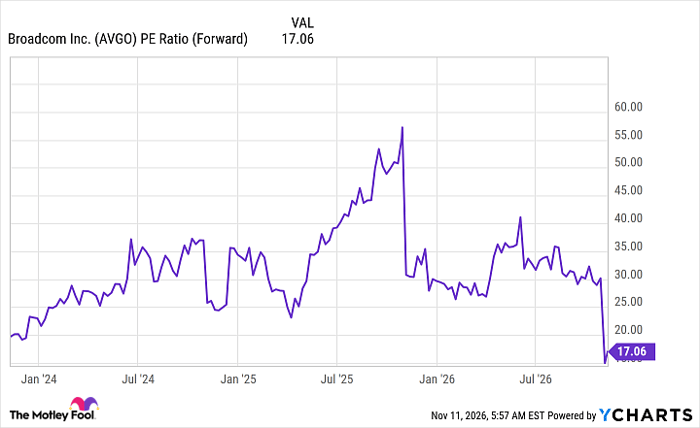
AVGO PE Ratio (Forward) data by YCharts
Between Nvidia and AMD, there is a huge mismatch. Nvidia's stock hasn't gotten much respect over 2026, while AMD's valuation has soared. After the latest sell-off, Nvidia trades at just 10.6 times next year's earnings. Meanwhile, AMD trades for three times as much at 29 times next year's earnings.
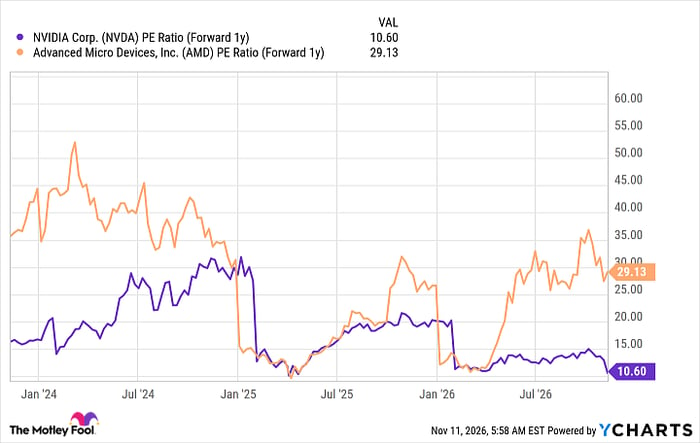
NVDA PE Ratio (Forward 1y) data by YCharts
The question is, what is a reasonable price to pay for these companies?
I think AMD's valuation is far too high, and that could sap its future returns. Nvidia's is dirt cheap and ripe for a strong rebound once this news cycle blows over, but I can understand why some investors want to steer clear for a while.
Lastly, Broadcom has no problems and is trading at a cheap level. If you're looking for the AI chipmaker with the highest upside and the lowest risk, I think Broadcom is the clear winner here.
Should you buy stock in Nvidia right now?
Before you buy stock in Nvidia, consider this:
The Motley Fool Stock Advisor analyst team just identified what they believe are the 10 best stocks for investors to buy now… and Nvidia wasn’t one of them. The 10 stocks that made the cut could produce monster returns in the coming years.
Consider when Netflix made this list on December 17, 2004... if you invested $1,000 at the time of our recommendation, you’d have $335,171!* Or when Nvidia made this list on April 15, 2005... if you invested $1,000 at the time of our recommendation, you’d have $1,000,640!*
Now, it’s worth noting Stock Advisor’s total average return is 823% — a market-crushing outperformance compared to 208% for the S&P 500. Don't miss the latest top 10 list, available with Stock Advisor, and join an investing community built by individual investors for individual investors.
See the 10 stocks »
*Stock Advisor returns as of November 14, 2026.
Keithen Drury has positions in Broadcom and Nvidia. The Motley Fool has positions in and recommends Advanced Micro Devices, Broadcom, and Nvidia. The Motley Fool has a disclosure policy.
Recommended Articles


