


Walmart Rises Over 10% in Past Month, Nearing 52-Week High: Q3 Earnings May Push Stock to $150
TradingKey - As of the close on November 12, Eastern Time, Walmart (WMT) shares stood at $126.19, up more than 10% over the past month and about 7% below its 52-week high of $135.16.
The rebound over the past month has driven the stock closer to its previous high, and market focus has also shifted to the fiscal 2027 third-quarter earnings report due before the market opens on November 19, with attention on whether e-commerce, advertising, and membership businesses can sustain growth, and whether profit performance can support further upside for the stock.
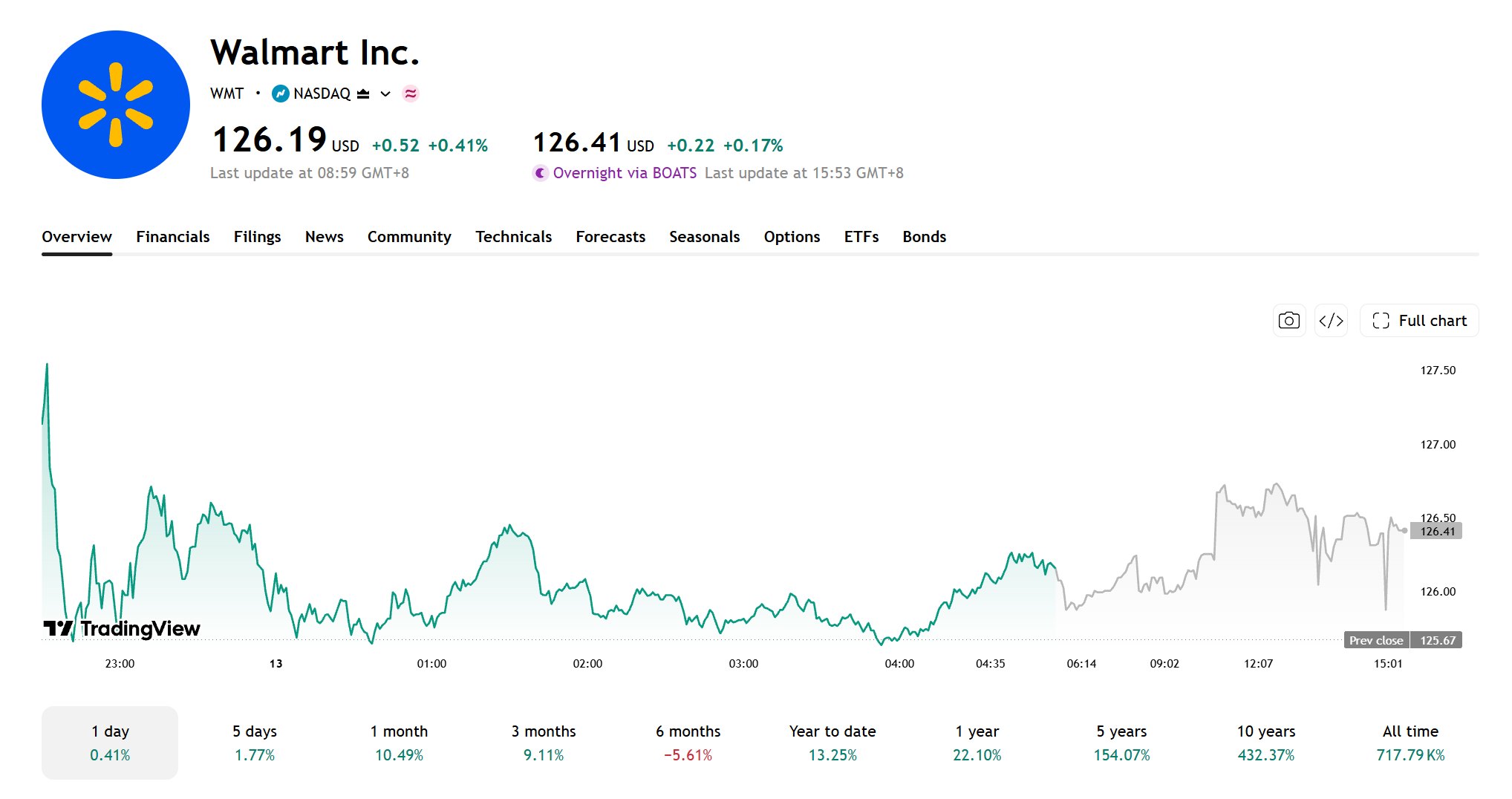
[Source: TradingView]
E-Commerce and Membership Growth, Profit Performance and Full-Year Guidance in Focus
Looking back at the second fiscal quarter, Walmart's revenue grew 5.9% year-over-year to $187.9 billion, up 5.1% on a constant-currency basis. Global e-commerce sales rose 23%, and U.S. comparable sales increased 2.6%.
Adjusted earnings per share grew 19.1% year-over-year to $0.81, and adjusted operating income increased 17.4% on a constant-currency basis, with tariff refunds contributing approximately 7.5 percentage points of the growth.
The company expects third-quarter adjusted operating income to grow 2% to 4%, with adjusted earnings per share of $0.62 to $0.64; full-year adjusted operating income is expected to grow 7% to 8.5%, with adjusted earnings per share of $2.80 to $2.87.
Ahead of the third-quarter earnings release, JPMorgan, UBS, and Mizuho raised their price targets for Walmart to $145, $149, and $135, respectively, reflecting institutions' positive expectations for the company's growth prospects.
The key focus of this earnings report is whether adjusted operating income can reach the high end of guidance and whether management will raise full-year earnings expectations. If results beat expectations and full-year guidance is raised, it is expected to boost market confidence and provide support for the stock to further break through $135.
WMT Technical Analysis: Earnings May Catalyze Breakout, Stock Poised to Challenge $150
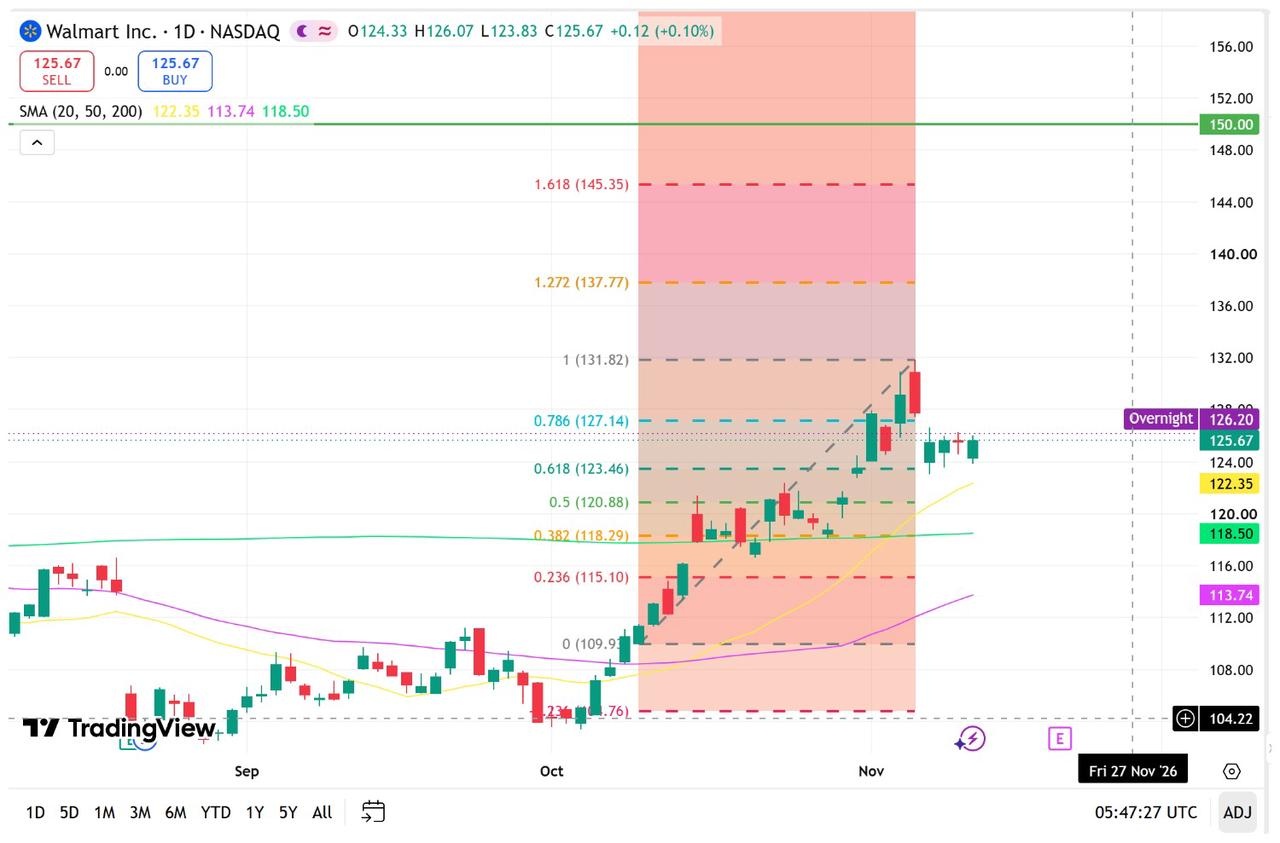
Walmart's stock price rebounded from an intraday low of $109.93 on October 9 to hit a high of $131.82 on November 5 before pulling back.
As of the November 11 close, the stock stood at $125.66, falling below the 0.236 Fibonacci retracement level of $127.14 but remaining above the 0.382 retracement level of $123.46, pointing to a weakening short-term trend.
[Source: TradingView]
Overhead resistance: $126.65, $131.82, and $135.16.
The stock first needs to reclaim $126.65 before focusing on the November 5 high of $131.82. Trading volume that day was about 42.07 million shares, significantly higher than the daily average of about 22.33 million shares over the past month; however, after surging higher, the stock pulled back to close at $127.72, indicating heavy overhead selling pressure.
If the stock breaks above $131.82 on heavy volume, it will next test its 52-week high of $135.16. Only a decisive breakout above the $135-$136 zone is likely to open the door to further upside.
Upside targets: $137.77, $145.35, and $150.
Calculated using the $109.93-$131.82 range, the 1.272 and 1.618 Fibonacci extensions are approximately $137.77 and $145.35, respectively. If the stock breaks above $135-$136, initial focus will be on $137.77; a further break above $145 would position it to challenge the $150 psychological level.
Downside support: $123.46, $120.88, and $118.29.
If the stock fails to reclaim $126.65 and decisively breaks below $123.46 on a daily closing basis, it could next pull back to $120.88; if that level gives way, attention will turn to support near $118.29.
Overall, Walmart remains in a pullback phase following its rebound. In the short term, it must first reclaim $126.65 before challenging the $135 resistance level. If earnings results fuel a decisive breakout above $135, the next target could be $150.
Recommended Articles


