


Apple's Market Value Grew From $350 Billion to $4 Trillion During Tim Cook's 15 Years as CEO. Here's What That Growth Curve Means for Apple's Next Chapter Under John Ternus
Key Points
Apple is highly unlikely to match the returns it produced under Tim Cook over the next 15 years.
Still, the company has several strengths that could allow it to beat the market over the long run.
- Motley Fool Issues Rare "Total Conviction" Buy Alert ›
At the end of August, Tim Cook stepped down as CEO of Apple (NASDAQ:AAPL), ending a highly successful tenure as the head of one of the world's largest companies. Tim Cook led Apple as it revolutionized the tech sector and became the world's first trillion-dollar company. Apple is now worth $5.2 trillion, up from just $350 billion when Tim Cook took over -- though it was worth about $4.6 trillion when Cook ended his tenure as CEO. What does that mean for Apple's new leader, John Ternus?

Image source: Getty Images.
Missed Nvidia in 2009? This Rare Signal Is Flashing Again. In 2009, a "Double Down" signal flashed for a little-known chipmaker called Nvidia. For the first time in years, that same "Total Conviction" signal is flashing for a company 1/100th the size of Nvidia. Continue »
A tough act to follow
Tim Cook became the CEO of Apple in 2011, four years after the first iPhone was released. Apple's famous smartphone was already a hit, but Tim Cook oversaw the company's creation and launch of several other highly popular products, such as the Apple Watch and the AirPods.
Perhaps more importantly, Tim Cook transformed Apple's installed base into a massive cash-generating machine through millions of paid subscriptions across more than a dozen services. Apple's services segment is now its second-largest by sales, and it carries much juicier margins than hardware products. That's the business John Ternus is inheriting: a lineup of popular devices, an even more popular brand name, and a massive consumer technology ecosystem with more than 2.5 billion active devices in circulation.
Apple is a stronger company than it was in 2011, but it is also far larger and operates in a more competitive environment. Could John Ternus really deliver returns on par with those that shareholders saw under Tim Cook's tenure?
Almost certainly not. Apple could be worth over $60 trillion in 15 years if Ternus can pull that off. To put things in perspective, consider that the entire GDP of the U.S. last year was just under $31 trillion -- Apple would be valued at nearly twice that by 2041 if Ternus can match Cook's performance over this period. That's not happening, but that doesn't mean Apple's shares are no longer worth investing in. Let's consider some reasons why the stock remains attractive.
Apple's excellent prospects
Apple has been the best-performing Magnificent Seven stock this year. There are several reasons for that, and at least one of them matters a great deal for the company's prospects. Apple's iPhone 17, introduced last year, has become very popular and powered a strong renewal cycle. Partly thanks to this product, Apple's top-line growth in recent quarters has been much stronger than the company's average over the past three years.
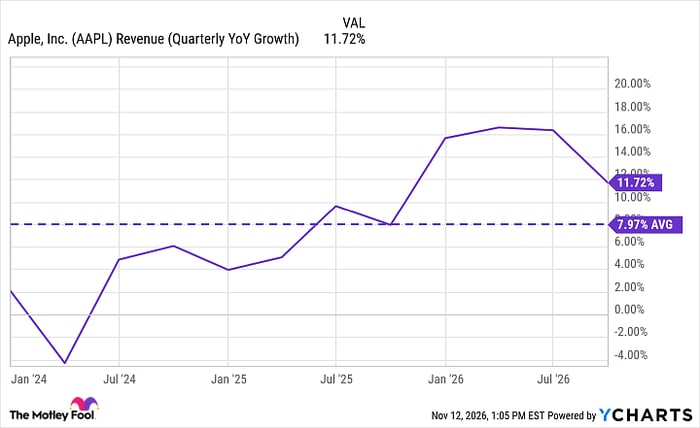
AAPL Revenue (Quarterly YoY Growth) data by YCharts
Here's the lesson: Apple is so popular and has such a large customer base that even a single highly successful product can meaningfully move the needle for the company. And Apple may have found its next gem already. The company announced the iPhone Duo, its first attempt at a foldable smartphone, in September. The iPhone Duo has already become a hit.
It quickly sold out once it became available, and Apple is facing supply constraints. The best part is that this may just be the beginning. Foldable smartphones account for just 2% of the overall smartphone market, according to some data. Expanding this space with a device priced above other iPhone models may help boost Apple's sales growth in the medium term.
And even if the first-generation iPhone Duo has some problems -- there have been reports of the screen cracking, though these cases are rare -- Apple's large installed base means it can use consumer data to craft better devices in the future. There are also reportedly brand-new devices the company is working on, including smart glasses.
Apple does not need every single one of them to be successful. One or two successes could boost sales growth and expand its installed base, thereby increasing service revenue and helping lift the company's margins and profits over the next decade.
Here's another reason to invest in Apple: The company prioritizes returning capital to shareholders through dividends and share buybacks. Here's the bottom line: The tech leader may not match the returns it recorded during Cook's tenure, but it can still deliver market-beating returns.
Should you buy stock in Apple right now?
Before you buy stock in Apple, consider this:
The Motley Fool Stock Advisor analyst team just identified what they believe are the 10 best stocks for investors to buy now… and Apple wasn’t one of them. The 10 stocks that made the cut could produce monster returns in the coming years.
Consider when Netflix made this list on December 17, 2004... if you invested $1,000 at the time of our recommendation, you’d have $335,171!* Or when Nvidia made this list on April 15, 2005... if you invested $1,000 at the time of our recommendation, you’d have $1,000,640!*
Now, it’s worth noting Stock Advisor’s total average return is 823% — a market-crushing outperformance compared to 208% for the S&P 500. Don't miss the latest top 10 list, available with Stock Advisor, and join an investing community built by individual investors for individual investors.
See the 10 stocks »
*Stock Advisor returns as of November 14, 2026.
Prosper Junior Bakiny has no position in any of the stocks mentioned. The Motley Fool has positions in and recommends Apple. The Motley Fool has a disclosure policy.
Recommended Articles


