


How These 5 Apparel and Footwear Stocks Differ
Key Points
Lululemon is rebuilding its leadership team from the top down after sales fell 4% last quarter.
On sells running shoes at full price and grew sales 17% last quarter, while Deckers leans on just two brands, HOKA and UGG.
TJX makes money from other brands' leftover inventory, and Abercrombie keeps adding new places to sell, including Target.
- 10 stocks we like better than Lululemon Athletica Inc. ›
Here's a simple way to think about the following five clothing and shoe companies: They all sell you something to wear, but each one makes its money in a completely different way. That matters more than it sounds. Three of them are each worth roughly $12 billion right now, yet they're in very different spots. When you look at apparel stocks, who the customer is and how the product reaches them tells you more than the logo does.
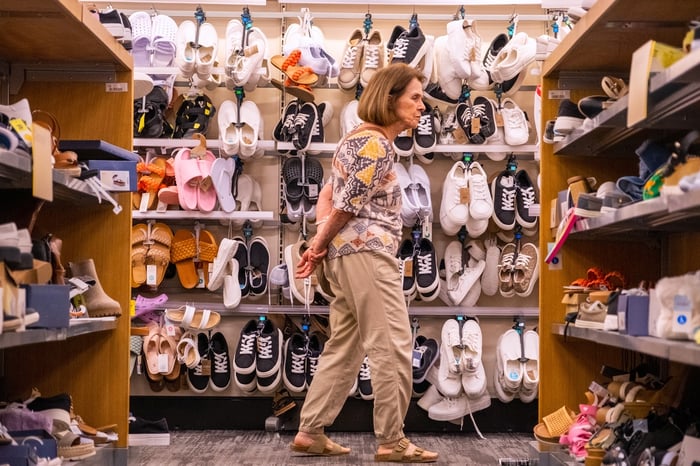
Image source: Getty Images.
Missed Nvidia in 2009? This Rare Signal Is Flashing Again. In 2009, a "Double Down" signal flashed for a little-known chipmaker called Nvidia. For the first time in years, that same "Total Conviction" signal is flashing for a company 1/100th the size of Nvidia. Continue »
1. Lululemon: A famous brand rebuilding its kitchen
Lululemon Athletica (NASDAQ: LULU) sells premium leggings and workout clothes through its own 825 stores and its website. That control is great when its products are hot. When they aren't, there's nowhere to hide.
Last quarter, revenue fell 4%, and comparable sales, which track only stores and sites that have been open for at least a year, dropped 9%. Management expects revenue to fall 10% to 11% in the current quarter.
CEO Heidi O'Neill, who spent decades at Nike, took over in September. She is rebuilding the team. In October, she hired away Athleta CEO Maggie Gauger to be chief product officer, saying the company would put "product, design, and innovation at the center of how we operate." A new brand chief brought in from Four Seasons started Nov. 9. Shares closed at $107.45 on Nov. 11.
2. On Holding: The running shoe that doesn't go on sale
On Holding (NYSE: ONON), the Swiss maker of those cloud-soled sneakers, is the growth story here. Third-quarter sales rose 17.2% to a record 931.4 million Swiss francs (about $1.12 billion), and sales through its own stores and website jumped 25%.
What sets On Holding apart is its pricing strategy. Management calls it "innovation that consumers choose at full price," and its gross margin, the share of each sale left after paying to make the product, hit 66.9% in Q3 (excluding a one-time tariff refund). It's also branching out: Apparel sales grew 38.7%, helped by a Zendaya collection. Shares closed at $34.71.
3. Deckers: Two brands, two seasons
Deckers Outdoor (NYSE: DECK) is basically two businesses: Hoka running shoes and Ugg boots. Last quarter, Hoka sales grew 6.8%, and Ugg grew 3.5%. Sales through other retailers rose 5.5%, while sales on its own sites and stores slipped 1.8%.
CEO Stefano Caroti pointed to "a challenging consumer environment," and Deckers now expects only high-single-digit percentage growth at Hoka this year. Meanwhile, it spent $637 million buying back its own stock in the first six months of fiscal 2027.
At $84, the stock trades below the roughly $99 per share average it paid for the shares it repurchased. Ugg's big quarter is the holiday one; a cold December matters.
4. TJX: It profits from everyone else's leftovers
TJX Companies (NYSE: TJX), the owner of TJ Maxx, Marshalls, and HomeGoods, doesn't design much at all. It buys brand-name and designer goods opportunistically and sells them at prices generally 20% to 60% below regular stores, with no coupons or sales.
"Availability of branded, quality merchandise continues to be outstanding," CEO Ernie Herrman said in August.
Comparable sales rose 4% last quarter, led by HomeGoods at 7%, though TJ Maxx and Marshalls grew just 1%. TJX plans to speed up store openings next year and now sees room for 7,500 stores. At $135.96, it's worth about $150 billion, more than the other four combined, and it's one of the steadier retail stocks to own.
5. Abercrombie & Fitch: A mall brand that found new shelves
Abercrombie & Fitch (NYSE: ANF) runs two brands: its namesake chain, and Hollister. Second-quarter sales hit a record $1.3 billion, its 15th straight quarter of growth, led by an 8% gain at the Abercrombie brands. Hollister grew 2%.
The strategy now is reaching people outside its own stores. In June, Hollister launched a dorm and bedding line at Target, its first move into home goods, with new items slated for release before the holidays. It has also bought back 7% of its shares this year.
Shares trade near $151. About $100 million of last quarter's pre-tax profit came from tariff refunds, so the real test is whether sales keep climbing without that help.
Should you buy stock in Lululemon Athletica Inc. right now?
Before you buy stock in Lululemon Athletica Inc., consider this:
The Motley Fool Stock Advisor analyst team just identified what they believe are the 10 best stocks for investors to buy now… and Lululemon Athletica Inc. wasn’t one of them. The 10 stocks that made the cut could produce monster returns in the coming years.
Consider when Netflix made this list on December 17, 2004... if you invested $1,000 at the time of our recommendation, you’d have $348,060!* Or when Nvidia made this list on April 15, 2005... if you invested $1,000 at the time of our recommendation, you’d have $1,067,492!*
Now, it’s worth noting Stock Advisor’s total average return is 849% — a market-crushing outperformance compared to 210% for the S&P 500. Don't miss the latest top 10 list, available with Stock Advisor, and join an investing community built by individual investors for individual investors.
See the 10 stocks »
*Stock Advisor returns as of November 13, 2026.
Micah Zimmerman has no position in any of the stocks mentioned. The Motley Fool has positions in and recommends Deckers Outdoor, Nike, On Holding, TJX Companies, and Target. The Motley Fool recommends Abercrombie & Fitch and Lululemon Athletica Inc. The Motley Fool has a disclosure policy.
Recommended Articles


