

Microsoft Falls Over 2% Premarket as Massive Global Outage Hits Outlook and Teams, Raising Concerns Over Enterprise Service Stability

Source Tradingkey

TradingKey - As of press time on November 13, Eastern Time, Microsoft (MSFT) fell about 2.8% in pre-market trading to $508.33.

On November 12, multiple Microsoft services suffered a widespread outage, affecting certain features of Outlook, Teams, Copilot, and other Microsoft 365 applications. The outage lasted about 12 hours and extended into Friday business hours in the Asia-Pacific region.

As this marks the second major outage for Microsoft's Microsoft 365 services this year, enterprise customer concerns over service reliability have intensified once again.
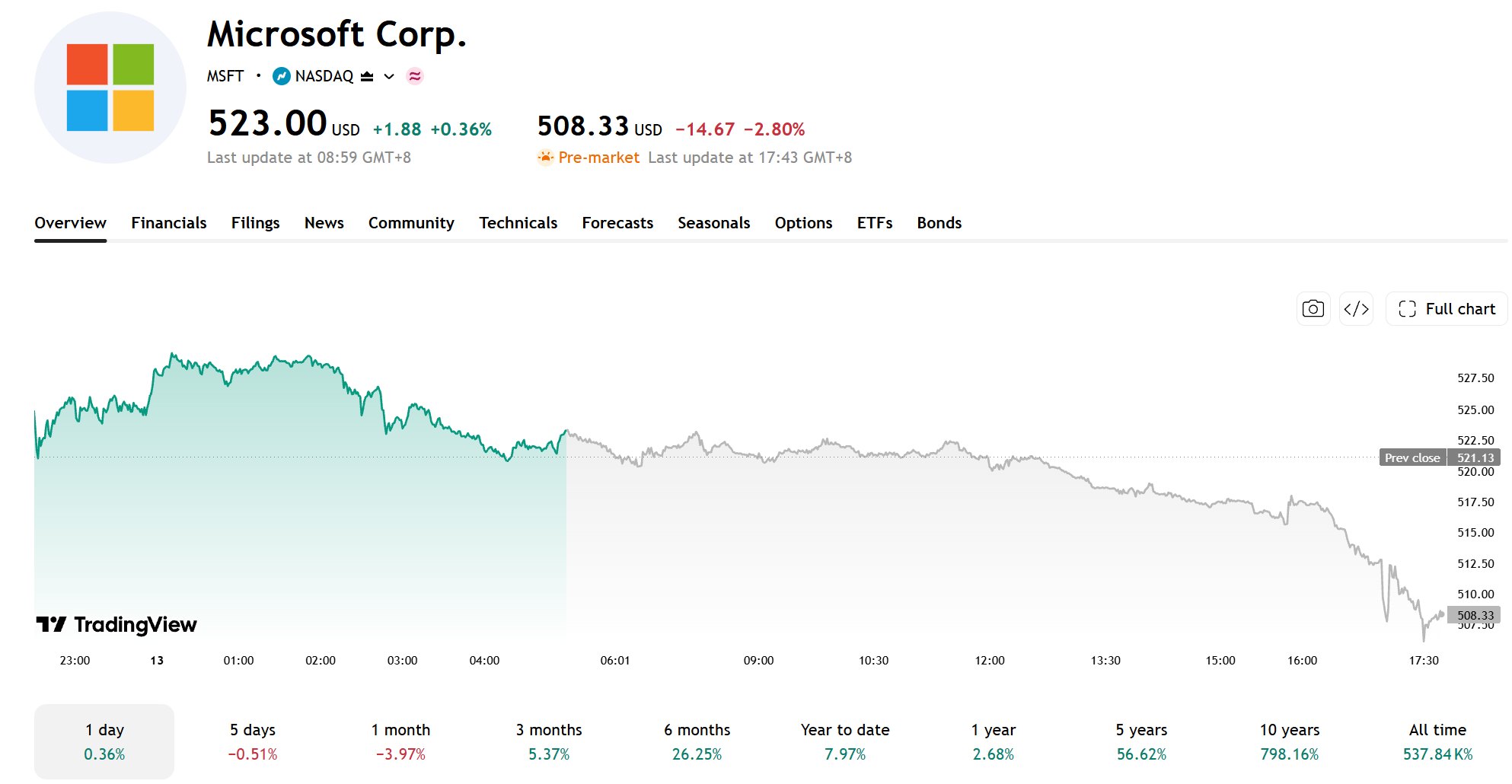
msft-11-13-e4550685112c4f40a588739bd34baf93

[Source: TradingView]

Multiple Microsoft Services Suffer Outage Lasting Over 12 Hours

The outage primarily affected Exchange Online, Microsoft's cloud-based email and calendar service, and spilled over into other Microsoft 365 features that rely on it. Some users were unable to access Outlook mailboxes normally, with sending and receiving emails as well as inbox loading also impacted.

Certain Teams features were also affected, particularly calendar and meeting scheduling functions that depend on Exchange Online, while features independent of the service remained largely operational.

Downdetector data showed that Outlook outage reports peaked at approximately 138,000 around 1:00 p.m. Eastern Time on November 12. The disruption subsequently spread across multiple countries and regions, with service anomalies also emerging in markets such as India, Australia, and Japan.

The disruption also affected some third-party services. OpenAI stated that its Microsoft connector experienced issues, leaving certain new connections and related tools unavailable; Anthropic also reported that its Microsoft 365 connector was affected by the upstream service outage.

Microsoft stated that some servers failed automated health checks and were taken out of service, reducing the number of available servers and driving up the load on the remaining infrastructure. The investigation also revealed that processes responsible for establishing secure connections on affected servers became overloaded, preventing them from properly handling requests.

To restore service, Microsoft took measures including restarting affected servers, rerouting traffic, and throttling connection traffic in certain regions, while also testing configuration adjustments.

As of press time, Microsoft was still advancing its remediation efforts. Earlier, some servers returned to service became unresponsive again after traffic resumed, resulting in unstable recovery progress.

The latest update indicates that server stability has improved after Microsoft deployed upstream authentication and routing configuration patches, and the company is gradually expanding their rollout. Meanwhile, the company is boosting infrastructure capacity by adding virtual machine resources.

To mitigate the impact of delayed email delivery during the outage, Microsoft extended the email timeout window to 48 hours to protect messages pending processing.

Microsoft stated that there is currently no indication the outage was caused by malicious activity, and the specific cause remains under investigation.

Enterprise Service Stability Impacts Customer Confidence

Outlook and Teams are essential tools for daily operations across many enterprises. The outage disrupted email transmission, meeting scheduling, and certain collaboration features, highlighting how deeply Microsoft's productivity services are integrated into everyday enterprise operations.

Enterprise customers focus not only on software features and pricing, but also place significant value on service availability and fault recovery capabilities. If similar disruptions recur, they could undermine customer confidence in Microsoft's service reliability and prompt some businesses to consider backup communication and collaboration solutions.

There is currently no evidence to suggest that this outage has led to enterprise customer churn, nor can it be concluded that Microsoft's enterprise services revenue will be materially affected.

Investors will need to monitor Microsoft's explanation regarding the cause of the outage going forward, as well as whether the company further enhances its server health checks, fault isolation, and service recovery mechanisms.

In the near term, the market will focus on whether Microsoft can fully restore services and identify the cause of the failure. Over the long term, service stability and customer retention will influence how enterprises evaluate Microsoft's productivity and cloud services.

Disclaimer: For information purposes only. Past performance is not indicative of future results.
placeholder
Gold Price Analysis Today | Forex Gold Analysis | XAU/USD Analysis - November 11, 2026Get the latest gold price analysis, forex gold insights, and XAU/USD analysis for November 11, 2026. Read on for the details.
Author  Mitrade
Nov 11, Wed
Get the latest gold price analysis, forex gold insights, and XAU/USD analysis for November 11, 2026. Read on for the details.
placeholder
Bitcoin lost its 200-day average — but the exit started three sessions before the CPIBitcoin fell 2.5% to about $73,400 on 11 November, an 11-week low, breaking its 200-day moving average near $73,100. The 24-hour liquidation tally reached $632 to $705 million, roughly 82% of it longs. But spot ETF outflows began three sessions earlier and USDT's market cap has shrunk $6.6 billion in 60 days — the leveraged length left before the inflation print did. A double top at 81,890 and 81,080 leaves a measured target of 69,366.
Author  Suzie
Nov 11, Wed
Bitcoin fell 2.5% to about $73,400 on 11 November, an 11-week low, breaking its 200-day moving average near $73,100. The 24-hour liquidation tally reached $632 to $705 million, roughly 82% of it longs. But spot ETF outflows began three sessions earlier and USDT's market cap has shrunk $6.6 billion in 60 days — the leveraged length left before the inflation print did. A double top at 81,890 and 81,080 leaves a measured target of 69,366.
placeholder
Nvidia slid 7.7% after hours while AMD and Broadcom rose — the AI trade changed hands, it didn't breakNvidia closed Wednesday at 173.73, up 2.87%, then fell as much as 8.1% to 159.44 after reports that its board was preparing for a possible leadership change. The same session, the Philadelphia Semiconductor Index rose 5.7% with all 30 components higher, CoreWeave jumped 24.7% on 168% revenue growth, and Micron added 11.9%. If AI demand were being repriced, AMD and Broadcom would not be bid. This is a governance discount on one name, and 204.54 — the 200-day average — is the level that settles it.
Author  Irene Q.
Nov 12, Thu
Nvidia closed Wednesday at 173.73, up 2.87%, then fell as much as 8.1% to 159.44 after reports that its board was preparing for a possible leadership change. The same session, the Philadelphia Semiconductor Index rose 5.7% with all 30 components higher, CoreWeave jumped 24.7% on 168% revenue growth, and Micron added 11.9%. If AI demand were being repriced, AMD and Broadcom would not be bid. This is a governance discount on one name, and 204.54 — the 200-day average — is the level that settles it.
placeholder
Gold hit a one-year low while central banks bought 321 tonnes — the sellers were never the ones you thinkSpot gold closed at 3,876 on Thursday, down 2.8% and its lowest close in more than a year, with an intraday low near 3,852. The dollar is at a 19-month high of 103.21 and the 10-year yield is at 5.10%, so the price move is easy to explain. What is harder to explain is who sold: central banks bought 321 tonnes in Q3, the PBoC added for a 24th straight month, ETF holdings are near a record 4,256 tonnes, and roughly 95% of the futures selling came from non-reportable and sovereign-type accounts rather than hedge funds. This piece separates the two books that have to balance.
Author  Irene Q.
Yesterday 02: 40
Spot gold closed at 3,876 on Thursday, down 2.8% and its lowest close in more than a year, with an intraday low near 3,852. The dollar is at a 19-month high of 103.21 and the 10-year yield is at 5.10%, so the price move is easy to explain. What is harder to explain is who sold: central banks bought 321 tonnes in Q3, the PBoC added for a 24th straight month, ETF holdings are near a record 4,256 tonnes, and roughly 95% of the futures selling came from non-reportable and sovereign-type accounts rather than hedge funds. This piece separates the two books that have to balance.
placeholder
Brent rose 3.3% and US crude stocks built 4.66 million barrels in the same weekBrent January settled at 95.82, up 3.3%, and WTI at 88.74, up 2.55%, after the US signalled it would not pursue a deal with Iran and attacks on Gulf shipping continued. In the same week, EIA data showed US crude inventories rising 4.657 million barrels against expectations of a 1.1 million draw, with gasoline up another 1.799 million. OPEC output also rebounded 1.96 million barrels a day to 27.16 million in October, led by Saudi Arabia at 10.56 million. This piece separates the geopolitical premium from the physical balance and lays out where each side of the trade is anchored.
Author  Irene Q.
Yesterday 03: 06
Brent January settled at 95.82, up 3.3%, and WTI at 88.74, up 2.55%, after the US signalled it would not pursue a deal with Iran and attacks on Gulf shipping continued. In the same week, EIA data showed US crude inventories rising 4.657 million barrels against expectations of a 1.1 million draw, with gasoline up another 1.799 million. OPEC output also rebounded 1.96 million barrels a day to 27.16 million in October, led by Saudi Arabia at 10.56 million. This piece separates the geopolitical premium from the physical balance and lays out where each side of the trade is anchored.
goTop
quote