


Nvidia's Jensen Huang Is on the Hot Seat. Here's What I'm Doing With My Nvidia Stock
Key Points
The Nvidia saga has taken another turn, and predicting where it goes next seems impossible.
Investors should focus on risk management, ensuring they don't have excessive exposure to Nvidia.
Huang's exit would likely not affect the business over the near term, but it could make a significant difference over several years.
- Motley Fool Issues Rare "Total Conviction" Buy Alert ›
In just a few days, Nvidia (NASDAQ:NVDA) CEO Jensen Huang has gone from AI's rock star to a Greek tragedy.
Over the weekend, Huang admitted to an affair with a suspected Chinese spy, sparking an investigation by the company and multiple calls for inquiries across the federal government due to Nvidia's possible violation of chip export restrictions.
Missed AI’s "Act 1"? Act 2 Could Be 15x Bigger. Most investors think they missed the AI boat because they didn't buy Nvidia in 2005. But according to our analysts, we’re only at the end of "Act 1"—the R&D phase. "Act 2" is the global rollout. Continue »
Just three days later, on Wednesday, The New York Times reported that Huang had had a relationship with an Nvidia executive, Kimberly Powell, Nvidia's vice president of healthcare, who reports directly to him. Their relationship would appear to be in violation of the company's code of conduct, and on Wednesday, Nvidia's leadership met to discuss Huang's future with the company. The Wall Street Journal reported that Nvidia's board is preparing to remove Huang.
Nvidia stock tumbled on Monday and Tuesday in response to the admission of the relationship with the purported Chinese agent. After a partial recovery on Wednesday, the stock dropped 7% in after-hours trading on news of the second affair.
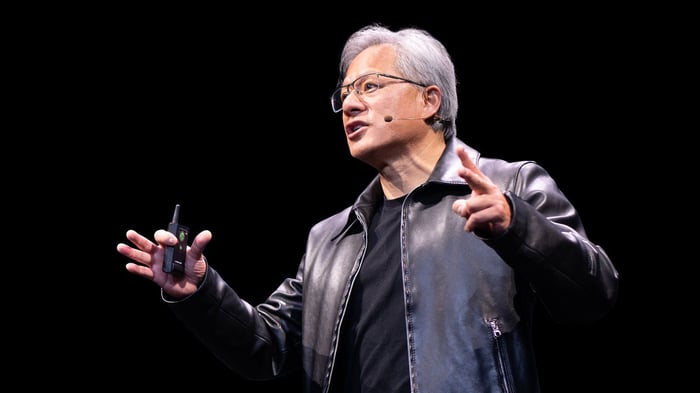
Image source: Nvidia.
Nvidia's future hangs in the balance
Nvidia and its investors are in uncharted territory here. Over the last few years, Huang has become the face of not just Nvidia, but AI itself. His company, until recently, was the most valuable in the world, and its chips are at the heart of the AI boom, in demand from virtually every company working in AI, from labs to hyperscalers to physical AI.
With that success, Huang has reached a status that few CEOs before him have, on par with Elon Musk and Steve Jobs, recognized as both visionaries and celebrities. Now, Huang's painstakingly built empire could come crumbling down.
Huang is 63, but the company has no clear succession in place. Nvidia's board has a history of deferring to Huang, and he has imposed an unusually flat organizational structure on the company, giving him roughly 50 direct reports.
Nvidia has no Chief Operating Officer or Chief Marketing Officer, choosing to designate those positions with the lesser EVP title. In other words, Huang has enormous shoes to fill if he were to be let go, and finding a suitable replacement won't be easy.
What I'm doing with my Nvidia stock
Predicting what comes next here is a fool's errand. If Huang is dismissed as CEO, we don't know who will take his place, and we don't know how the market will react to whomever that person might be. We also don't know what the fallout will be from any federal investigations against the company, which could lead to fines, increased oversight, or stricter bans on its exports.
Nvidia's technological lead is strong enough to support the company's dominance in the near term, but the semiconductor industry changes quickly and without Huang at the helm, Nvidia's workhorse culture could drift, and its execution could slip, leaving room for competitors. Huang's exit would introduce a lot of variables that investors otherwise wouldn't have to consider.
I think the question of what to do with your Nvidia stock is more about risk management than predicting the future of the business. There's simply too much uncertainty in the near term.
Nvidia makes up less than 2% of my portfolio, so it's not a major position for me. I'm content to hold onto that stake given the company's valuation and the potential for a rebound. However, if it made up a larger percentage like 10% or certainly 20%, I would be trimming it down. That may seem painful after the stock lost a third of its value over the last month, but it could easily lose another third from here, and if it makes up a sizable amount of your portfolio, you're likely sitting on significant gains.
Even if the after-hours loss sticks, Nvidia is still roughly flat from where it was at the end of March. Selling to trim your exposure is a reasonable move, given the crisis at the top of the company.
Missed Nvidia in 2009? This Rare Signal Is Flashing Again
In 2009, a "Double Down" signal flashed for a little-known chipmaker called Nvidia. If you’d invested $5,000 then, you’d be sitting on $2,195,396 today.*
Now, for the first time in years, that same "Total Conviction" signal is flashing for a company 1/100th the size of Nvidia. It’s a key player in the $1.8 trillion space race, and with the stock recently sitting 20% off its highs, the window to get in early is closing fast.
Continue »
*Stock Advisor returns as of November 11, 2026.
Jeremy Bowman has positions in Nvidia. The Motley Fool has positions in and recommends Nvidia. The Motley Fool has a disclosure policy.
Recommended Articles


