


Bitcoin ETFs sold $1.28 billion in a week — and BTC is still above 75,000


US spot Bitcoin ETFs recorded $1.28 billion of net outflows in the week to Nov 6, the biggest weekly redemption since late June, according to SoSoValue. BlackRock's IBIT alone accounted for $1.21 billion, including roughly $403 million on Friday. And yet bitcoin fell only from $80,405 on Nov 4 to $74,940 on Monday — a 6.8% move — and is still holding the 75,000 line. The funds sold; the price did not break.
The $1.28 billion week, day by day
| Date | Net flow (US$m) | BTC close | Note |
|---|---|---|---|
| Nov 2 | -398.6 | 77,345 | Largest single-day outflow of the week |
| Nov 3 | -115.6 | 80,405 | Brief bounce to the week's high |
| Nov 4 | +74.6 | 80,405 | Only inflow day |
| Nov 5 | -430.2 | 75,942 | Biggest daily outflow since July 13 (-424.7) |
| Nov 6 | -411.9 | 75,747 | IBIT -403 |
| Nov 9 (Mon) | — | 74,940 | Holding above 75,000 |
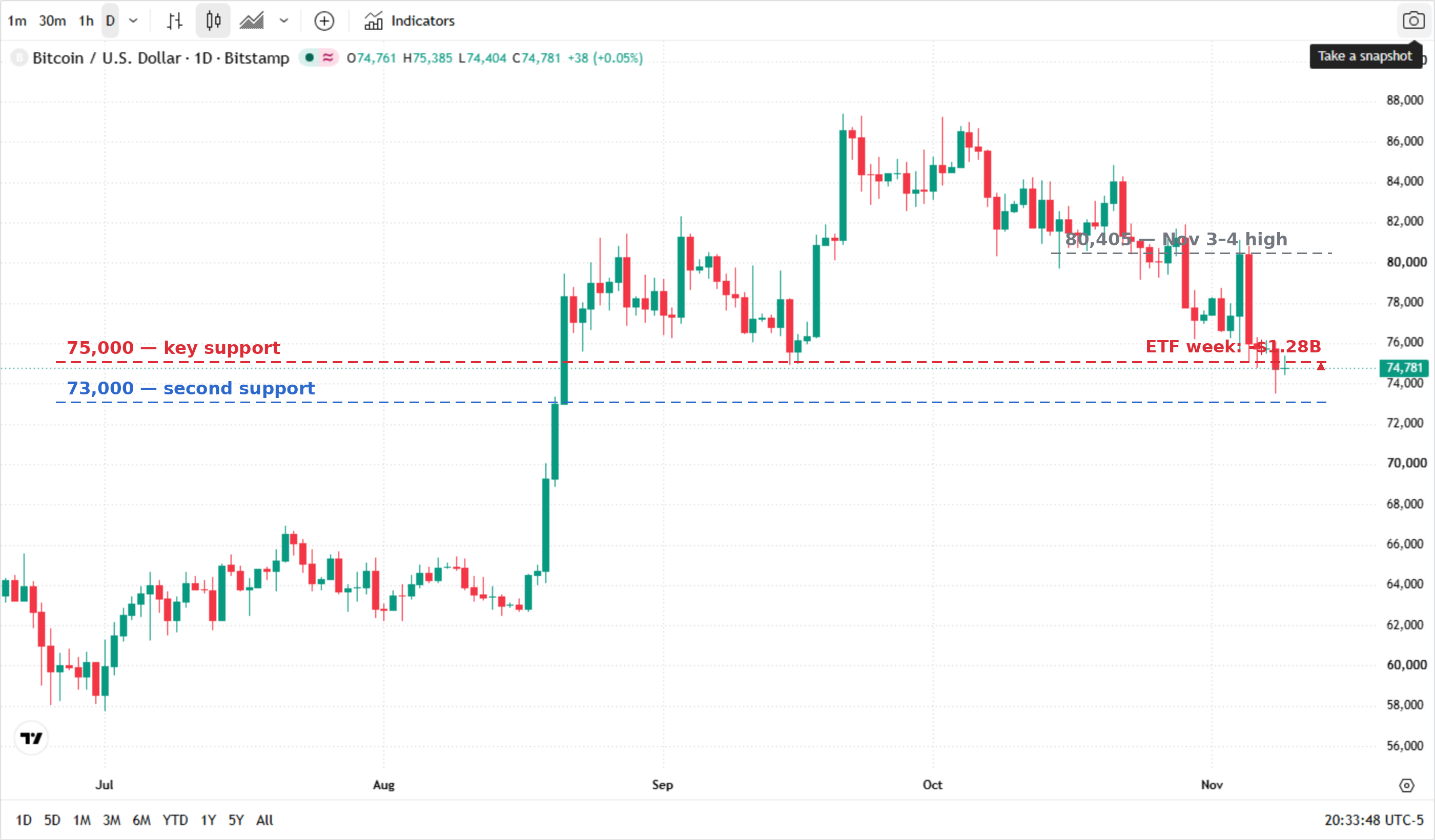
* Chart source: TradingView (BITSTAMP:BTCUSD, daily)
The composition is narrow. IBIT took $1.21 billion of the $1.28 billion weekly total; FBTC (+$93.1m), BITB (+$16.6m), BTCO (+$4.0m) and MSBT (+$3.3m) were the only funds with inflows. Total net assets across the complex sit near $97.5 billion, and cumulative net inflows since launch are about $55.2 billion — which means 2026 year-to-date flows have now flipped negative, at roughly -$914 million.
That last number is the one that reframes the week. This is not a stampede out of a crowded trade that never worked; it is the unwinding of a three-week inflow stretch that had added $3.8 billion, the strongest of 2026. One month of buying has been given back, not two years.
Why the price didn't follow the funds
Two mechanisms explain the gap.
First, the leverage flush did the damage in a single session. On Nov 5, more than $1.08 billion of positions were liquidated in 24 hours, roughly 88% of them longs. That is a margin event, not a spot event: forced sellers hit the order book, price gaps down, and the ETF flow that follows is partly the accounting of that move rather than its cause.
Second, the buyers who left the ETFs are not the same buyers who hold spot. The Polymarket contract on "BTC above $76,000 on Nov 9" was pricing around 47.5 cents over the weekend — a coin flip, not a capitulation. Spot volumes were thin into the Monday Asian open, and BTC held $75,000 despite the weekend headline flow.
The regulatory tape did not help. A revised CLARITY Act targeting "non-decentralised" DeFi operators is working through the text stage, and UniCredit is reportedly looking for a crypto trading and custody partner. Neither is a 2026 earnings event for bitcoin, but both add to the list of things the market has to price.
75,000 is the line that keeps the story alive
The technical map is simple, and it is the reason this week matters more than the flow print.
$75,000 is the round-number floor that has held since the Nov 5 liquidation; a daily close below it opens $73,000 and then the $70,000 shelf. On the upside, $80,405 — the Nov 3–4 high — is the first level that would invalidate the "ETF selling is exhausting itself" reading. The 2026 low of $58,380 (June 30) and the January high of $96,769 frame the wider range.
The ETF flow is the confirming variable, not the leading one. If outflows continue at $400 million a day while BTC holds above 75,000, the marginal seller is the fund allocator, and the spot market is absorbing it. If outflows slow to under $100 million a day and BTC still cannot reclaim 80,405, the problem is demand, not supply.
What would prove this reading wrong
The argument here is that the ETF outflow is a rotation and a de-leveraging, not an institutional exit. Three things would falsify it.
One: a second consecutive week of outflows above $1 billion, which would move the story from "giving back three weeks" to "structural redemption." Two: a daily close below $73,000 on rising spot volume, which would mean spot holders are joining the sellers rather than absorbing them. Three: ETH/BTC breaking below its October low while BTC holds — that would signal a broad crypto de-risking rather than a bitcoin-specific fund rotation.
None of those has happened yet. But the flow print is the fastest-moving input in this market, and one more week like the last one would change the interpretation without changing a single price level.
Read more
* The content presented above, whether from a third party or not, is considered as general advice only. This article should not be construed as containing investment advice, investment recommendations, an offer of or solicitation for any transactions in financial instruments.


