


AMD or Nvidia: Which AI Chip Stock Would I Buy With $1,000 Today?
Key Points
AMD's fiscal Q3 results were good, but its data center segment growth did slow.
Nvidia's fiscal Q3 results are still to come, but it has a track record of outperforming AMD.
- Motley Fool Issues Rare "Total Conviction" Buy Alert ›
AMD (NASDAQ: AMD) and Nvidia (NASDAQ: NVDA) are two of the largest competitors in the AI processor industry. The third primary one is Broadcom (NASDAQ: AVGO), but its niche in that segment differs from theirs. Nvidia and AMD compete in the same field, designing powerful general-purpose chips while Broadcom designs highly specialized computing units for specific AI workloads.
AMD's share price has more than doubled so far this year, seriously outperforming Nvidia, which is just about flat. However, what matters more for investors is what's ahead. So, if you've got $1,000 ready to invest, is AMD or Nvidia the better stock to buy today? I think it's clearly Nvidia, and the numbers speak for themselves.
Missed AI’s "Act 1"? Act 2 Could Be 15x Bigger. Most investors think they missed the AI boat because they didn't buy Nvidia in 2005. But according to our analysts, we’re only at the end of "Act 1"—the R&D phase. "Act 2" is the global rollout. Continue »
Image source: The Motley Fool.
Investors are still waiting for Nvidia's fiscal Q3 results
On Nov. 3, AMD reported its fiscal Q3 earnings. Nvidia's fiscal quarters end one month later than AMD's, so we'll have to wait until Nov. 17 to hear from Nvidia. However, AMD's results were pretty strong.
What investors care about most when comparing these two are their data center divisions. For AMD, this segment saw revenue growth of 97% year over year to $8.5 billion. While that was a strong result, it was still a slowdown from Q2's 107% growth to $6.7 billion.
When Nvidia reports on Nov. 17, investors will be looking closely to see if it follows suit with a growth slowdown, or if it continues to report accelerating revenue gains. During Nvidia's fiscal Q2, its data center revenue rose 117% year over year to $89 billion. So, despite sales that were more than 10 times larger than AMD's, it was growing significantly faster. If it can keep up the trend of growing faster than AMD, I think this scores a major point in Nvidia's favor, as it's far harder for such a massive business to grow that fast.
However, Nvidia's overall business is far more leveraged to the state of the data center segment than AMD is. In fiscal Q2, Nvidia's total revenue was $96.2 billion, so its $89 billion data center revenue made up over 90% of its total. In Q3, AMD's $8.5 billion total was well over half of AMD's $13.3 billion, but its other segments make a much more meaningful contribution to its results. This could be a bad thing for AMD if data center spending takes off over the next few years (like it's projected to do), or it could be a good thing if the data center build-out slows due to new laws and regulations being passed.
Regardless, Nvidia still has the growth edge here, but it also holds another huge advantage.
Nvidia's stock is cheap
In 2026, AMD and Nvidia's businesses have done quite well and are delivering similar levels of growth. However, AMD's stock has soared while Nvidia's has stagnated. While I'm not sure why there is a performance split between these two, it has revealed some pricing discrepancies in the stocks.
As we get closer to turning the calendar to 2027, I think valuing the stocks based on next year's earnings estimates is a smart idea. AMD trades at 30 times next year's expected earnings, which is a bit expensive. However, Nvidia trades at just under 13 times next year's earnings, which is an absolute bargain price.
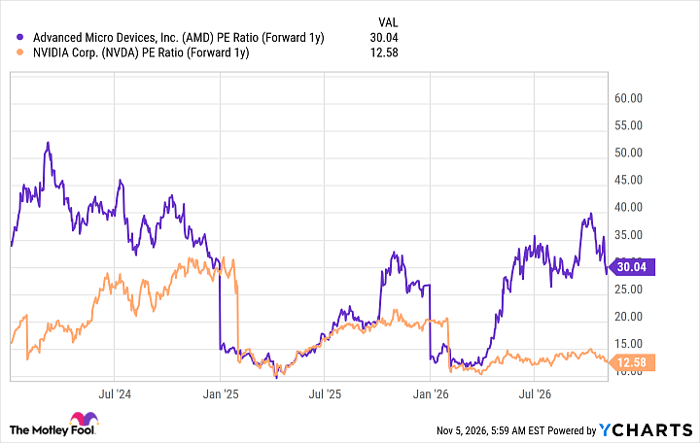
AMD PE Ratio (Forward 1y) data by YCharts.
So, AMD is far more expensive than Nvidia, and I think that's the final piece in the puzzle here. It's not often you can buy shares of a company that is by far the largest name in its industry and also growing faster than its top competitor at a huge discount to the competition, but that's exactly what's going on with Nvidia's stock.
As a result, I think that Nvidia is the best semiconductor stock to invest $1,000 in right now. AMD has had a strong run this year, but now it's about time for the leader to reassert itself. I think Nvidia's 2027 stock performance could mirror AMD's performance in 2026, and if I'm right, its shareholders will be well rewarded.
Should you buy stock in Nvidia right now?
Before you buy stock in Nvidia, consider this:
The Motley Fool Stock Advisor analyst team just identified what they believe are the 10 best stocks for investors to buy now… and Nvidia wasn’t one of them. The 10 stocks that made the cut could produce monster returns in the coming years.
Consider when Netflix made this list on December 17, 2004... if you invested $1,000 at the time of our recommendation, you’d have $341,966!* Or when Nvidia made this list on April 15, 2005... if you invested $1,000 at the time of our recommendation, you’d have $1,146,819!*
Now, it’s worth noting Stock Advisor’s total average return is 852% — a market-crushing outperformance compared to 203% for the S&P 500. Don't miss the latest top 10 list, available with Stock Advisor, and join an investing community built by individual investors for individual investors.
See the 10 stocks »
*Stock Advisor returns as of November 8, 2026.
Keithen Drury has positions in Broadcom and Nvidia. The Motley Fool has positions in and recommends Advanced Micro Devices, Broadcom, and Nvidia. The Motley Fool has a disclosure policy.
Recommended Articles


