


If the Fed Raises Interest Rates in December, I'm Making This 1 Investing Move
Key Points
Most interest rate traders expect rates to increase in December.
What investing moves, if any, should a rate hike prompt?
- Motley Fool Issues Rare "Total Conviction" Buy Alert ›
The Federal Open Market Committee decided not to raise interest rates when it last met on Oct. 28, but a rate hike in December is expected.
In the Federal Open Market Committee's (FOMC) last summary of projections, members targeted a year-end median federal funds rate of 4.1%. The rate is currently in the 3.75% to 4% range, so their median projections would suggest one more rate hike this year.
Missed Nvidia in 2009? This Rare Signal Is Flashing Again. In 2009, a "Double Down" signal flashed for a little-known chipmaker called Nvidia. For the first time in years, that same "Total Conviction" signal is flashing for a company 1/100th the size of Nvidia. Continue »
Does that mean the Federal Reserve will raise rates when it meets next on Dec. 8-9? No, but based on the fact that inflation keeps rising and the FOMC itself said it was likely, it is widely anticipated.
At the time of this writing, the CME FedWatch survey says that 68% of interest rate traders expect a rate hike in December, while 32% say that rates will hold. No one sees rates declining in December.
As for the longer-term projections, the dotplot indicates that rates will be at 4.1% in 2027, which means they see no movement next year, assuming a rate hike in December. The CME FedWatch poll says 34% expect rates at 4.25% to 4.50% a year from now, in December 2027. That would indicate two rate hikes from the current range.
Some 33% say rates will be at 4% to 4.25% next year, while 11% say they will be where they are now, 3.75% to 4%. Only 1% anticipate rates declining in 2027 to the 3.50% to 3.75% range.
While these projections are subject to change, investors should anticipate that rates will rise in December and stay high at least through 2027 -- and likely beyond. Should that alter your investment strategy?
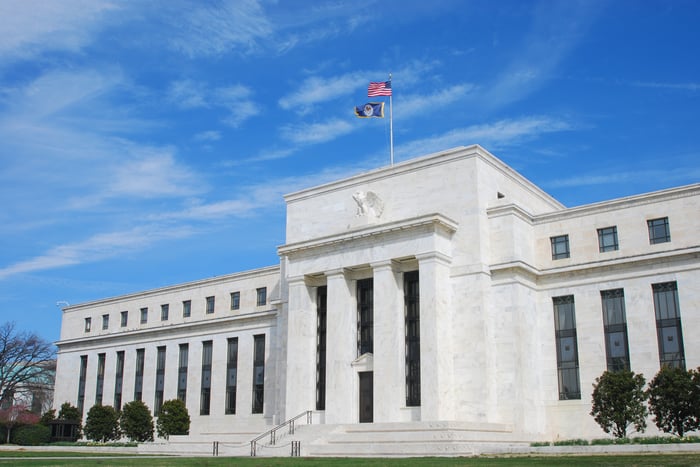
Image source: Getty Images.
Higher for longer
As a long-term investor, the fluctuating interest rate should not, in itself, signal that any major portfolio moves need to be made.
That seems particularly true in this case. This does not appear to be the beginning of a Fed tightening regime like we saw in 2022. In 2022, inflation was rising rapidly and rates had been at 0%, so it was clear that rates would be moving steadily higher for quite a while to cool down inflation.
This is a very different environment. Rates had already started to come down as inflation had been under control, but tariffs followed by the war in Iran and its impact on energy prices has begun to move inflation higher.
But the Fed has given no indication in its dotplot or statements that this is the start of an aggressive plan to hike rates. It is more likely that rates will hover around where they are now, maybe moving slightly higher, but staying roughly where they are, at least in 2027. It's what many call a higher-for-longer scenario.
Of course, things can change ... just like they did last year. In December 2025, rates were lowered to 3.50% to 3.75% and the expectation was for one rate cut in 2026 to 3.25% to 3.50%, and one more rate cut in 2027 to 3% to 3.25%. But, the war in Iran happened and instead of a rate cut, we got a rate hike.
With the Democrats winning the House and Senate on Nov. 3, there is strong sentiment to end the war, eliminate the Trump tariff increases, and rebuild trade relationships. This could potentially bring down prices and lead to rate cuts instead of rate hikes. And it may not -- but the point is, these projections are not set in stone and could certainly change.
Keep calm and carry on
That's why, as an investor, the first thing I would do if the FOMC raises rates in December is to sit tight and do nothing.
This doesn't appear to be the start of aggressive rate tightening, and it is likely that rates will hold steady for a while. There is even a chance that they start to move back down next year.
Even before the election, the FOMC, in its September dotplot, expected inflation to be down to 2.3% at the end of 2027, so there is an expectation for declining inflation -- and that would be a good thing for rates.
But in the broader view, even if rates dipped in 2027, it will probably not be a major shift. You should be prepared for a stable, but higher-for-longer rate environment.
At the end of 2027, after the FOMC acts, investors should review their portfolios as a matter of course. This is especially true with a new Congress coming in and new policies. There could certainly be some changes afoot that impact your portfolio at the margins, but right now it's too early to tell.
Missed AI’s "Act 1"? Act 2 Could Be 14x Bigger
Most investors think they missed the AI boat because they didn't buy Nvidia in 2005.
But according to our analysts, we’re only at the end of "Act 1"—the R&D phase. "Act 2" is the global rollout, a massive technology build-out that Google’s CEO says could be more profound than fire or electricity.
While everyone watches the chip designers, one "backbone" company provides the critical technology that Nvidia and AMD literally cannot function without. We’ve detailed this under-the-radar player in our new AI Playbook.
Continue »
The Motley Fool has a disclosure policy.
Recommended Articles


