


Why Is Robinhood Stock Down 40% From Its Record High?
Key Points
Robinhood's clients engage in risky trading activity, mainly in the options, cryptocurrency, and prediction markets.
Numerous studies have found that most retail investors who trade short-dated options lose money over time, which isn't good for Robinhood's business.
Robinhood stock has plummeted by 40% from its peak, but it's still relatively expensive, which opens the door to more potential downside.
- Motley Fool Issues Rare "Total Conviction" Buy Alert ›
Robinhood Markets (NASDAQ: HOOD) operates an investing platform where its clients buy and sell stocks, options contracts, futures contracts, cryptocurrencies, and even event contracts in prediction markets. Its stock hit an all-time high of $152.46 last year, but it has since plummeted by 40% as investors worry about the sustainability of the company's growth.
Buying and holding a diversified portfolio of at least 50 stocks is a surefire way to build wealth over the long term, but many of Robinhood's clients are more focused on short-term trading, which often leads to steep losses.
Missed AI’s "Act 1"? Act 2 Could Be 15x Bigger. Most investors think they missed the AI boat because they didn't buy Nvidia in 2005. But according to our analysts, we’re only at the end of "Act 1"—the R&D phase. "Act 2" is the global rollout. Continue »
In fact, the commissions Robinhood earned from options trading activity was three-times higher than the commissions it earned from stock investing during the third quarter (ended Sept. 30), and history suggests this will create a serious issue for its business in the near future. Here's what could happen next.

Image source: The Motley Fool.
The high-risk behavior of Robinhood's clients isn't sustainable
Robinhood generated $1.4 billion in revenue during the third quarter, a modest 12% increase from the year-ago period. Transaction-based revenue accounted for $867 million of that total, while net interest income contributed $415 million.
Transaction-based revenue is the money Robinhood generates from its core business, which involves processing trades on behalf of its clients. Options trading was the single largest contributor in the third quarter at $399 million, a 31% increase from the year-ago period. Cryptocurrency trading revenue, on the other hand, plummeted by 55% to $120 million, as steep corrections in most major coins and tokens kept investors sidelined.
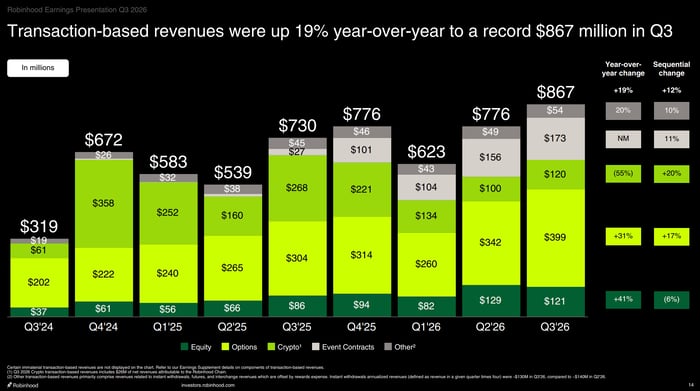
Image source: Robinhood Markets.
Retail traders often use options to make short-term all-or-nothing bets on the direction of an index like the S&P 500, or an individual stock. This can be fruitful during a bull market because so many stocks are carrying significant upward momentum, but severe losses can ensue when things turn around. In fact, several studies have found that most retail investors lose money over time when trading these risky derivatives.
Robinhood has been here before. In the second quarter of 2021, which was near the peak of the last bull market, the bulk of the company's transaction revenue came from the risky options and crypto markets. But just one year later in the second quarter of 2022, options revenue was down 31%, while crypto revenue suffered a 75% collapse. This led to a staggering 90% decline in Robinhood stock.
Unfortunately, there is a high chance history will repeat. Elevated inflation, rising interest rates, and turbulence in the artificial intelligence industry could trigger the next bear market in stocks, and take Robinhood's options commissions down with it. To the company's credit, it has added a new source of revenue by entering the prediction markets, but this simply offers clients yet another way to make extremely risky, all-or-nothing bets on various global events.
Robinhood stock is expensive, despite its recent decline
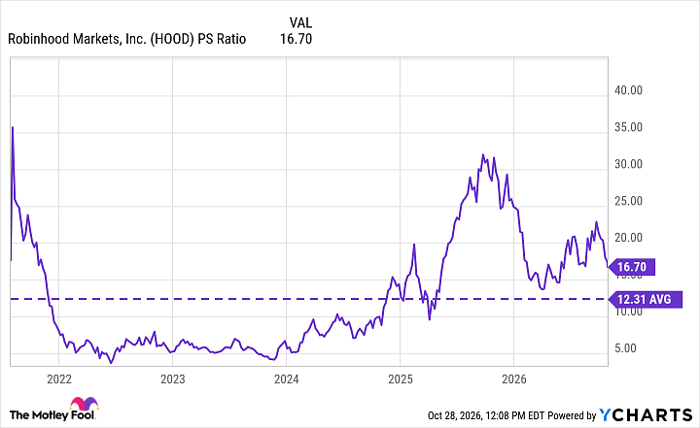
Despite the 40% decline from its record high, Robinhood stock is still trading at an elevated price-to-sales (P/S) ratio of 16.7, which is a premium to its average of 12.3 since going public in 2021.
HOOD PS Ratio data by YCharts
Robinhood stock would have to decline by a further 26% just to trade in line with its long-term average P/S ratio. However, if the company's options trading revenue experiences a sharp drop like it did after 2021, that would organically lift its P/S ratio, thus potentially resulting in an even steeper decline in its stock.
But there is a silver lining. If interest rates continue to rise, Robinhood's net interest income could experience a nice bump. This represents the interest the company earns on margin loans, client cash balances, and its own corporate cash. This could offset at least some of the decline in options commissions if the broader market does experience a correction.
With that said, I personally wouldn't buy Robinhood stock right now because I feel the risk of downside is far too high given its valuation, especially with the broader market facing some serious headwinds.
Should you buy stock in Robinhood Markets right now?
Before you buy stock in Robinhood Markets, consider this:
The Motley Fool Stock Advisor analyst team just identified what they believe are the 10 best stocks for investors to buy now… and Robinhood Markets wasn’t one of them. The 10 stocks that made the cut could produce monster returns in the coming years.
Consider when Netflix made this list on December 17, 2004... if you invested $1,000 at the time of our recommendation, you’d have $334,793!* Or when Nvidia made this list on April 15, 2005... if you invested $1,000 at the time of our recommendation, you’d have $1,257,420!*
Now, it’s worth noting Stock Advisor’s total average return is 874% — a market-crushing outperformance compared to 209% for the S&P 500. Don't miss the latest top 10 list, available with Stock Advisor, and join an investing community built by individual investors for individual investors.
See the 10 stocks »
*Stock Advisor returns as of October 31, 2026.
Anthony Di Pizio has no position in any of the stocks mentioned. The Motley Fool recommends Robinhood Markets. The Motley Fool has a disclosure policy.
Recommended Articles


