


When Interest Rates Move, These 7 Income Stocks React Very Differently
Key Points
REITs, especially mortgage REITs, are very sensitive to changes in interest rates.
Companies like Coca-Cola don't have any sensitivity to interest rates.
MLPs have mixed sensitivities to interest rates.
- 10 stocks we like better than Coca-Cola ›
Interest rates have moved sharply this year. The 10-year Treasury yield is currently over 5%, near its highest level in a quarter century, and up from its low near 4% before the war with Iran began.
Some dividend stocks are highly sensitive to changes in interest rates, while others aren't. Here's a look at how rates affect seven popular income stocks.
Missed AI’s "Act 1"? Act 2 Could Be 15x Bigger. Most investors think they missed the AI boat because they didn't buy Nvidia in 2005. But according to our analysts, we’re only at the end of "Act 1"—the R&D phase. "Act 2" is the global rollout. Continue »

Image source: Getty Images.
AGNC Investment
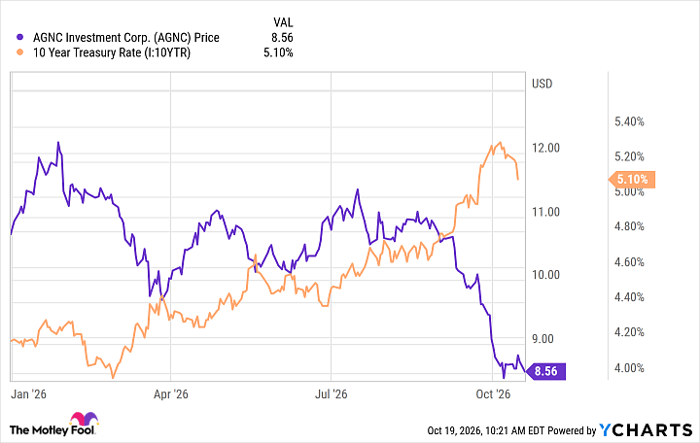
AGNC Investment (NASDAQ: AGNC) currently yields nearly 17%. Shares of the mortgage REIT have tumbled over the past couple of months, driven lower by the surge in the 10-year:
AGNC data by YCharts
That's due to two factors. Mortgage REITs typically borrow short-term to fund their long-term mortgage investments. Rising rates increase their borrowing costs, narrowing the spread between the income generated by their mortgage investments and their costs. Additionally, rising rates make lower-risk investments like Treasuries more attractive to income-seeking investors. That puts downward pressure on the share price of higher-risk, income-generating investments like REITs, driving up their yields to compensate investors for their higher risk profile. In AGNC's case, its yield has risen from around 13% to 17%.
Annaly Capital Management
Annaly Capital Management (NYSE: NLY) currently yields over 16%. Like AGNC, it's a mortgage REIT highly sensitive to changes in interest rates. Its share price is currently down more than 25% from its peak, following AGNC's decline.
Annaly is slightly less sensitive to rate changes than AGNC because it has lower leverage and greater diversification (it also invests in mortgage servicing rights). However, these two dividend stocks are among the most sensitive to rate changes due to their business models.
Coca-Cola
Coca-Cola (NYSE: KO) currently yields around 2.3%. The beverage giant is the opposite of mortgage REITs: its business is highly rate-insensitive. Its share price has risen sharply this year (by more than 30%), accelerating its rise amid the recent surge in rates.
Coca-Cola has several resilient features that insulate it from the impact of rising rates. It has a fortress balance sheet primarily consisting of long-term, fixed-rate debt. Meanwhile, its business has pricing power, allowing it to raise prices to offset higher costs (inflation and interest expenses). These more durable features make Coca-Cola an ideal stock to hold in any market environment.
Energy Transfer
Energy Transfer (TXSE: ET) currently yields around 6.7%. The master limited partnership (MLP) has mixed sensitivity to changes in interest rates. As a high-yielding investment, higher rates tend to put downward pressure on its market value to boost its yield (its unit price is currently down more than 7% from its high earlier this year). It also tends to borrow heavily to fund its expansion (organic capital projects and acquisitions). As a result, it will experience some impact from higher borrowing costs.
However, Energy Transfer has some rate offsets. One of the factors driving rates up these days is inflation, largely due to higher energy prices. Those prices benefit Energy Transfer as it has some commodity-sensitive cash flows (about 10% of its earnings).
Enterprise Products Partners
Enterprise Products Partners (NYSE: EPD) currently yields around 6.1%. Like Energy Transfer, it's an MLP. As a result, it, too, has some rate sensitivity. For example, its unit price is also down over 7% from its peak earlier this year, pushing up its yield.
However, it has similar offsets. It has a little bit more commodity price sensitivity than Energy Transfer at about 80% of its earnings during the first half of this year. As a result, it's currently benefiting from the surge in oil and gas prices, which should help mitigate much of the impact of higher interest expenses from rising rates.
Realty Income
Realty Income (NYSE: O) currently yields 5.9%. As a REIT, it's more sensitive to rates, though not as sensitive as mortgage REITs. Its share price has fallen more than 15% from its peak earlier this year, driving up its dividend yield to compensate investors for its higher risk profile.
Higher rates increase the cost of capital of REITs (it's more expensive to borrow money and more dilutive to issue new shares), making it more challenging to fund growth investments (acquisitions and capital projects). However, Realty Income has taken notable steps to mitigate this impact by securing several private capital partnerships (joint ventures and a private capital fund management platform). As a result, higher rates will have a smaller impact on its growth than on other REITs, as it can tap new funding sources.
Vici Properties
Vici Properties (NYSE: VICI) currently yields around 7.9%. This REIT is more similar to Realty Income in some respects, as it's less sensitive to interest rate changes than mortgage REITs. However, it's still more sensitive than Realty Income because it has a weaker balance sheet (Realty Income is A-rated while Vici Properties has the lowest investment-grade ratings (BBB-/Baa3).
Additionally, Vici Properties is battling a non-rate headwind this year. One of its largest tenants (Caesars, at 38% of its rent) is facing issues at several of its regional properties, prompting concerns about a potential rent reduction. That situation has added additional pressure to Vici's stock price, which has fallen nearly 25% from its earlier peak.
Evaluate rate risk before buying a dividend stock
One of the key mistakes many income investors make is buying a stock solely for its yield. That can cause them to overlook risks, such as the impact of rate changes on the company. Some dividend stocks are relatively immune to interest rates (e.g., Coca-Cola), while others are highly rate-sensitive (e.g., mortgage REITs).
Should you buy stock in Coca-Cola right now?
Before you buy stock in Coca-Cola, consider this:
The Motley Fool Stock Advisor analyst team just identified what they believe are the 10 best stocks for investors to buy now… and Coca-Cola wasn’t one of them. The 10 stocks that made the cut could produce monster returns in the coming years.
Consider when Netflix made this list on December 17, 2004... if you invested $1,000 at the time of our recommendation, you’d have $376,696!* Or when Nvidia made this list on April 15, 2005... if you invested $1,000 at the time of our recommendation, you’d have $1,333,920!*
Now, it’s worth noting Stock Advisor’s total average return is 925% — a market-crushing outperformance compared to 212% for the S&P 500. Don't miss the latest top 10 list, available with Stock Advisor, and join an investing community built by individual investors for individual investors.
See the 10 stocks »
*Stock Advisor returns as of October 20, 2026.
Matt DiLallo has positions in Coca-Cola, Energy Transfer, Enterprise Products Partners, Realty Income, and Vici Properties. The Motley Fool has positions in and recommends Realty Income. The Motley Fool recommends Enterprise Products Partners and Vici Properties. The Motley Fool has a disclosure policy.
Recommended Articles


