


Tesla vs. Nvidia: Which Physical AI Stock Has the Bigger Robotics Payoff by 2030?
Key Points
Nvidia is building the technology stack to support a wide range of robots.
Tesla's Optimus robots could find a huge market, but the adoption and growth path for the devices is harder to predict.
By 2030, Nvidia's technology could be foundational to robots made by many different companies.
- 10 stocks we like better than Nvidia ›
Humanoid robots are starting to look less like science fiction and more like our future co-workers. I'm guilty of having thought that the general-purpose robot trend would come and go, but it's now seemingly here to stay, leaving investors with the task of trying to figure out which companies will benefit the most and putting their money to work accordingly. To me, the bigger question isn't which one is going to build the flashiest humanoid, but which company will supply the toolbox powering the broader robotics industry.
Between Tesla (NASDAQ: TSLA) and Nvidia (NASDAQ: NVDA), I think Nvidia has the cleaner robotics opportunity through 2030. Tesla's vision is bold, but its robot story depends on several moving parts. Nvidia's is simpler: It wants to provide the technology that everyone else builds on, and it also wants to provide the chips.
Missed AI’s "Act 1"? Act 2 Could Be 15x Bigger. Most investors think they missed the AI boat because they didn't buy Nvidia in 2005. But according to our analysts, we’re only at the end of "Act 1"—the R&D phase. "Act 2" is the global rollout. Continue »
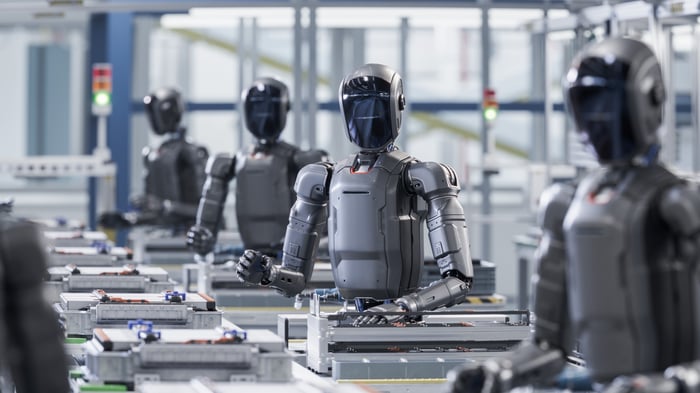
Image source: Getty Images.
Why Nvidia's robotics story is built to compound
Nvidia is not betting on one robot. It is trying to supply the brains, tools, and training grounds for many different types of robots across factories, warehouses, hospitals, and labs. At its 2026 GTC conference, Nvidia announced that industrial and humanoid players such as ABB Robotics, Agility, FANUC, Figure, Universal Robots, KUKA, Medtronic, and others are building "production‑scale physical AI" on its technology. The company describes a "full‑stack platform" for robotics that spans computing hardware, open models, simulation frameworks, and software, all meant to help partners develop, train, and deploy intelligent machines faster.
Concretely, Nvidia has been rolling out building blocks that fit together. It introduced Cosmos world models, which generate synthetic environments and scenarios for robots to learn in, and Isaac frameworks such as Isaac Lab that let developers teach robots skills in simulations before they touch the real world. On the hardware side, the Jetson Thor and Jetson T4000 modules are designed as standard robot computers, bringing Nvidia's latest chip architecture into compact systems that can run onboard in robots and other autonomous machines.
The potential payoff here is bigger than any single product launch. If Nvidia succeeds, every robot its partners build could carry Nvidia chips and software, providing it with a consistent stream of revenue as the industry grows. By 2030, that could mean several robotics-related revenue streams, from chips powering robots in factories and warehouses to software, AI models, and ongoing upgrades as those machines take on more jobs.
Why Tesla's robotics payoff is harder to predict
Tesla's own AI and robotics team lays out a clear end goal for its Optimus program: a general‑purpose humanoid robot that can perform unsafe, repetitive, or boring tasks, built on software stacks that handle balance, navigation, perception, and interactions with the physical world. On paper, that is exactly the kind of physical AI vision that investors dream about -- a walking machine that can eventually move through factories, warehouses, and maybe homes.
The company is pursuing Optimus while juggling several other major priorities. It is working to expand and win approval for its self-driving and robotaxi plans, manage a global car and energy business, and build the AI computing infrastructure and factories needed to support all of it.
Tesla describes its goal as deploying autonomy across "vehicles, robots and more," underscoring that Optimus is part of a broader push rather than a stand-alone bet. That ambition is a strength, but it also adds complexity: Demand for Tesla vehicles, pricing decisions, regulatory issues around self-driving, energy projects, and factory execution will all influence how much time, money, and attention the robot program receives.
By 2030, Tesla could turn Optimus into a serious business, and perhaps outcompete Nvidia. It could also end up in a place where its robots are important to the company, but still fighting against cars, robotaxis, and energy storage for capital and attention.
Why I'd pick Nvidia for the robotics payoff
So, when I think about a physical AI stock with more upside potential from robotics by 2030, I lean toward Nvidia. Nvidia is positioning itself as the provider of a shared toolkit for robot makers, with open models, simulation tools, and standard computing modules that its various partners can plug into their own designs.
If the next several years bring a real wave of humanoid robots into factories and logistics, I'd rather own the company supplying the technology and brains behind dozens of different machines than bet on one company trying to make a single humanoid product work.
Should you buy stock in Nvidia right now?
Before you buy stock in Nvidia, consider this:
The Motley Fool Stock Advisor analyst team just identified what they believe are the 10 best stocks for investors to buy now… and Nvidia wasn’t one of them. The 10 stocks that made the cut could produce monster returns in the coming years.
Consider when Netflix made this list on December 17, 2004... if you invested $1,000 at the time of our recommendation, you’d have $386,781!* Or when Nvidia made this list on April 15, 2005... if you invested $1,000 at the time of our recommendation, you’d have $1,379,943!*
Now, it’s worth noting Stock Advisor’s total average return is 936% — a market-crushing outperformance compared to 213% for the S&P 500. Don't miss the latest top 10 list, available with Stock Advisor, and join an investing community built by individual investors for individual investors.
See the 10 stocks »
*Stock Advisor returns as of September 25, 2026.
Micah Zimmerman has no position in any of the stocks mentioned. The Motley Fool has positions in and recommends Medtronic, Nvidia, and Tesla. The Motley Fool recommends Fanuc. The Motley Fool has a disclosure policy.
Recommended Articles


