


Dollar holds above 100 near a 3-month high — three Fed speakers and a $69 billion auction land tonight

The dollar index closed at 100.43 on Monday, up about 0.22% and its highest close since late July. That caps a 1.02% ~ 1.1% weekly gain, the best in more than three months. Tuesday's Asian session has kept the index above the 100.00 handle, and the immediate catalysts are all scheduled for tonight: three Federal Reserve speakers and a $69 billion two-year note auction, the opening leg of $183 billion of Treasury supply this week.
The move: a dollar that keeps grinding higher
| US Dollar Index (DXY) | Level |
|---|---|
| Monday close | 100.43 (+0.22%) |
| Tuesday (Asia) | holding above the 100.00 handle |
| Last week | +1.02% ~ 1.1% — best in 3+ months |
| Highest close since | late July |
The move is notable less for its size than for its persistence — the dollar has now recovered almost the entire August drawdown, and it has done so while oil collapsed. That combination is the tell: this is a rates story, not a safe-haven story.
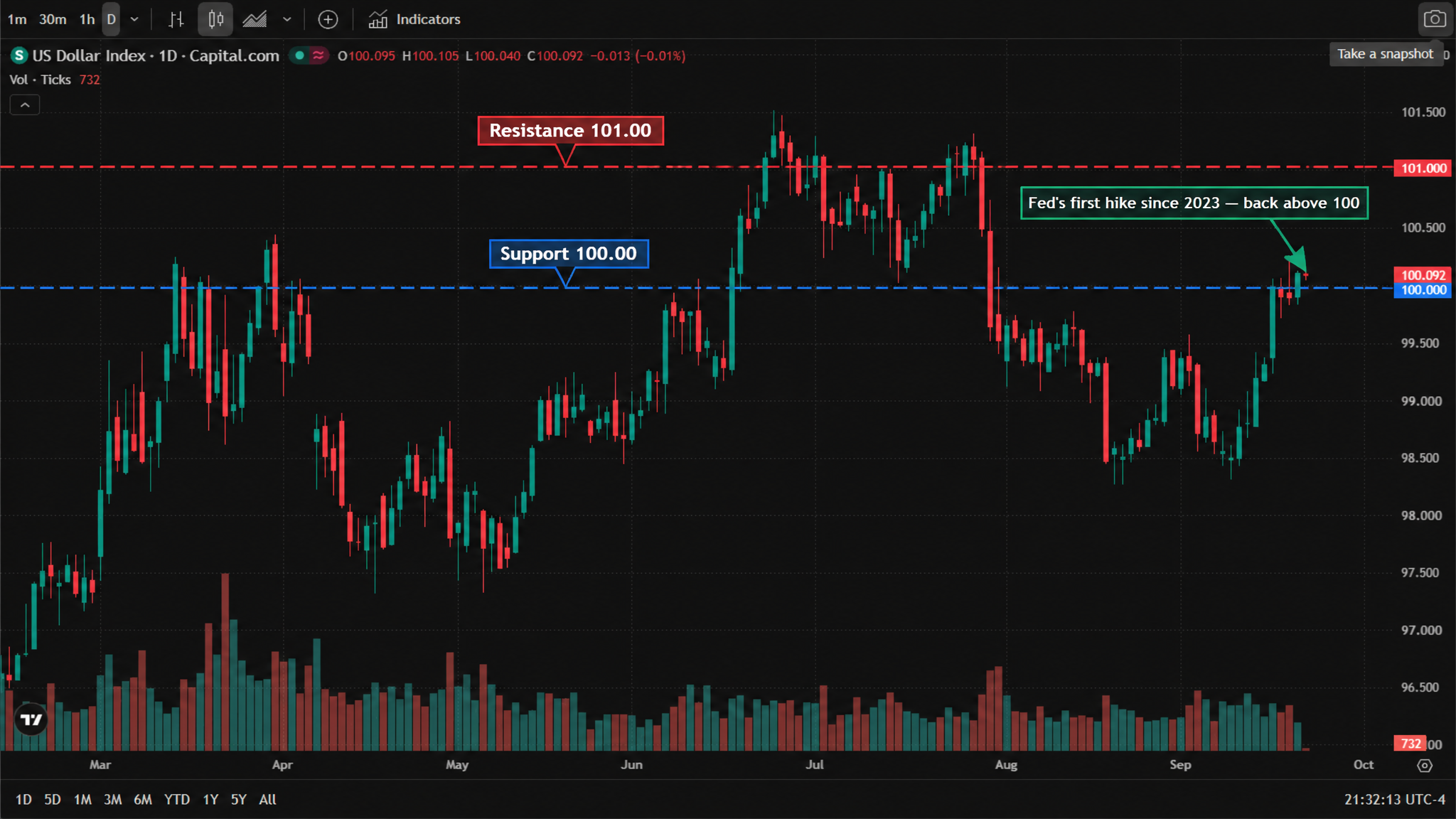
* Chart source: official TradingView chart screenshot (CAPITALCOM:DXY).
Why: a hawkish Fed and a flattening curve
The dollar's grind is fully explained by the rate picture. On September 16 the Fed raised rates 25 basis points to 3.75% ~ 4.00% — its first hike since July 2023, delivered on a 12-0 unanimous vote. The dot plot showed 16 of 18 policymakers expect at least one more increase this year, lifting the median year-end projection to 4.1%. Chair Warsh described inflation as "too high and persistent too long" without committing to a move at the next meeting.
Officials have reinforced that since. Musalem said core inflation may be running a full percentage point above target and that rates "may need to rise further"; Kashkari argued inflation is too high across the economy; Goolsbee warned that repeated supply shocks can no longer be treated as noise. Rate futures now price roughly 50% ~ 56.5% for an October hike and 88% for December, with a 42.4% probability of at least two more moves by year-end.
The bond market is confirming it at the short end. The two-year yield sits at 4.757%, while the 10-year has slipped back to 4.955% — below the 5% line, largely because oil's collapse has drained the inflation premium. That is a flattening curve: the front end is pricing the Fed, the long end is pricing lower inflation. A flatter curve is historically dollar-supportive, which is precisely what the index is reflecting.
Where the pressure is landing
The dollar's strength is visible across the major pairs, and the pattern is consistent — the currencies with the least hawkish central banks are taking the damage:
| Pair | Level | Context |
|---|---|---|
| EUR/USD | ~1.1464 (-0.2%) | Near the September low of 1.1455, below its 50-day average |
| GBP/USD | 1.3369 (-0.2%) | Fifth decline in six sessions; weakest since late July |
| USD/JPY | ~157.29 ~ 157.42 | Second straight down session; Japan's markets are closed through September 23 |
| EUR/JPY | ~180.34 ~ 180.48 | Euro softness against the yen mirrors the dollar move |
Europe is not the problem — it simply isn't hawkish enough to match. The ECB did hike this month on a unanimous vote and lifted its 2026 inflation forecast from 2.6% to 3%, with officials hinting at another move as early as October. But Chief Economist Lane has cautioned that an energy shock could delay the return to 2% until after mid-2027, and traders have trimmed ECB hike bets. The Bank of England has now held rates six times in a row at 3.75% on a 6-3 split, with UK inflation at 3.1%. European government bonds rallied hard on the oil move — German 10-year yields fell 7bp to 3.45%, their biggest drop in four months.
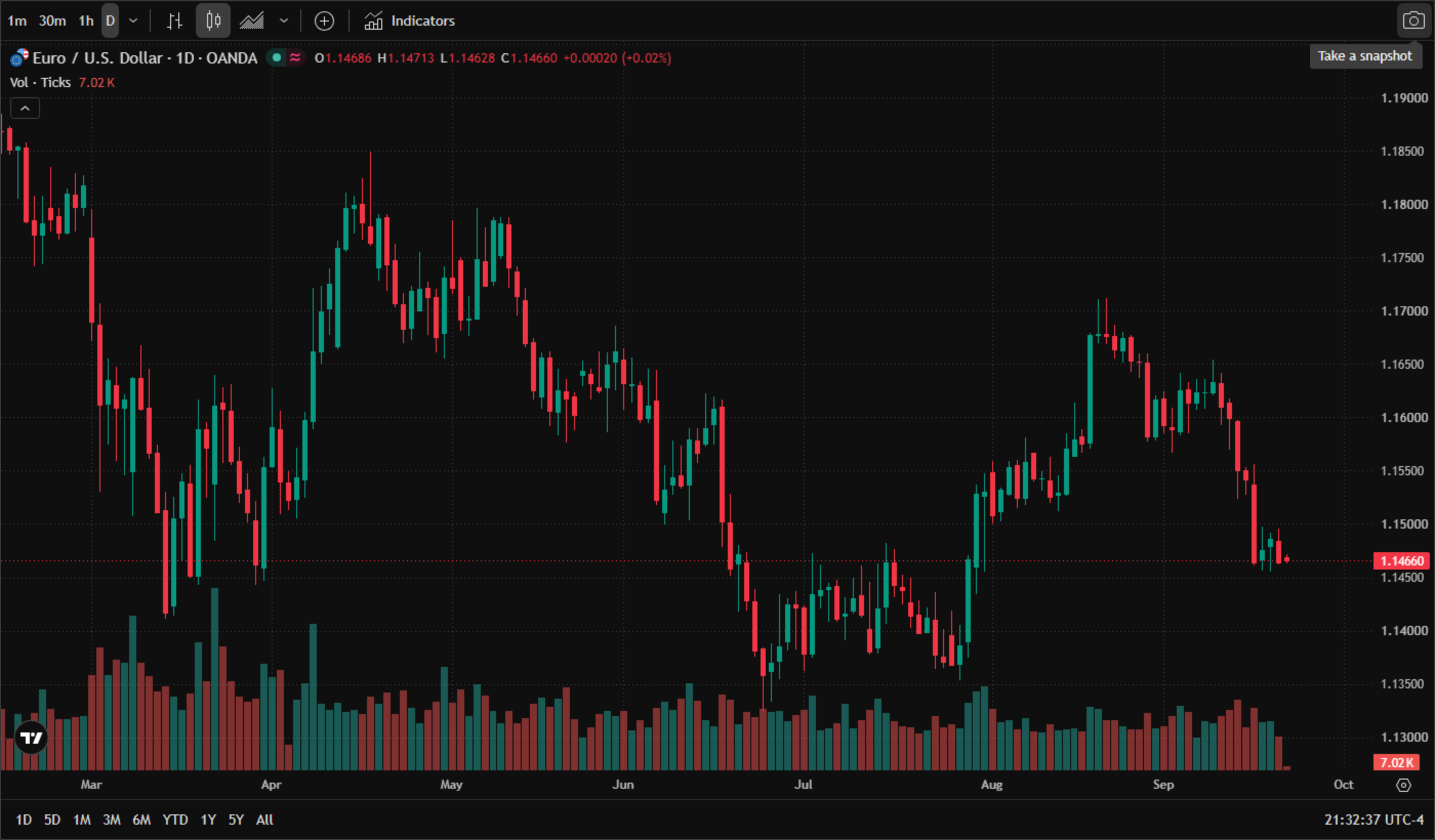
* Chart source: official TradingView chart screenshot (OANDA:EURUSD).
Levels and what to watch tonight
DXY: the 100.00 handle is now support, not resistance — it held on Monday's close and again in Asia. A clean break above 101.00 opens the door to the summer highs, while a loss of 100.00 would signal the market reading the Fed as done.
EUR/USD: 1.1455 is the line in the sand. A break puts the 1.1400 area in play; reclaiming 1.1500 would require a dovish surprise.
GBP/USD: 1.3369 is already the weakest since late July, with 1.3300 as the next shelf.
Tonight's calendar (all times ET):
| Time | Event |
|---|---|
| 10:00 | Weekly ADP employment data; Richmond Fed manufacturing index |
| 10:05 | New York Fed President Williams — keynote at the 2026 US Treasury Market Conference |
| 10:20 | Fed Vice Chair Jefferson — Treasury market functioning |
| 13:00 | $69 billion two-year note auction (previous high yield 4.315%) |
| 13:00 | Richmond Fed President Barkin |
Also due this week: $70 billion of five-year notes on September 23 and $44 billion of seven-year notes on September 24 — $183 billion of supply in total, which is itself a dollar variable.
Scenario A — the speakers stay hawkish. Williams or Jefferson echo Musalem on inflation being too high, and the two-year auction clears at a firm yield. The dollar extends toward 101.00, and EUR/USD tests 1.1455 in earnest.
Scenario B — the speakers soften. Either official downplays the October meeting, or the auction draws weak demand and pushes yields lower. The index slips back below 100.00, and the crowded short positions in the euro and sterling get a squeeze.
Worth remembering: this week the dollar is moving on Fed communication, not on data. With no major release until the flash PMIs later in the week, tonight's three speeches carry outsized weight for positioning.
Related reads: for the session that first pushed the index through 100, see Dollar index tops 100 for the first time since July; for how the rate path landed on equities that same day, see Dow drops 631 points as the Fed hikes — but futures are rebounding.
Read more
Before making any trading decisions, it is important to equip yourself with sufficient fundamental knowledge, have a comprehensive understanding of market trends, be aware of risks and hidden costs, carefully consider investment targets, level of experience, risk appetite, and seek professional advice if necessary.
Furthermore, the content of this article is solely the author's personal opinion and does not necessarily constitute investment advice. The content of this article is for reference purposes only, and readers should not use this article as a basis for any investment decisions.
Investors should not rely on this information as a substitute for independent judgment or make decisions solely based on this information. It does not constitute any trading activity and does not guarantee any profits in trading.
If you have any inquiries regarding the data, information, or content related to Mitrade in this article, please contact us via email: insights@mitrade.com. The Mitrade team will carefully review the content to continue improving the quality of the article.


