

Yen touches 158.37 as Tokyo reopens, then slips back — ¥15.4 trillion of intervention and the 200-day line stand between here and 160


coverImg
Source: DepositPhotos

Mitrade Insights — The yen has run into a wall built out of its own central bank's money. USD/JPY touched 158.37 overnight — its highest level since early September — before easing back to 157.88 as Japanese markets reopened on Thursday after a three-day holiday. The 200-day moving average sits at 158.43, and the Ministry of Finance has already spent a record ¥15.4 trillion defending the currency since late July. So the question is no longer whether Tokyo will act, but whether a rate gap still north of 250 basis points makes any intervention stick.

The move

Japan's markets were shut from September 21 to 23. Trading resumed Thursday with the Nikkei 225 opening 0.69% higher (+446 points) at 65,465.06, while the currency pair had spent those three thin sessions grinding higher offshore.

USD/JPY — key reference levelsLevel
September 23 intraday high158.39
September 24 intraday high158.37
200-day moving average~158.43
Asia price on September 24~157.88 (−0.29%)
160.00psychological level, intervention watch zone

The dollar has now pushed the yen to the doorstep of its 200-day average without managing a single close above it since early September. In a holiday-thinned market that is a very different thing from an actual break.
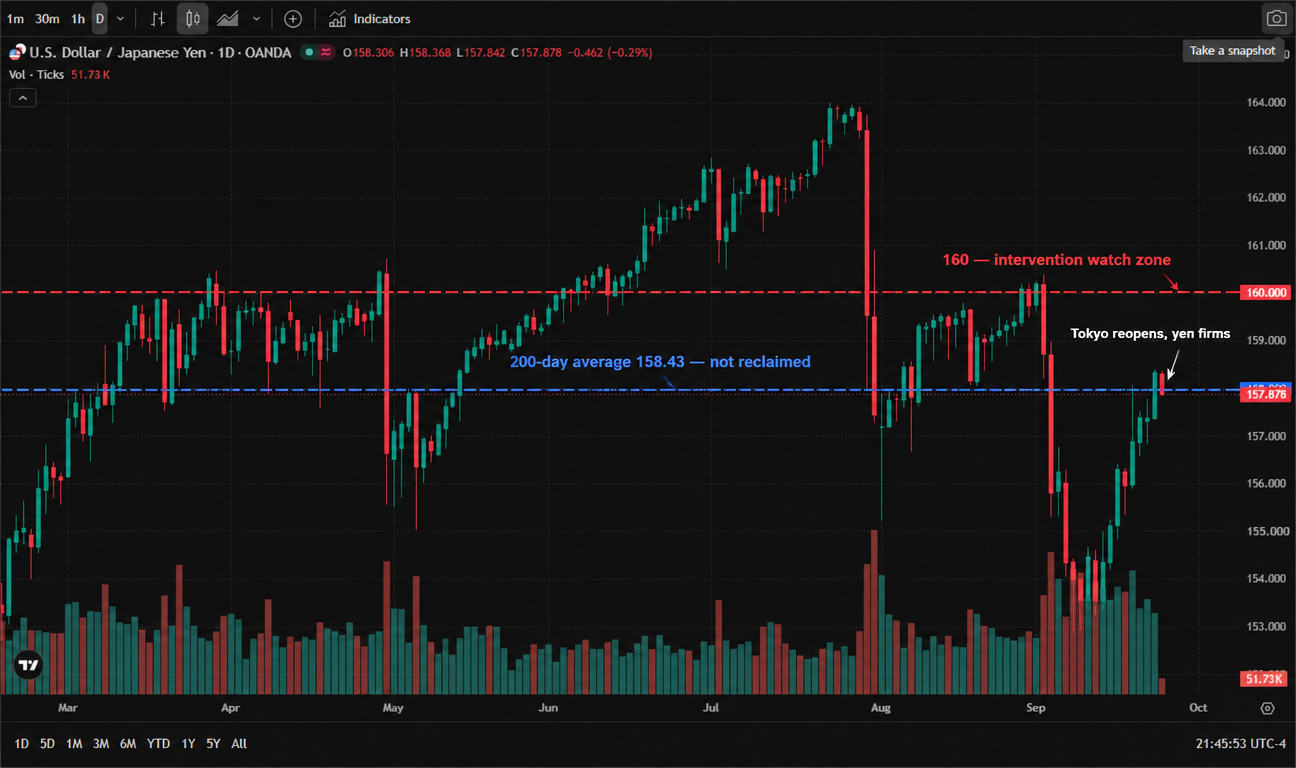
 USD/JPY (OANDA:USDJPY) daily chart (official TradingView screenshot, OANDA data feed, real candlesticks and volume from March to October 2026, English interface, UTC-4) — the pair traded between 155 and 160 from March to April, began a strong advance in May and peaked near 164 in July before an abrupt drop back to 156, rallied to about 161 in August and fell sharply again, then recovered above 158 in late September. As of the Asia session on September 24, 2026 it trades at 157.878, with an open of 158.306, a high of 158.368, a low of 157.842 and a decline of 0.462 (−0.29%) on 51.73K volume.

* Chart source: official TradingView screenshot (OANDA:USDJPY).

Why the yen is still weak

Three forces explain why a hiking central bank still has a falling currency:

  1. The hike is fully priced. The Bank of Japan raised its policy rate 25 basis points to 1.25% on September 18 — the highest since 1995 — but the vote was 7–2 (Asada and Sato dissenting) and the statement gave no clear guidance on the pace from here.

  2. Markets do not believe the next one. Rate markets assign only about 30% odds to a move to 1.50% in October, against roughly 90% by December. A slow path means the rate gap barely narrows.

  3. The gap is still enormous. The Fed's target range sits at 3.75%–4.00% after its September 16 hike, more than 250 basis points above Japan's 1.25%. Carry trades remain economically rational.

The dollar side of the equation got its own push this week: US September flash PMIs came in far above expectations, sending the 10-year Treasury yield to its highest since July 2007 and lifting the dollar index to a two-month high near 101.
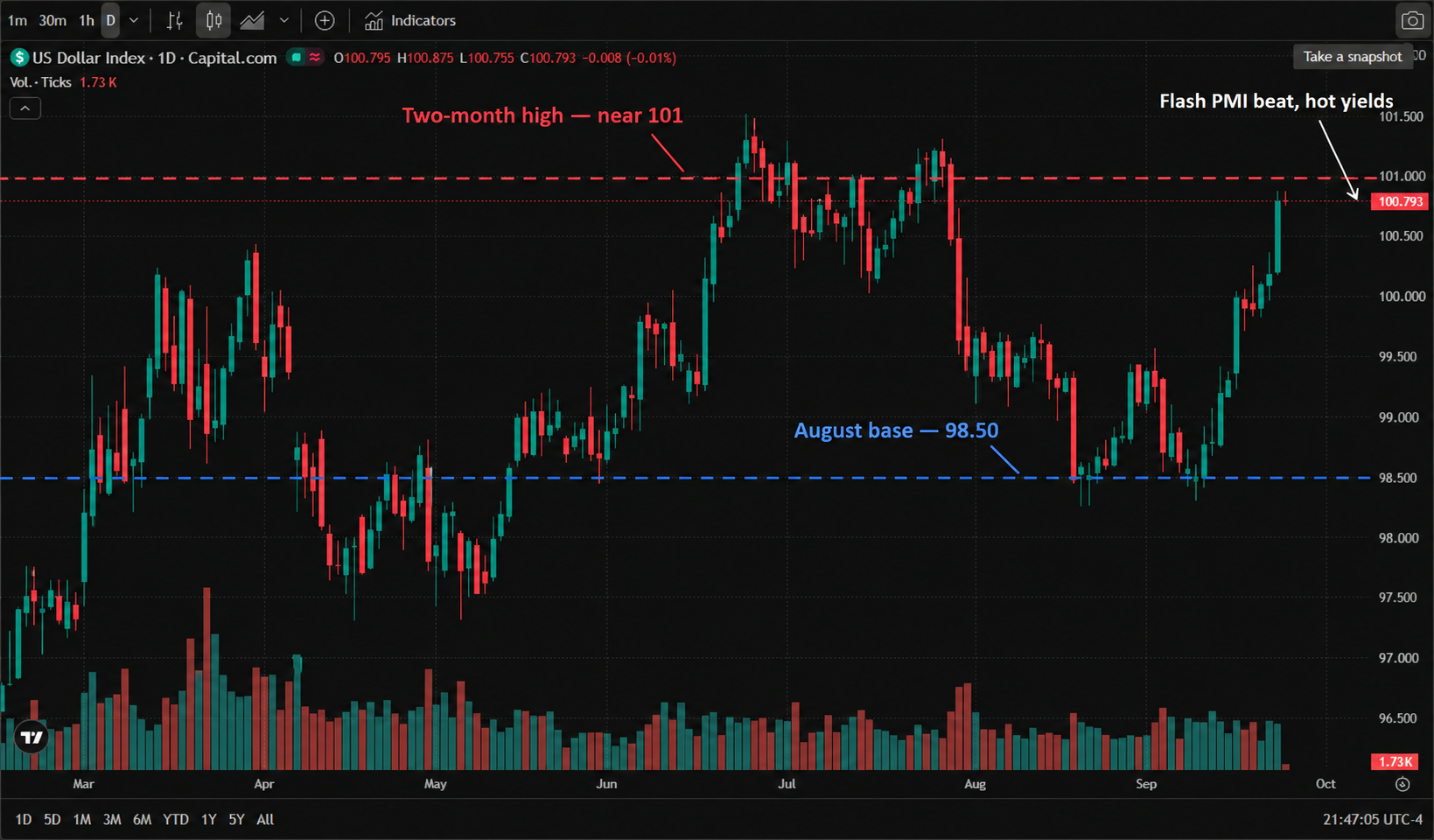
US Dollar Index (Capital.com:DXY) daily chart (official TradingView screenshot, Capital.com data feed, real candlesticks and volume from March to October 2026, English interface, UTC-4) — the index fell from about 100.5 in March to a low near 97.5 in April, recovered to 100 in May, spiked to about 101.5 in early July before a steep slide to 98.5, then spent August chopping between 98 and 99 and rallied hard through September. As of the September 24, 2026 Asia session it trades at 100.793, with an open of 100.795, a high of 100.875 and a low of 100.755.

* Chart source: official TradingView screenshot (Capital.com:DXY).

¥15.4 trillion, and a rate check

The Ministry of Finance bought ¥15.4 trillion between July 30 and August 26 — the largest single-month intervention on record, exceeding the ¥11.7 trillion spent in April and May. On July 31 the US Treasury joined the operation, the first joint yen-buying action by the two countries since 1998.

That held USD/JPY below 160 for roughly four weeks. It did not change the direction. And on September 18 the Bank of Japan conducted a "rate check" — the same step that preceded the July intervention, which desks read as a preparatory signal rather than a coincidence.

Levels

PairResistanceSupport
USD/JPY158.43 (200-day) / 159.00 / 160.00 (intervention zone)157.84 (Sep 24 low) / 156.86 (Sep 21 level)
AUD/JPY112.85 (100-day) / 113.38 (July high)110.00 (round number) / 109.67 (Sep 14 low)

AUD/JPY — the carry pair Australian and Asian desks watch most closely — slipped to 110.97 on Thursday, within a yen of its September 14 low, after Australia's August unemployment rate rose to 4.6%, the highest since late 2021. That number landed just four days before the RBA decision on September 28–29, where a hike to 4.60% is still around 90% priced.

What to watch, and two scenarios

Tonight brings US initial jobless claims (consensus around 201K, prior 196K) plus another round of Fed speakers. Next week belongs to the RBA on September 28–29 and then the FOMC on October 27–28, where markets now price roughly 70% odds of another 25bp hike.
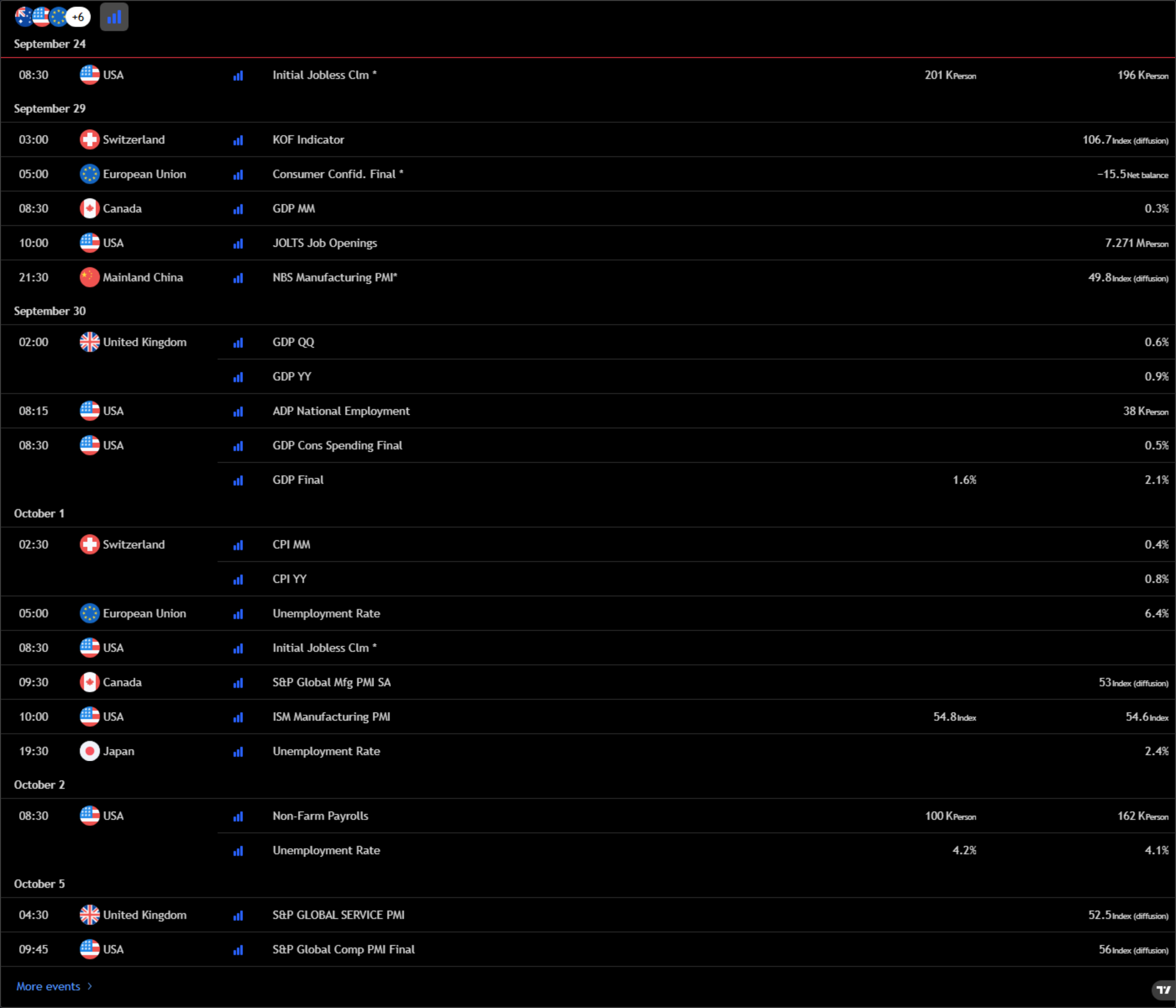
TradingView economic calendar (English interface, America/New_York time zone) for September 24 to October 5, 2026 — Australian unemployment rate at 4.6% against a 4.5% forecast, US initial jobless claims expected at 201K versus 196K prior, then JOLTS job openings, ADP employment at 38K, final Q2 GDP at 1.6%, ISM manufacturing at 54.8, and US non-farm payrolls on October 2 expected at 100K versus 162K prior.

* Chart source: official TradingView economic calendar widget.

Scenario A — Tokyo intervenes again. If USD/JPY pushes into 159.00–160.00 during Tokyo hours, the probability of an MoF operation rises sharply. The July precedent suggests it would land in a thin liquidity window and produce a 2–3 yen single-day drop, dragging AUD/JPY down toward 110.00 and possibly 109.67. This is a risk to yen shorts, not a trend change.

Scenario B — the rate gap reasserts itself. If tonight's claims stay firm and Fed speakers hold the hawkish line, the carry logic takes over again. USD/JPY closes above 158.43 and targets 159.00; AUD/JPY lags on weaker Australian data and chops between 110 and 112.

Read more

  • Gold Price Forecast: Gold Tumbles Below $3,900 as Trump Says No Need for Iran Deal; Can October PPI Spur a Rebound?
  • Today’s Market Recap: Nvidia Drops Over 4% After Jensen Huang Resigns, AMD and Broadcom Both Rise Over 5%
  • Note: If you want to share the article 《Yen touches 158.37 as Tokyo reopens, then slips back — ¥15.4 trillion of intervention and the 200-day line stand between here and 160》, make sure you retain the original link. For more information, please visit Insights or browse www.mitrade.com.

    * The content presented above, whether from a third party or not, is considered as general advice only.  This article should not be construed as containing investment advice, investment recommendations, an offer of or solicitation for any transactions in financial instruments.

    goTop
    quote
    Related Articles
    placeholder
    Weekly Report: DXY 103.41, 10-year 5.15%, AUD carry 3bp — three FX regimes flipped in one weekThe dollar index rose 1.09% to 103.41, a 19-month high, while the US 10-year closed at 5.154% and the Australia-US two-year spread collapsed to about 3 basis points from 36. EURUSD fell 1.59% to 1.1024, USDJPY rose 1.51% to 159.78 and AUDUSD fell 1.79% to 0.6764, a 10-month low. Three FX regimes — the broad dollar, the US rate level and the Australian carry premium — flipped in the same week. This report marks the thresholds, ranks which one can flip back first, and lists the week's calendar.
    Author  Irene Q.
    8 hours ago
    The dollar index rose 1.09% to 103.41, a 19-month high, while the US 10-year closed at 5.154% and the Australia-US two-year spread collapsed to about 3 basis points from 36. EURUSD fell 1.59% to 1.1024, USDJPY rose 1.51% to 159.78 and AUDUSD fell 1.79% to 0.6764, a 10-month low. Three FX regimes — the broad dollar, the US rate level and the Australian carry premium — flipped in the same week. This report marks the thresholds, ranks which one can flip back first, and lists the week's calendar.
    placeholder
    Euro softens below 1.1050 as traders ramp up Fed rate hike betsThe EUR/USD pair declines to around 1.1025 during the early Asian trading hours on Monday. Growing speculations that the US central bank will lift the interest rate in the December policy meeting support the US Dollar (USD) against the Euro (EUR).
    Author  FXStreet
    10 hours ago
    The EUR/USD pair declines to around 1.1025 during the early Asian trading hours on Monday. Growing speculations that the US central bank will lift the interest rate in the December policy meeting support the US Dollar (USD) against the Euro (EUR).
    placeholder
    Weekly Report: The dollar rose and the euro rose with it — three FX divergences, one should convergeDXY added 0.41% last week and EURUSD added 0.41% in the same five sessions, despite a 60-day correlation of -0.73. AUDUSD fell 1.36% after the RBA's sixth hike of the year, and USDJPY barely moved 0.19% even as markets priced a December BOJ hike. Three divergences, one of which the mechanism forces to close.
    Author  Irene Q.
    Nov 09, Mon
    DXY added 0.41% last week and EURUSD added 0.41% in the same five sessions, despite a 60-day correlation of -0.73. AUDUSD fell 1.36% after the RBA's sixth hike of the year, and USDJPY barely moved 0.19% even as markets priced a December BOJ hike. Three divergences, one of which the mechanism forces to close.
    placeholder
    Forex Today: No signs of Dollar strength on US midterm election dayFinancial markets cling to a cautious stance early Tuesday as focus remains on the midterm elections in the United States (US).
    Author  FXStreet
    Nov 03, Tue
    Financial markets cling to a cautious stance early Tuesday as focus remains on the midterm elections in the United States (US).
    placeholder
    Today’s Market Recap: Fed Holds Rates Steady, Memory Chip Sector Surges, Micron Up Over 5%, SanDisk Up Over 7%, Google Drops Nearly 10% After HoursOn October 28, Eastern Time, the three major U.S. stock indices closed slightly higher across the board. The Federal Reserve announced it would keep interest rates u
    Author  TradingKey
    Oct 29, Thu
    On October 28, Eastern Time, the three major U.S. stock indices closed slightly higher across the board. The Federal Reserve announced it would keep interest rates u
    Live Quotes
    Name / SymbolChart% Change / Price
    USDJPY
    USDJPY
    0.00%0.00

    Forex Related Articles

    • How to Identify Forex Scams? Warning Signs Every Trader Should Know
    • Stop Loss: Your Savior In The Market
    • Is Mitrade a Legit Broker? A Transparent Review of Security, Platform, and Trading Conditions (2026 Updated)
    • Is Mitrade Right for You? A Complete Guide on How to Start Trading CFDs in 5 Steps
    • 6 Leading ASIC-Regulated Forex Trading Platforms&Apps in Australia (2026 Update)
    • Forex Trading In Malaysia - Top 10 Forex Brokers for Malaysia: Regulated & Trader-Friendly Picks

    Click to view more