


Meet the Super Semiconductor ETF With 34.7% of Its Assets Parked in Intel, AMD, Micron, and Nvidia
Key Points
The semiconductor industry supplies the data center chips and components powering the artificial intelligence (AI) revolution.
The iShares Semiconductor ETF holds 30 of America's leading chip stocks, with large positions in Intel, Advanced Micro Devices, Micron Technology, and Nvidia.
The ETF has outperformed the broader market since it launched in 2001, but investors should brace for some volatility in the near term.
- 10 stocks we like better than iShares Trust - iShares Semiconductor ETF ›
The iShares Semiconductor ETF (NASDAQ: SOXX) is an exchange-traded fund (ETF) that exclusively invests in companies that design, manufacture, and distribute chips and components, but particularly those operating in the artificial intelligence (AI) segment of the industry.
Although the ETF holds 30 semiconductor stocks, a substantial portion of its assets is concentrated in its top four positions: Intel, Advanced Micro Devices, Micron Technology, and Nvidia.
Missed AI’s "Act 1"? Act 2 Could Be 15x Bigger. Most investors think they missed the AI boat because they didn't buy Nvidia in 2005. But according to our analysts, we’re only at the end of "Act 1"—the R&D phase. "Act 2" is the global rollout. Continue »
The blistering returns in those stocks during 2026 have fueled a 90% year-to-date return in the ETF, but is there still time for investors to buy it?

Image source: Getty Images.
America's best AI hardware stocks in one ETF
ETFs can hold hundreds or even thousands of individual stocks, so they are often a diversified investment in their own right. But given that the iShares Semiconductor ETF has such a narrow focus, investors shouldn't put all of their eggs in this basket. Instead, the iShares ETF could be a great addition to a diversified portfolio of other funds and individual stocks, particularly one that doesn't have much exposure to the AI hardware space already.
Investors who haven't owned a slice of the semiconductor industry since the AI boom began to gather momentum in early 2023 have likely underperformed the broader market. Intel, AMD, Micron, and Nvidia have delivered a blistering median return of 1,160% since then, more than 10 times the S&P 500's (SNPINDEX: ^GSPC) return over the same period.
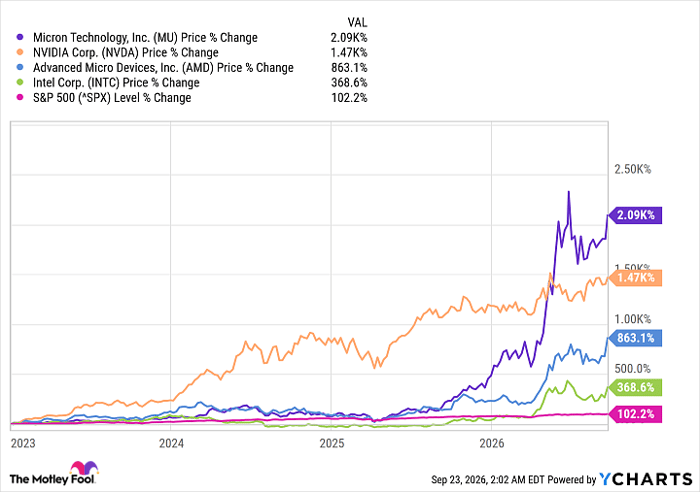
MU data by YCharts
The iShares ETF has more than one-third of its assets parked in those four stocks alone.
|
Stock |
iShares ETF Portfolio Weighting |
|---|---|
|
1. Intel |
9.86% |
|
2. Advanced Micro Devices (AMD) |
9.48% |
|
3. Micron Technology |
7.90% |
|
4. Nvidia |
7.47% |
Data source: iShares. Portfolio weightings are accurate as of Sept. 21, 2026, and are subject to change.
Intel has aggressively expanded into the AI segment with data center accelerators such as the Gaudi series, specifically designed for training and inference workloads. However, to protect its leadership in the personal computing space, it also launched the Core Ultra processors, enabling devices to run some AI workloads locally. Personal computing could be the next major growth area in AI hardware, particularly as models become more efficient.
Intel is still lagging behind rivals like AMD and Nvidia in the data center segment. Those two companies make some of the world's most powerful graphics processing units (GPUs), which are the preferred chips for running large-scale AI workloads. Nvidia's Vera Rubin GPU system has set the benchmark, but AMD's new MI450 GPU has become a worthy alternative when configured in the company's specialized Helios rack.
But none of those chipmakers could deploy their AI data center systems without high bandwidth memory (HBM), and Micron is one of the industry's top suppliers. HBM keeps data flowing to data center processors seamlessly, preventing bottlenecks that would slow down AI chatbots, agents, and other applications.
Outside its top four positions, the iShares ETF also holds Broadcom, which designs its own AI data center chips; SK Hynix, another top HBM supplier; and Taiwan Semiconductor Manufacturing, which fabricates semiconductors for Nvidia, AMD, and many other chipmakers.
The iShares Semiconductor ETF has a very strong track record
The iShares Semiconductor ETF has delivered a compound annual return of 14.2% since its launch in 2001, beating the S&P 500, which returned an average of 9% per year over the same period. While the AI boom is fueling its returns right now, the ETF has also benefited from the broad adoption of technologies like smartphones, enterprise software, and cloud computing over the last two-and-a-half decades.
The AI industry will probably be a major source of semiconductor demand for many years to come, but the returns investors have enjoyed since early 2023 simply aren't sustainable. Most semiconductor companies are currently reporting inflated profit margins because global supply shortages have enabled them to dictate prices. This won't last as additional manufacturing capacity comes online, so earnings will be under pressure across the industry over the next couple of years.
Therefore, as discussed, it's important that investors only buy the iShares Semiconductor ETF as part of a diversified portfolio. While it is likely to deliver positive returns over the long term, this strategy will minimize the effects of any potential volatility along the way.
Should you buy stock in iShares Trust - iShares Semiconductor ETF right now?
Before you buy stock in iShares Trust - iShares Semiconductor ETF, consider this:
The Motley Fool Stock Advisor analyst team just identified what they believe are the 10 best stocks for investors to buy now… and iShares Trust - iShares Semiconductor ETF wasn’t one of them. The 10 stocks that made the cut could produce monster returns in the coming years.
Consider when Netflix made this list on December 17, 2004... if you invested $1,000 at the time of our recommendation, you’d have $384,839!* Or when Nvidia made this list on April 15, 2005... if you invested $1,000 at the time of our recommendation, you’d have $1,385,657!*
Now, it’s worth noting Stock Advisor’s total average return is 936% — a market-crushing outperformance compared to 213% for the S&P 500. Don't miss the latest top 10 list, available with Stock Advisor, and join an investing community built by individual investors for individual investors.
See the 10 stocks »
*Stock Advisor returns as of September 25, 2026.
Anthony Di Pizio has no position in any of the stocks mentioned. The Motley Fool has positions in and recommends Advanced Micro Devices, Broadcom, Intel, Micron Technology, Nvidia, Taiwan Semiconductor Manufacturing, and iShares Trust - iShares Semiconductor ETF. The Motley Fool has a disclosure policy.
Recommended Articles


