


1 Unstoppable Stock to Buy Before It Joins Nvidia, Alphabet, Apple, and Microsoft in the $3 Trillion Club
Key Points
The U.S. is home to 13 public companies worth $1 trillion or more, but only four are currently in the exclusive $3 trillion club.
Meta Platforms could join them within a couple of years based on the growing success of artificial intelligence products like Muse.
Meta stock is attractively valued right now, so it could be a great long-term buy.
- 10 stocks we like better than Meta Platforms ›
The U.S. is home to 13 public companies worth $1 trillion or more, but only Nvidia, Alphabet, Apple, and Microsoft are worth over $3 trillion as I write this (Sept. 22).
I predict Meta Platforms (NASDAQ: META) will join that exclusive club within the next couple of years, thanks to its aggressive investments in artificial intelligence (AI). Earlier this month, the company launched a personalized AI agent called Muse that can perform tasks outside of its Facebook, Instagram, and WhatsApp social media applications.
Missed AI’s "Act 1"? Act 2 Could Be 15x Bigger. Most investors think they missed the AI boat because they didn't buy Nvidia in 2005. But according to our analysts, we’re only at the end of "Act 1"—the R&D phase. "Act 2" is the global rollout. Continue »
Muse's surging popularity has whipped investors into a frenzy, sending Meta stock soaring by 11% on Monday alone. The company now has a market capitalization of $1.91 trillion, and here's how it could join the $3 trillion club.

Image source: Getty Images.
Muse marks the start of a new era for Meta
Around 3.6 billion people use at least one of Meta's social media apps every single day. Since there are only 8.3 billion people on Earth and the company's apps are blocked in China, it's getting harder to find new users. Therefore, Meta is now more focused on keeping existing users online for longer periods of time, so they see more ads and generate more revenue for the company.
So far, Meta has achieved this by integrating AI into its recommendation algorithms to learn what content each user likes to see on Facebook and Instagram, so it can show them more of it. These algorithms will only grow more accurate with time, because they are constantly learning and evolving.
But during his conference call with shareholders for the second quarter of 2026 (ended June 30), chief executive officer Mark Zuckerberg explained that AI agents could eventually transform the social media experience by assisting users with every part of their lives. The company proceeded to launch the Muse AI agent on Sept. 8, which is designed to do exactly that.
Muse can tap into almost any third-party app (with permission), so it can help the user write emails, book a vacation, shop online, and more. Muse even integrates with a digital wallet called Link, which was built by Stripe, so it can make payments at the user's request. This agent gives Meta an opportunity to capture a much bigger share of global internet traffic. The company isn't competing with just other social media giants anymore, but also entrenched platforms such as Google Search.
Muse has its own mobile app, and it operates through its own secure virtual machine that stores all of its data. It also conducts internet searches with its own internal browser, so it's one of the safest agents on the market right now.
AI spending could be a headwind for Meta's earnings in the coming years
Muse was built from the ground up on an entirely new family of foundation models called Muse Spark. These differ from Meta's Llama family of open-source AI models, which have been downloaded over 1 billion times. The company wanted the Muse agent to have its own identity, but more importantly, it also wanted to prioritize security.
Unfortunately, it's incredibly expensive to develop AI models. Meta spent $72 billion on data center infrastructure in 2025 to ensure it had enough computing power to achieve its goals. The company's latest guidance suggests spending could double to $145 billion during 2026, and there is no apparent plan to slow down.
Meta can't deduct these capital expenditures up front because data centers have a useful life of several years, so it depreciates the infrastructure over time instead. In practice, that means the company's spending in 2025 and 2026 could negatively impact its earnings in 2027, 2028, 2029, and beyond, so generating a return on AI products like Muse is absolutely critical.
Wall Street's average forecast (provided by Yahoo! Finance) suggests Meta could grow its revenue by 20% to $306 billion in 2027, which would be a solid result. However, its earnings are expected to increase by just 8% to $33.87 per share, as its data center spending starts to take a toll on the bottom line.
Meta has a mathematical path to the $3 trillion club
Meta can still reach the $3 trillion club within a couple of years, despite the earnings headwind. Based on the company's trailing 12-month earnings of $26.55 per share, its stock is trading at a price-to-earnings (P/E) ratio of 28.2, a considerable discount to the Nasdaq-100 index, which has a P/E of 34.1. In other words, Meta looks undervalued compared to a basket of America's leading tech giants.
Looking ahead, if we assume Meta's earnings come in at $33.87 per share next year as Wall Street expects, then its stock has a forward P/E ratio of just 21.5. That suggests the stock will have to climb by 59% before the end of next year just to match the current P/E of the Nasdaq-100 -- resulting in a market cap of $3 trillion.
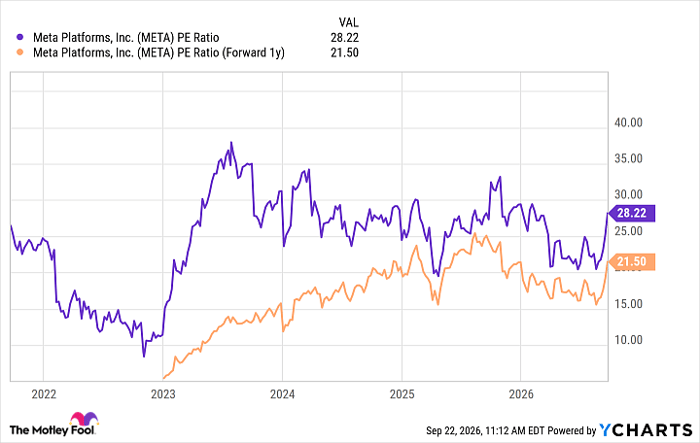
META PE Ratio data by YCharts
Even if Meta's P/E remains at a discount to the P/E of the Nasdaq-100, it could still achieve a $3 trillion market cap sometime in 2028 by simply generating moderate earnings growth.
Should you buy stock in Meta Platforms right now?
Before you buy stock in Meta Platforms, consider this:
The Motley Fool Stock Advisor analyst team just identified what they believe are the 10 best stocks for investors to buy now… and Meta Platforms wasn’t one of them. The 10 stocks that made the cut could produce monster returns in the coming years.
Consider when Netflix made this list on December 17, 2004... if you invested $1,000 at the time of our recommendation, you’d have $389,154!* Or when Nvidia made this list on April 15, 2005... if you invested $1,000 at the time of our recommendation, you’d have $1,406,303!*
Now, it’s worth noting Stock Advisor’s total average return is 949% — a market-crushing outperformance compared to 214% for the S&P 500. Don't miss the latest top 10 list, available with Stock Advisor, and join an investing community built by individual investors for individual investors.
See the 10 stocks »
*Stock Advisor returns as of September 24, 2026.
Anthony Di Pizio has no position in any of the stocks mentioned. The Motley Fool has positions in and recommends Alphabet, Apple, Meta Platforms, Microsoft, and Nvidia. The Motley Fool has a disclosure policy.
Recommended Articles


