


AMD vs. Intel: Which Artificial Intelligence (AI) Chip Stock Has More Room to Run?
Key Points
AMD is more diversified in AI chips than Intel.
AMD has been eating into Intel's data center CPU dominance.
AMD's cheaper valuation and stronger prospects suggest that it is a better buy right now.
- 10 stocks we like better than Advanced Micro Devices ›
Advanced Micro Devices (NASDAQ:AMD) and Intel (NASDAQ:INTC) have been multibagger investments over the past year, which isn't surprising, given that both companies are seeing healthy growth in revenue and earnings driven by the fast-growing demand for their chips in artificial intelligence (AI) data centers.
While AMD stock has soared 285% over the past year, Intel's gains have been even more stunning at 322%. Investors will now be wondering whether to buy these semiconductor stocks following such impressive gains. The good news is that both Intel and AMD have room to fly higher.
Missed AI’s "Act 1"? Act 2 Could Be 15x Bigger. Most investors think they missed the AI boat because they didn't buy Nvidia in 2005. But according to our analysts, we’re only at the end of "Act 1"—the R&D phase. "Act 2" is the global rollout. Continue »
However, if you have to choose one of these stocks for your portfolio, which one should it be? Let's find out.

Image source: The Motley Fool.
AMD and Intel serve similar end markets, but one of them is in a more advantageous position
Both Intel and AMD design and/or manufacture central processing units (CPUs). These chips are used in personal computers and data centers. The demand for CPUs in AI data centers has taken off lately, driven primarily by their important role in handling inference and agentic AI tasks.
AMD noted earlier this year that the ratio of CPUs to graphics processing units (GPUs) is now shifting from 1:4/1:8 in AI data centers to 1:1. This paradigm shift away from GPUs in AI data centers is creating a terrific growth opportunity for both AMD and Intel. According to AMD, the server CPU total addressable market (TAM) could increase at a compound annual growth rate (CAGR) of more than 50% through 2030, hitting $220 billion by the end of the decade.
Intel and AMD are involved in a tussle to get ahead of each other in this market. It is worth noting that Intel is currently the larger player in server CPUs, controlling 65.5% of this market, according to Mercury Research. AMD controls the rest of the server CPU space, but its share has been growing at a nice clip. In fact, AMD gained 7.2 percentage points of the server CPU market on a year-over-year basis in Q2.
At the same time, AMD is a more diversified AI data center company due to its presence in the GPU market. Its Instinct line of data center GPUs is witnessing widespread adoption by major customers such as OpenAI, Meta Platforms, Anthropic, and others. So, AMD is in a stronger position to capitalize on the fast-growing demand for AI compute due to its diversified product lineup.
This also explains why the company's data center revenue grew faster than Intel's last quarter. AMD's data center revenue jumped 107% year over year in Q2 to $6.7 billion, fueled by strong demand for both server CPUs and data center GPUs. Meanwhile, Intel's data center and AI (DCAI) segment revenue increased by 59% year over year in Q2 to $6.3 billion.
So, AMD seems to be in a much stronger position than Intel to capitalize on the AI chip boom. Its robust market share gains and presence in the lucrative AI data center space should enable it to continue growing faster than Intel in the long run. In fact, analysts have become more bullish about AMD's growth prospects lately, while toning down their expectations for Intel.
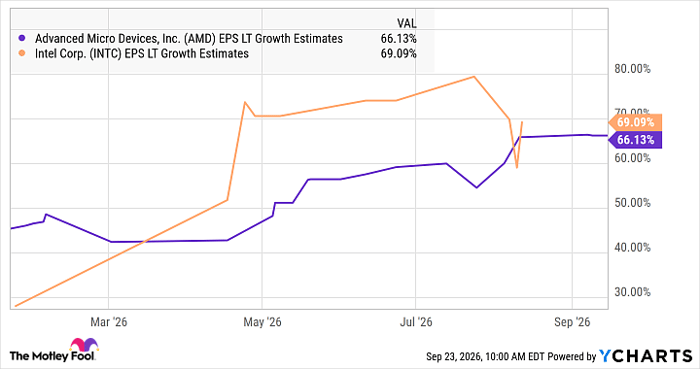
AMD EPS LT Growth Estimates data by YCharts
Additionally, there is another simple reason to favor AMD right now for investors looking to capitalize on the AI chip boom.
A simple reason to invest in AMD stock right now
Intel stock's big surge over the past year has made it expensive. It trades at 63 times forward earnings, while AMD is significantly cheaper at 40 times forward earnings. It is easy to see why that's the case.
Consensus estimates project a 262% surge in Intel's earnings this year, well above AMD's 82% projected growth. However, AMD's growth rate is anticipated to accelerate to 105% in 2027, while Intel's growth is expected to slow down to 36%. We have already seen the reasons why that could indeed be the case.
After all, AMD is in a stronger position to benefit from the booming demand for AI chips, a market it expects could generate $2 trillion in annual revenue by 2030, growing at a CAGR of 40%. So, investors looking to choose one of these two AI stocks for their portfolio now have a simple decision to make, as AMD seems like the chip company with better upside potential and a cheaper valuation.
Should you buy stock in Advanced Micro Devices right now?
Before you buy stock in Advanced Micro Devices, consider this:
The Motley Fool Stock Advisor analyst team just identified what they believe are the 10 best stocks for investors to buy now… and Advanced Micro Devices wasn’t one of them. The 10 stocks that made the cut could produce monster returns in the coming years.
Consider when Netflix made this list on December 17, 2004... if you invested $1,000 at the time of our recommendation, you’d have $389,154!* Or when Nvidia made this list on April 15, 2005... if you invested $1,000 at the time of our recommendation, you’d have $1,406,303!*
Now, it’s worth noting Stock Advisor’s total average return is 949% — a market-crushing outperformance compared to 214% for the S&P 500. Don't miss the latest top 10 list, available with Stock Advisor, and join an investing community built by individual investors for individual investors.
See the 10 stocks »
*Stock Advisor returns as of September 24, 2026.
Harsh Chauhan has no position in any of the stocks mentioned. The Motley Fool has positions in and recommends Advanced Micro Devices, Intel, and Meta Platforms. The Motley Fool has a disclosure policy.
Recommended Articles


