

Anthropic's Claude agents find a CRISPR-like enzyme system but can't say what it does

Source Cryptopolitan

Anthropic said on Wednesday that Claude agents flagged an uncharacterized enzyme system in viral DNA after about 21 hours of searching.

The system has a CRISPR-like pattern, but the company says it doesn’t know what the system does yet. It is one of the first results from a molecular biology group Anthropic set up in spring 2026.

Ten reruns of the same search all missed the repeat array

The team has named the find array-associated reverse transcriptases, or ART. Bacteria combat viruses by using reverse transcriptases, which convert RNA into DNA.

Beside it sat what caught Claude’s eye, an evenly spaced run of repeat DNA next to a second gene of unknown purpose.

That three-part layout echoes CRISPR, which stores a library of RNA guides in an array. Each ART array contains 3 to 21 copies of a short repeat and no Cas genes are situated near any ART locus, the preprint states.

Public RNA data from a Staphylococcus phage reveal the array transcribed into distinct short RNAs. They were up to 8% of the phage RNA 15 minutes post-infection.

The preprint notes the team hasn’t demonstrated the enzyme is active or that it acts on those RNAs.

Anthropic gave the agents a brief. Hunt through 1.9 billion protein clusters for new reverse transcriptase systems.

Each task was planned and run by one worker agent and reviewed by a supervisor agent. As the findings accumulated, supervisors opened new tasks.

The campaign ran for 21.5 hours, the preprint says, with no human input, across 949 agent sessions and 215.6 million tokens. Anthropic’s post rounds these to about 950 agents and 210 million tokens.

Agents amassed ~200,000 enzyme clusters and scored 3,564 candidate partner families. The campaign closed with 19 reports for human review.

ART surfaced almost by accident. An agent reading raw DNA beside a peculiar enzyme wrote that it could see a repeat pattern “by eye,” then counted the repeats and looked them up in the literature before writing it up.

Anthropic repeated the same campaign ten more times. All missed the array, no rerun read the DNA upstream of the enzyme.

When given the DNA directly, the best models described the array in a minimum of 90% of attempts, but with the addition of tools and files, the rate sank to as low as 32%.
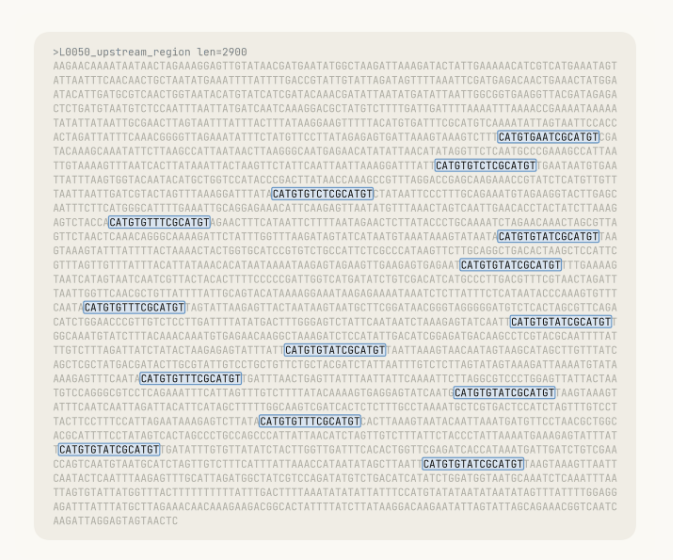
Claude agents flag a CRISPR-like enzyme system in 21 hours, though Anthropic can't yet say what it does.
The raw DNA a Claude agent was reading when it spotted the repeat array, from Anthropic’s Sept 23 2026 post.

Feng Zhang backs more study as Kevin Blake doubts any therapy

Feng Zhang, a CRISPR pioneer at MIT and the Broad Institute, reviewed the preprint. He called the identification of RNA-repeat arrays tied to reverse transcriptases “genuinely intriguing,” saying it “merits further investigation.”

On X, CEO Dario Amodei went a step further. The “molecular machine” could “represent a new gene editing mechanism,” he suggested, in keeping with his bet that AI could compress decades of biological progress into years.

ART came out of a Bay Area lab Anthropic only recently made public. The company says the facility works at biosafety levels 1 and 2, does not handle pathogens that infect humans and leaves all bench work to human scientists.

As Cryptopolitan reported when the wet lab was confirmed, it is testing to see if Claude can help direct experiments.

In April, Anthropic purchased startup Coefficient Bio for about $400 million. That same month, OpenAI shipped its own life sciences model, GPT-Rosalind.

Anthropic says experiments to nail down what ART does are already underway. It is inviting other scientists to put forward proposals to conduct research.

Don’t just read crypto news. Understand it. Subscribe to our newsletter. It's free.

Disclaimer: For information purposes only. Past performance is not indicative of future results.
placeholder
Gold ends three-week slide at the $4,400 line — eight straight days of ETF inflows vs a 5% 10-year and a 100 dollarSpot gold closed Friday at $4,378.39, up 0.84% on the day and about 0.8% for the week — its first weekly gain in four weeks — with the intraday high of $4,399.67 leaving it 33 cents shy of the $4,400 line. Gold ETFs have now logged eight straight sessions of inflows, but with the 10-year back above 5% and the dollar index near 100, here is what decides whether this is a reversal or a bounce.
Author  Suzie
Sep 20, Sun
Spot gold closed Friday at $4,378.39, up 0.84% on the day and about 0.8% for the week — its first weekly gain in four weeks — with the intraday high of $4,399.67 leaving it 33 cents shy of the $4,400 line. Gold ETFs have now logged eight straight sessions of inflows, but with the 10-year back above 5% and the dollar index near 100, here is what decides whether this is a reversal or a bounce.
placeholder
October hike odds climb toward 60% as Goldman and BofA both flip — what Warsh's "dose of accommodation" really changedRate futures now price roughly 55% to 62% for a 25bp hike at the October 27-28 FOMC, up from about 30% before Chair Warsh's post-meeting framing that the Fed is merely "removing some accommodation." Goldman Sachs has added an October hike to its forecast and Bank of America now sees moves in both October and December. Here is the repricing, the language behind it, and the two data points that decide it.
Author  Irene Q.
Yesterday 06: 22
Rate futures now price roughly 55% to 62% for a 25bp hike at the October 27-28 FOMC, up from about 30% before Chair Warsh's post-meeting framing that the Fed is merely "removing some accommodation." Goldman Sachs has added an October hike to its forecast and Bank of America now sees moves in both October and December. Here is the repricing, the language behind it, and the two data points that decide it.
placeholder
Memory chips surge, Nasdaq notches a second straight record close — why the Dow fell 185 points anywayMicron gained 5%, SanDisk 6.8%, Seagate 4% and Western Digital 3% as the memory complex led the Nasdaq Composite to a second consecutive record close of 27,244.28. But the Dow fell 185 points as JPMorgan, Wells Fargo and Schwab slid more than 3% each — a split tape that says more about positioning than about the economy.
Author  Irene Q.
Yesterday 06: 51
Micron gained 5%, SanDisk 6.8%, Seagate 4% and Western Digital 3% as the memory complex led the Nasdaq Composite to a second consecutive record close of 27,244.28. But the Dow fell 185 points as JPMorgan, Wells Fargo and Schwab slid more than 3% each — a split tape that says more about positioning than about the economy.
placeholder
Gold Price Forecast: XAU/USD drifts toward $4.300 with bears gaining tractionGold (XAU/USD) retraces Tuesday’s gains on Wednesday and drifts lower, approaching the $4,300 area as the US Dollar Index (DXY) rallies further amid high US Treasury yields.
Author  FXStreet
Yesterday 10: 02
Gold (XAU/USD) retraces Tuesday’s gains on Wednesday and drifts lower, approaching the $4,300 area as the US Dollar Index (DXY) rallies further amid high US Treasury yields.
placeholder
US input costs rose at the fastest pace in four years — the September flash PMI beat is an inflation story, not a growth storyUS September flash PMIs came in far above expectations, with the composite at 58.4, a five-year high. But the detail that moved markets was input cost inflation at its fastest since October 2022, driven by fuel, transport and supply shortages. Brent is back above $100 and the 10-year Treasury yield has hit its highest since 2007.
Author  Suzie
7 hours ago
US September flash PMIs came in far above expectations, with the composite at 58.4, a five-year high. But the detail that moved markets was input cost inflation at its fastest since October 2022, driven by fuel, transport and supply shortages. Brent is back above $100 and the 10-year Treasury yield has hit its highest since 2007.
goTop
quote