

Solana and Robinhood Chain launchpads lead as crypto fees explode in September

Source Cryptopolitan

Crypto economic activity, reflected by app fees, continued rising in 2026. The most active apps expanded their fee production, becoming one of the viable use cases for on-chain activity. 

Crypto economic activity reached a new peak as Q3 closed, a total of $3.3B in fees generated for the period. In September alone, revenue-generating apps produced $1.44B in fees. 

The fee-sharing model caused a revival of Web3 activity after a long period of slower on-chain usage. 

During previous periods, Web3 fees were mostly generated by airdrop farming. In the past year, new revenue-sharing models appeared, and in Q3, reflection tokens linked to tokenized assets boosted on-chain fees. 

The fee generation depends on real app usage, and the size of fees or on-chain tax varies for each app and for some specific tokens. The model also includes crypto influencers, who try to bring back the fee-sharing model for token holders, especially for reflection meme tokens. 

Robinhood boosted crypto economic activity

Crypto economic activity depends on the appeal of chains, the presence of retail traders, and the available liquidity. Robinhood emerged as one of the leaders for on-chain token launches and trading. 

Based on Cryptorank data, Robinhood’s chain generated $368M in fees in September, ranking among the top fee-producing chains for the past month. The recent fee boom came from the initial round of meme token launches. 

Later, the Pons launchpad became the major fee producer for Robinhood, based on reflection tokens tied to tokenized equities, cryptos, or precious metals. Pons peaked on September 5, with $11.42M in daily fees. At the end of the month, Pons produced around $2M in daily fees. 
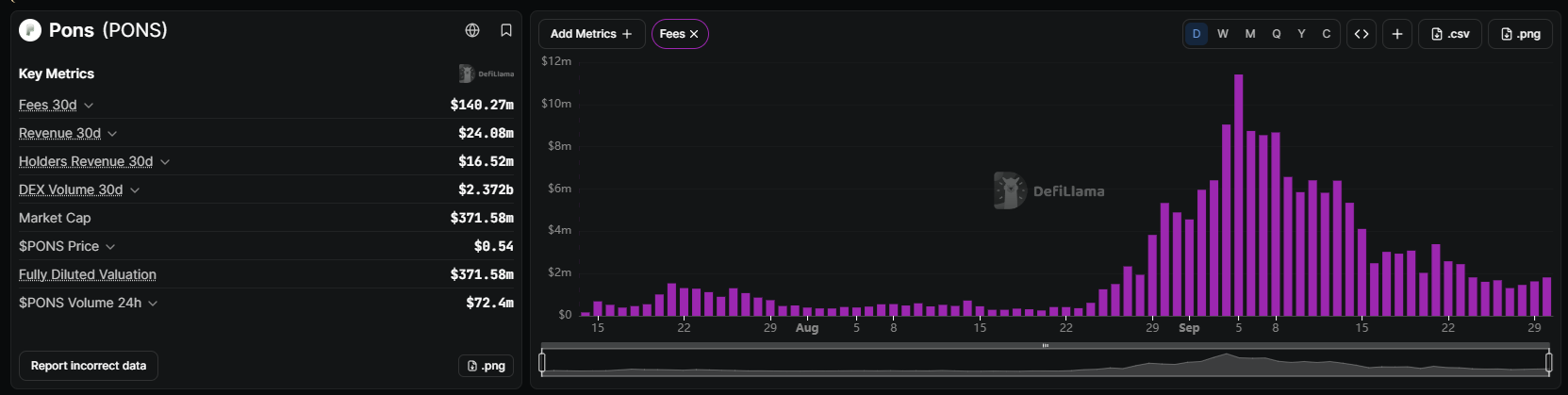
Crypto economic activity reached new records in Q3
Pons activity peaked in September, making a major contribution to overall fees and revenues on Robinhood chain. | Source: DeFi Llama

Fee sharing also turned into a mechanism to invite ‘trenches’ traders and holders. Crypto influencers also received unsolicited fee sharing on social media, with the invitation to boost exposure for specific meme tokens. 

Despite this, on-chain data shows that only a handful of memes offer meaningful fee-sharing revenues. On-chain data also shows some of the recent meme launches were rug pulls, often linked to the same launch teams. 

Decentralized trading also boosted crypto fees

Launchpads were only a part of the general fee production for leading chains. Decentralized trading and prediction markets still held strong. Some of the leading fee-producing apps still include Uniswap, which turned into the leading DEX. Uniswap benefited from its version on Robinhood, as well as a generally improved sentiment for altcoins and tokens. 

Hyperliquid and Polymarket retained their top 10 positions as fee producers. Hyperliquid made over $73M in fees for September, while Polymarket reached over $87M. As Cryptopolitan reported earlier, prediction markets broke above $20B in weekly trading for the first time.

Solana’s apps also remain among the top fee producers, with strong performance on the 24-hour time frame. PumpFun is still one of the key venues for launches, after adding its own version of reflection tokens. 

StonkFun, the recently launched venue for reflection tokens, as well as the Fomo copy-trading app added their new models to Solana. The recent quarterly fee results reflect those new types of apps, which quickly spread throughout the crypto space. 
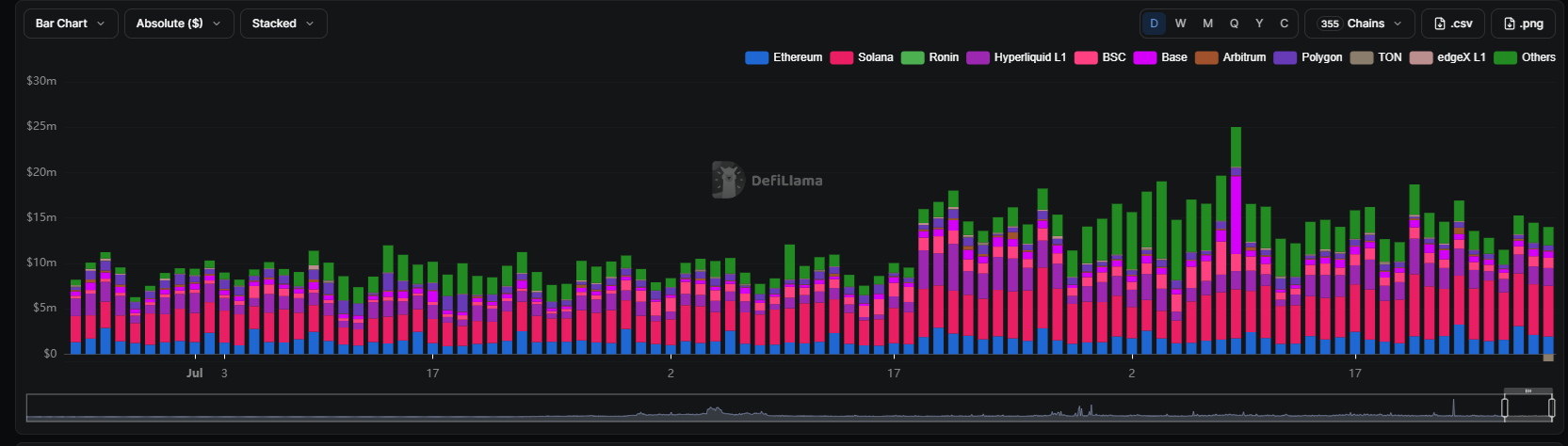
Crypto economic activity reached new records in Q3
Almost all chains saw a boost of on-chain activity, driven by launchpads and decentralized trading. | Source: DeFi Llama

As a result, Solana was still the leading chain by app revenue in September, with a total of $145.75M. Robinhood, despite its significant fees for September, only achieved app revenues of $86.8M. 

In September, almost all chains saw a boost in total app revenues. Even legacy chains with minimal activity found models that attracted new traders, whales, and influencers.

For now, the new apps and models are yet to prove their viability and risk profile, though they show Web3 technology can be revived with additional use cases to attract new liquidity.

Don’t just read crypto news. Understand it. Subscribe to our newsletter. It's free.

Disclaimer: For information purposes only. Past performance is not indicative of future results.
placeholder
October hike odds climb toward 60% as Goldman and BofA both flip — what Warsh's "dose of accommodation" really changedRate futures now price roughly 55% to 62% for a 25bp hike at the October 27-28 FOMC, up from about 30% before Chair Warsh's post-meeting framing that the Fed is merely "removing some accommodation." Goldman Sachs has added an October hike to its forecast and Bank of America now sees moves in both October and December. Here is the repricing, the language behind it, and the two data points that decide it.
Author  Irene Q.
Sep 23, Wed
Rate futures now price roughly 55% to 62% for a 25bp hike at the October 27-28 FOMC, up from about 30% before Chair Warsh's post-meeting framing that the Fed is merely "removing some accommodation." Goldman Sachs has added an October hike to its forecast and Bank of America now sees moves in both October and December. Here is the repricing, the language behind it, and the two data points that decide it.
placeholder
Four jobs reports in five days: what JOLTS, ADP, claims and the September payrolls mean for the October Fed decisionThe US labour market faces its densest data week of the month. JOLTS job openings land Tuesday (7.2 million expected), ADP on Wednesday (70,000 expected), initial claims on Thursday and the September non-farm payrolls on Friday (100,000 expected, down from 162,000). Markets price a 64%-70% chance of another quarter-point Fed hike on October 28. The dollar index sits at 100.77 and the S&P 500 at 7,729.8.
Author  Mitrade
Sep 28, Mon
The US labour market faces its densest data week of the month. JOLTS job openings land Tuesday (7.2 million expected), ADP on Wednesday (70,000 expected), initial claims on Thursday and the September non-farm payrolls on Friday (100,000 expected, down from 162,000). Markets price a 64%-70% chance of another quarter-point Fed hike on October 28. The dollar index sits at 100.77 and the S&P 500 at 7,729.8.
placeholder
Nvidia's $150 billion buyback landed — and the AI sector fell anyway. That's the signal worth tradingNvidia closed up 1.68% at $228.86 on 28 September after announcing a $150 billion share repurchase authorisation, the largest single corporate buyback on record, while the rest of the AI complex sold off: AMD -3.6%, Micron -2.6%, Meta -4.8% and the Philadelphia Semiconductor Index -1.61%. The divergence is not noise. Capital is rotating toward cash-flow certainty, not abandoning the AI theme. With Micron reporting after the close on 30 September, here is what the split means.
Author  Irene Q.
Yesterday 06: 31
Nvidia closed up 1.68% at $228.86 on 28 September after announcing a $150 billion share repurchase authorisation, the largest single corporate buyback on record, while the rest of the AI complex sold off: AMD -3.6%, Micron -2.6%, Meta -4.8% and the Philadelphia Semiconductor Index -1.61%. The divergence is not noise. Capital is rotating toward cash-flow certainty, not abandoning the AI theme. With Micron reporting after the close on 30 September, here is what the split means.
placeholder
The 30-year Treasury just hit a 22-year high — and the bond market is not pricing the Fed, it is pricing the deficitThe 30-year Treasury yield closed at 5.56% on 28 September, the highest since June 2004, while the 10-year reached 5.24% and the 20-year 5.60%. The curve has steepened roughly 30bp in eight sessions even as October hike odds sit at 70.3%. That gap is the story: the long end is repricing fiscal and inflation risk, not policy. With PCE on Wednesday and payrolls on Friday, here is what the long end is really saying.
Author  Irene Q.
Yesterday 07: 08
The 30-year Treasury yield closed at 5.56% on 28 September, the highest since June 2004, while the 10-year reached 5.24% and the 20-year 5.60%. The curve has steepened roughly 30bp in eight sessions even as October hike odds sit at 70.3%. That gap is the story: the long end is repricing fiscal and inflation risk, not policy. With PCE on Wednesday and payrolls on Friday, here is what the long end is really saying.
placeholder
【Daily Brief】30-year Treasury tops 5.59%, S&P 500 slips to 7,670 and gold holds $4,180 — PCE lands tonightThe 30-year Treasury yield closed at 5.59%, its highest since June 2002, and the Dow fell 131.59 points to 51,349.92. US consumer confidence dropped to 81.9, a 12-year low, and JOLTS job openings fell to 7.1 million. August PCE and Q3 GDP both land at 8:30am ET tonight.
Author  Suzie
6 hours ago
The 30-year Treasury yield closed at 5.59%, its highest since June 2002, and the Dow fell 131.59 points to 51,349.92. US consumer confidence dropped to 81.9, a 12-year low, and JOLTS job openings fell to 7.1 million. August PCE and Q3 GDP both land at 8:30am ET tonight.
goTop
quote