

BTC goes through largest accumulation wave since 2023

Source Cryptopolitan

BTC is going through another notable wave of accumulation. Exchange outflows and shifts to self-custodied wallets have returned to levels not seen since 2023. 

A shift in BTC sentiment put accumulation back on the radar. As BTC regained the $85,000 level and moved above its 365-day average, accumulation happened for both whales and retail. 

Moving BTC to self-custody wallets is also a response to growing geopolitical uncertainty. While BTC trades as a riskier Nasdaq proxy during boom times, it can also serve as a secure reserve, which still trades and settles 24/7. 

BTC self-custody comes in addition to ETF accumulation, and shows crypto natives are still not giving up on long-term storage, despite recent hacks and other threats. 

Binance shows peak BTC outflows

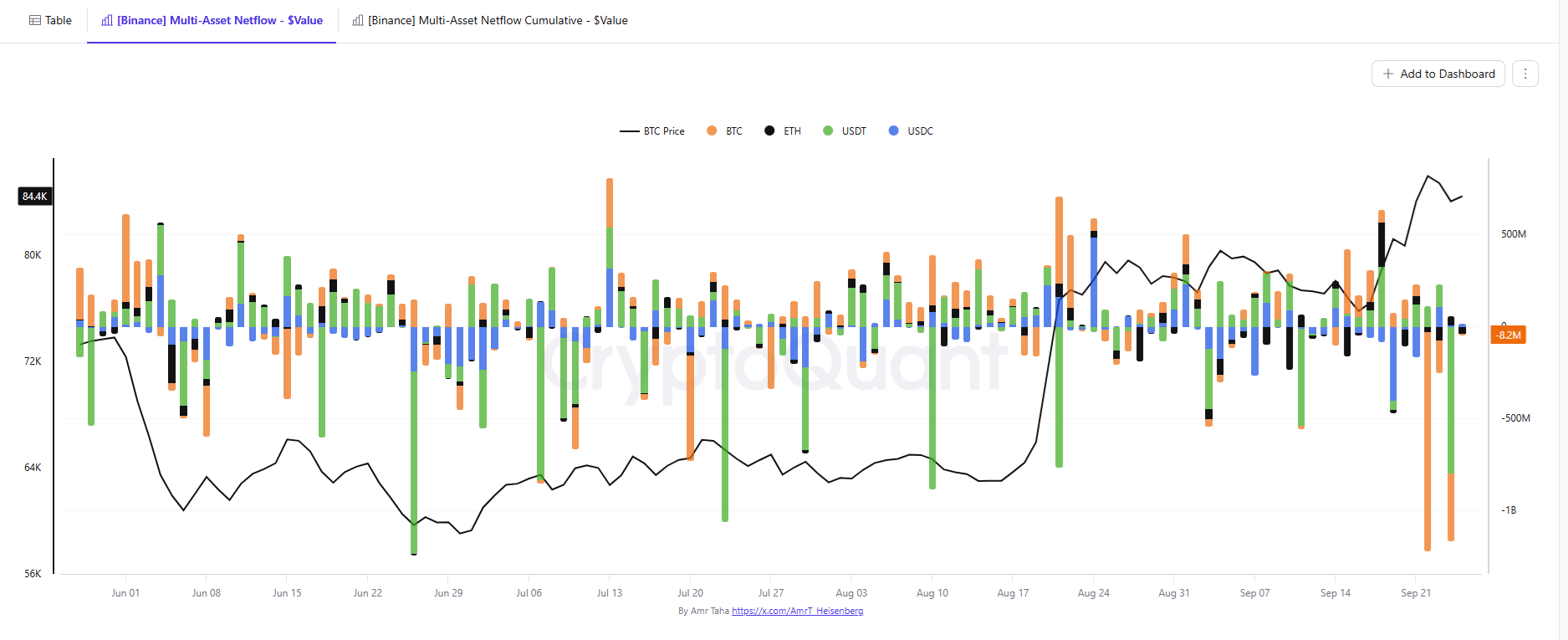
Another indicator of BTC accumulation is the sudden increase in outflows from Binance. Based on research by user @Darkfrost, BTC is showing signs of FOMO, as outflows reach levels not seen since 2023. 
BTC goes back into accumulation wallets
BTC was one of the main outflows from Binance, with a strong sign of external accumulation on September 22. | Source: Cryptoquant

Binance is usually absorbing spare BTC during periods of bearish sentiment, while outflows signal a much lower selling pressure. Ahead of the withdrawal spree, Binance had around 705K BTC in its reserve. In the past week alone, the reserve shrank to around 689K BTC, based on Cryptoquant data.

Exchanges as a whole hold around 2.7M BTC, near all-time lows. The reserves did not expand even with recent miner deposits. BTC has been taken off exchanges not only for self-storage, but for additional safety, as exchanges are at a significant risk of hacks.

The recent Bitget hack may accelerate the rush to protect personal BTC holdings.  

In September, there was also a shift in the size of spot orders. Demand came from large whales, making relatively small but regular purchases. Orders ranged at around 798 BTC, starting off in early September and rising as the BTC price rally progressed.
BTC goes back into accumulation wallets
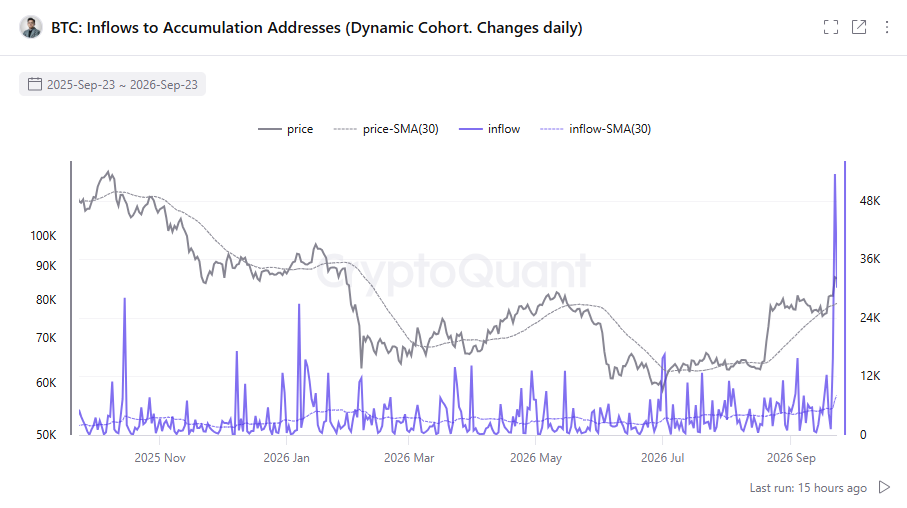
BTC accumulation spiked to levels not seen since 2023, as withdrawals signaled renewed confidence in holding BTC. | Source: Cryptoquant

General inflows to accumulation addresses also expanded in September, following a period of flat activity. 

For now, the accumulation has happened even without buying from treasury companies. Most treasury purchases have been frozen, while companies like Strategy and Metaplanet attempt to improve their balances and reserves. 

BTC shrimp and shark wallets gain activity

BTC accumulation is showing shrimp retail wallets may be making a return. Just as retail capitulated at the end of the previous bull cycle, buying is now returning once BTC has established a clear trend. 

In a single day, a total of 25,000 new shrimp wallets with under 1 BTC were created. For 2026 to date, the number of shrimp wallets has expanded by 4.64%.

BTC goes back into accumulation wallets
BTC shrimp and shark wallets became more active, as retail returned from its capitulation. | Source: Newhedge

Another cohort of active wallets is the shark-sized ones, holding 100 to 1,000 BTC. Those wallets also added BTC in the past month, expanding their total count by 4.62% in the year to date. 

According to holder records, all but the most recent BTC buyer wallets are increasing their balances. There were no signs of distribution during the BTC rally from lows of $59,000 to the recent local high at $87,000. The recent accumulation shows confidence in an ongoing BTC rally, as earlier buyers do not rush to distribute at this price range. 

Taking coins off exchanges also suggests another wave of confidence in the long-term BTC growth. For now, most of the BTC price pressure comes from the derivative market. BTC is in no danger of holder capitulation, as a large part of the supply has been redistributed to holders with long-term conviction. 

As a result, actual access to BTC may become even more scarce, while the leading crypto coin is used as collateral, a deep reserve, or simply a payment tool with still uncensored settlement.

If you're reading this, you’re already ahead. Stay there with our newsletter.

Disclaimer: For information purposes only. Past performance is not indicative of future results.
placeholder
WTI (USOIL) Is down 2.03% on Sep 25: Here Is WhyWTI (USOIL) is down 2.03% at Sep 24 22:20(UTC+0), now at $92.517, with a 7-day down of 3.63%.What is driving WTI (USOIL)’s stock price down today?The drop in WTI crude oil prices was primarily driven by
Author  TradingKey
14 hours ago
WTI (USOIL) is down 2.03% at Sep 24 22:20(UTC+0), now at $92.517, with a 7-day down of 3.63%.What is driving WTI (USOIL)’s stock price down today?The drop in WTI crude oil prices was primarily driven by
placeholder
Silver Price Forecast: XAG/USD remains steady near $64.00 as oil prices easeSilver price (XAG/USD) inches higher after two days of losses, trading around $63.90 per troy ounce during Asian hours on Friday. Non-yielding Silver is finding underlying support as inflation concerns ease following a pullback in crude oil prices.
Author  FXStreet
16 hours ago
Silver price (XAG/USD) inches higher after two days of losses, trading around $63.90 per troy ounce during Asian hours on Friday. Non-yielding Silver is finding underlying support as inflation concerns ease following a pullback in crude oil prices.
placeholder
Gold Price Forecast: Gold Drops Below $4,300, Will It Continue to Fall? As of the European session on September 24, gold prices (XAUUSD) extended their correction, dipping below $4,300 intraday to hit a low of $4,262.45. After previously rebounding close to $
Author  TradingKey
Yesterday 09: 57
As of the European session on September 24, gold prices (XAUUSD) extended their correction, dipping below $4,300 intraday to hit a low of $4,262.45. After previously rebounding close to $
placeholder
Yen touches 158.37 as Tokyo reopens, then slips back — ¥15.4 trillion of intervention and the 200-day line stand between here and 160USD/JPY reached 158.37 overnight, its highest since early September, then eased to 157.88 as Japanese markets reopened after a three-day holiday. The Ministry of Finance has spent ¥15.4 trillion defending the yen since late July and the BOJ ran a rate check on September 18. The 200-day average sits at 158.43.
Author  Irene Q.
Yesterday 06: 59
USD/JPY reached 158.37 overnight, its highest since early September, then eased to 157.88 as Japanese markets reopened after a three-day holiday. The Ministry of Finance has spent ¥15.4 trillion defending the yen since late July and the BOJ ran a rate check on September 18. The 200-day average sits at 158.43.
placeholder
US input costs rose at the fastest pace in four years — the September flash PMI beat is an inflation story, not a growth storyUS September flash PMIs came in far above expectations, with the composite at 58.4, a five-year high. But the detail that moved markets was input cost inflation at its fastest since October 2022, driven by fuel, transport and supply shortages. Brent is back above $100 and the 10-year Treasury yield has hit its highest since 2007.
Author  Suzie
Yesterday 06: 46
US September flash PMIs came in far above expectations, with the composite at 58.4, a five-year high. But the detail that moved markets was input cost inflation at its fastest since October 2022, driven by fuel, transport and supply shortages. Brent is back above $100 and the 10-year Treasury yield has hit its highest since 2007.
goTop
quote