


Silver Price Forecast: XAG/USD trades flat around $61.50, US data awaited
- Silver price wobbles near $61.45 ahead of the US PCE Inflation and the ADP Employment Change data.
- The US PCE Inflation is expected to have remained stick at 3.3% on an annualized basis in August.
- Economists expect US private sector to have hired 70K fresh workers in September.
Silver price (XAG/USD) trades in a tight range at around $61.45 during the European trading session on Wednesday. The white metal consolidates as investors await the United States (US) Personal Consumption Expenditure (PCE) Price Index data for August, which will be published at 12:30 GMT.
Investors will pay close attention to the US PCE inflation data as Federal Reserve (Fed) officials have explicitly stated that higher price pressures are a key concern for them. Fed policymakers have also stated that inflationary pressures are driven by both energy supply shocks and Artificial Intelligence (AI)-driven strong demand.
The core PCE inflation, which is closely tracked by Fed officials, is expected to have remained steady at 3.3% Year-on-Year (YoY), with monthly figures growing at a faster pace of 0.3% against the previous reading of 0.2%.
The inflation data is expected to have a significant influence on Fed’s interest rate expectations. Meanwhile, financial markets are confident that the Fed will extend its monetary-tightening cycle further in the remainder of the year.
Fed October hike seen as increasingly likely by TD Securities
According to TD Securities, “an October hike is looking more likely,” with the bank arguing that the Fed will be “unlikely to regain its confidence in inflation progress before the October meeting.” With “most participants expecting further tightening,” TD’s economists contend that “it does not make sense to wait until December to hike again,” reinforcing their view that the policy bias remains firmly skewed toward additional near-term tightening.
Higher interest rates by the Fed bode well for interest-bearing assets, such as Treasury Yields, but poorly for non-yielding assets, like Silver.
Just before the US PCE inflation data release, investors will focus on the ADP Employment Change data for September. The data is expected to show that the private sector created 70K fresh jobs, higher than 38K in August.
This week, the major catalyst for Fed’s interest rate expectations would be the Nonfarm Payrolls (NFP) data for September, which will be released on Friday.
Silver Technical Analysis
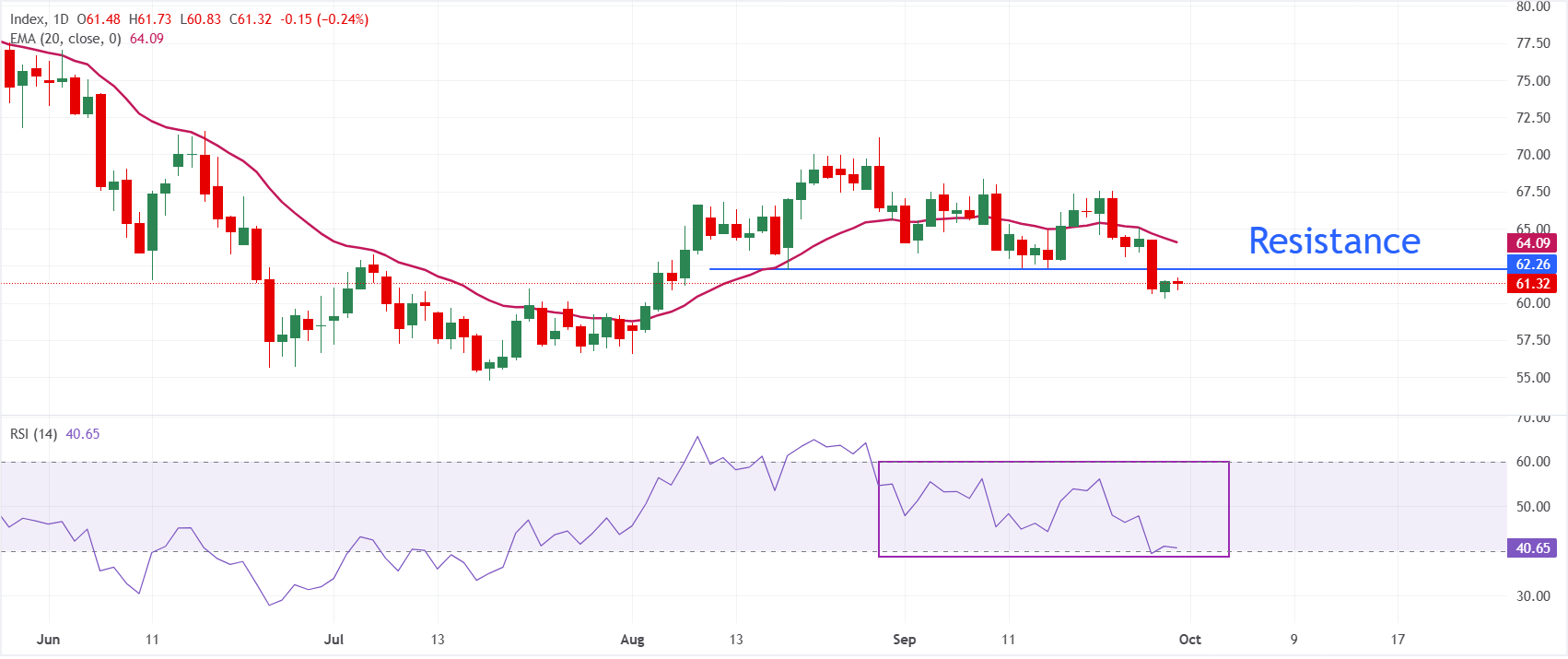
In the daily chart, XAG/USD trades at $61.32, maintaining a bearish near-term tone as it holds below the 20-period exponential moving average (EMA) at $64.09. The price trading under this key trend reference hints that recent strength has faded, while the Relative Strength Index (14) at 40.66 remains in neutral-to-weak territory, suggesting sellers still have the upper hand but without outright oversold conditions.
On the topside, immediate resistance is located at $62.26, followed by the 20-day EMA near $64.09, where any recovery is likely to face supply and where a sustained break would be needed to ease the current downside bias. On the downside, the psychological level of $60 is the key support level.
(The technical analysis of this story was written with the help of an AI tool. Know more.)
Silver FAQs
Silver is a precious metal highly traded among investors. It has been historically used as a store of value and a medium of exchange. Although less popular than Gold, traders may turn to Silver to diversify their investment portfolio, for its intrinsic value or as a potential hedge during high-inflation periods. Investors can buy physical Silver, in coins or in bars, or trade it through vehicles such as Exchange Traded Funds, which track its price on international markets.
Silver prices can move due to a wide range of factors. Geopolitical instability or fears of a deep recession can make Silver price escalate due to its safe-haven status, although to a lesser extent than Gold's. As a yieldless asset, Silver tends to rise with lower interest rates. Its moves also depend on how the US Dollar (USD) behaves as the asset is priced in dollars (XAG/USD). A strong Dollar tends to keep the price of Silver at bay, whereas a weaker Dollar is likely to propel prices up. Other factors such as investment demand, mining supply – Silver is much more abundant than Gold – and recycling rates can also affect prices.
Silver is widely used in industry, particularly in sectors such as electronics or solar energy, as it has one of the highest electric conductivity of all metals – more than Copper and Gold. A surge in demand can increase prices, while a decline tends to lower them. Dynamics in the US, Chinese and Indian economies can also contribute to price swings: for the US and particularly China, their big industrial sectors use Silver in various processes; in India, consumers’ demand for the precious metal for jewellery also plays a key role in setting prices.
Silver prices tend to follow Gold's moves. When Gold prices rise, Silver typically follows suit, as their status as safe-haven assets is similar. The Gold/Silver ratio, which shows the number of ounces of Silver needed to equal the value of one ounce of Gold, may help to determine the relative valuation between both metals. Some investors may consider a high ratio as an indicator that Silver is undervalued, or Gold is overvalued. On the contrary, a low ratio might suggest that Gold is undervalued relative to Silver.
Recommended Articles


