




Warren Buffett's Biggest Mistake Has Now Cost Berkshire Hathaway Up to $112 Billion (but I Don't Blame Him)
Key Points
Warren Buffett retired on Dec. 31, handing the keys to the trillion-dollar conglomerate he built to his protégé, Greg Abel.
The Oracle of Omaha dumped 75% of Berkshire Hathaway’s Apple stake before a huge run-up.
Buffett’s Apple blunder is forgivable for one key reason.
- These 10 stocks could mint the next wave of millionaires ›
Trillion-dollar conglomerate Berkshire Hathaway (NYSE:BRKA)(NYSE:BRKB) entered 2026 in uncharted territory for the first time in more than half a century. On Dec. 31, Warren Buffett, the company's longtime CEO, who oversaw a greater-than-6,000,000% outperformance of the benchmark S&P 500 since the mid-1960s, retired as CEO. His successor, Greg Abel, is now in charge of Berkshire's $350 billion investment portfolio.
While the Oracle of Omaha had a knack for spotting amazing deals hiding in plain sight, he wasn't infallible. Decisions made in the years leading up to his retirement with No. 1 holding Apple (NASDAQ:AAPL) have cost Berkshire Hathaway up to $112 billion in would-be gains.
Missed Nvidia in 2009? This Rare Signal Is Flashing Again. In 2009, a "Double Down" signal flashed for a little-known chipmaker called Nvidia. For the first time in years, that same "Total Conviction" signal is flashing for a company 1/100th the size of Nvidia. Continue »

Image source: Getty Images.
The Oracle of Omaha dumped 75% of Berkshire's Apple stake before it nearly doubled
Warren Buffett began building a position in the "Apple" of his eye in the first quarter of 2016. While artificial intelligence is all the rage today, Buffett was more interested in consumers' draw to the brand when he initially invested. Apple has an exceptionally loyal customer base that's shown a willingness to pay premium prices for its physical products (iPhone, iPad, and Mac).
By Sept. 30, 2023, Berkshire Hathaway's Apple stake had reached more than 915 million shares, worth $156.8 billion at the time, and accounted for well over 40% of the company's investment portfolio.
Then he began selling.
At Berkshire's annual shareholder meeting held in May 2024, the Oracle of Omaha suggested that tax-based selling was behind his decision to pare down Apple. Said Buffett:
It doesn't bother me in the least to write that check... it shouldn't bother you that we do it, and if I'm doing it at 21% this year and we're doing it a little higher percentage later on, I don't think you'll actually mind the fact that we sold a little Apple this year.
In other words, Buffett opined that corporate taxes would likely climb in the coming years and used this as a justification for paring down Apple at an advantageous tax rate.
The problem, in hindsight, is that Apple stock skyrocketed. The 687,642,574 shares Buffett sold in his final nine quarters as CEO (a 75% reduction) have cost Berkshire Hathaway up to $112 billion in gains.

Image source: Getty Images.
Buffett's Apple blunder is forgivable for one key reason
Although Berkshire Hathaway's now-former boss missed out on an even bigger payday for his company, I don't blame him one bit for selling three-quarters of the Apple stake. The reason? Apple violates the one rule Buffett hasn't wavered on in decades: valuation.
When Berkshire first began scooping up Apple stock, it was trading at a trailing 12-month price-to-earnings (P/E) ratio of just over 10. It was a bargain in every sense of the word and had exceptional customer loyalty/engagement to boot.
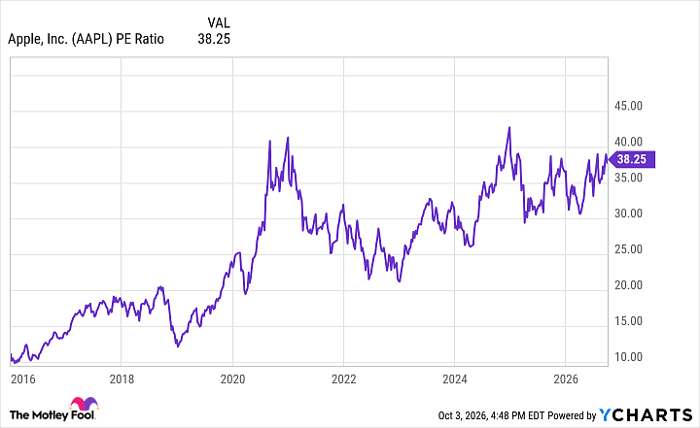
AAPL PE Ratio data by YCharts
As of Oct. 3, Apple was valued at almost 38 times forecast earnings for 2026. Not only is Apple historically pricey, but the stock market's valuation is within a stone's throw of rivaling the dot-com bubble. Even though Apple's higher-margin subscription services are an undeniable catalyst, the company simply isn't growing quickly enough to justify a forecast P/E ratio of 38 in 2026.
Warren Buffett was a net seller of stocks for 13 consecutive quarters leading up to his retirement because stock market valuations didn't make sense to him. I don't blame him one bit for selling 75% of Berkshire's Apple stake and remaining a stickler for value.
Don’t miss this second chance at a potentially lucrative opportunity
Ever feel like you missed the boat in buying the most successful stocks? Then you’ll want to hear this.
On rare occasions, our expert team of analysts issues a “Double Down” stock recommendation for companies that they think are about to pop. If you’re worried you’ve already missed your chance to invest, now is the best time to buy before it’s too late. And the numbers speak for themselves:
- Nvidia: if you invested $1,000 when we doubled down in 2009, you’d have $621,975!*
- Apple: if you invested $1,000 when we doubled down in 2008, you’d have $63,642!*
- Netflix: if you invested $1,000 when we doubled down in 2004, you’d have $370,440!*
Right now, we’re issuing “Double Down” alerts for three incredible companies, available when you join Stock Advisor, and there may not be another chance like this anytime soon.
See the 3 stocks »
*Stock Advisor returns as of October 8, 2026.
Sean Williams has no position in any of the stocks mentioned. The Motley Fool has positions in and recommends Apple and Berkshire Hathaway. The Motley Fool has a disclosure policy.
Recommended Articles


