




3 Dividend Stocks That Didn't Need $100 Oil to Keep Raising Their Payouts
Key Points
Oxy only needs oil to stay above $40 per barrel.
ExxonMobil can keep hiking its dividends if oil drops to $35 per barrel.
Energy Transfer’s “toll road” pipelines can survive extreme oil price swings.
- 10 stocks we like better than Occidental Petroleum ›
In early September, the prices of West Texas Intermediate (WTI) and Brent crude oil briefly soared above $100 per barrel as the conflict in Iran dragged on. That rally lifted many oil stocks, but it also slammed other industries with higher labor and logistics costs.
As of this writing, WTI trades at about $91 per barrel, while Brent remains above $100 per barrel. Those high prices will enable dividend-paying oil companies to generate ample cash to cover their payouts, but some investors might worry about dividend cuts if oil prices tumble.
Missed Nvidia in 2009? This Rare Signal Is Flashing Again. In 2009, a "Double Down" signal flashed for a little-known chipmaker called Nvidia. For the first time in years, that same "Total Conviction" signal is flashing for a company 1/100th the size of Nvidia. Continue »
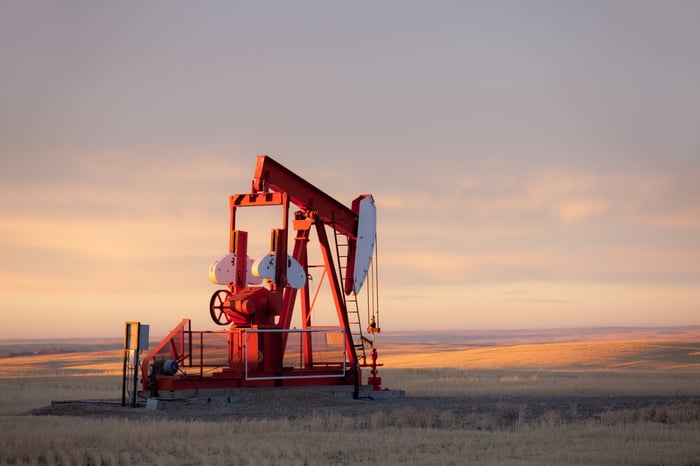
Image source: Getty Images.
But if we look closer at the big upstream, midstream, and downstream players, we'll find plenty of companies that can easily afford to raise their dividends even if the price of crude oil sinks far below $100. Let's see why three of them -- Occidental Petroleum (NYSE: OXY), ExxonMobil (NYSE: XOM), and Energy Transfer (NYSE: ET) -- are still worth buying today.
Occidental Petroleum
Occidental Petroleum, more commonly known as Oxy, generates most of its profits from its upstream business. Upstream companies flourish when oil prices are high, since their revenues generally rise much faster than their operating expenses. Oxy also divested its downstream business -- which fares better when oil prices are lower -- earlier this year.
Oxy produces the vast majority of its gas and oil in the U.S., so it's well-insulated from overseas conflicts. It also continues to reduce its drilling times, cut its structural costs, and increase its cash flow by integrating the assets it acquired through its 2024 acquisition of CrownRock.
Oxy pays a forward dividend yield of 1.9%, and it's raised its payout annually for five consecutive years. Its low trailing payout ratio of 30% gives it plenty of room for future hikes, and it only needs WTI crude oil prices to stay above its corporate breakeven price of $40 per barrel to support its capex and dividends. So while Oxy's upstream business would certainly benefit from soaring oil prices, it can still easily raise its dividends if oil prices pull back.
ExxonMobil
ExxonMobil, one of the world's largest integrated energy companies, owns upstream, midstream, and downstream assets in over 56 countries. That diversification makes it a less direct play on rising oil prices than Oxy, but it's also better insulated from a pullback.
Regardless of what happens to oil prices in the near term, ExxonMobil plans to increase its oil and gas production by nearly 3% annually through 2030. It gets most of its oil in the U.S., but it's been expanding in Asia, Africa, and South America. It has a bit more exposure to the Middle East than its closest competitors, but it offsets that pressure with its scale and diversification.
ExxonMobil only needs Brent crude oil prices (the preferred metric for multinational oil companies) to remain above $35 per barrel to cover its capex and dividends. It's raised its dividends annually for 43 consecutive years, pays a forward yield of 2.5%, and its trailing payout ratio of 53% suggests that streak will continue for the foreseeable future.
Energy Transfer
Energy Transfer, which operates over 140,000 miles of pipeline across 44 states, is one of the country's largest midstream companies. It delivers crude oil, natural gas, natural gas liquids (NGL), and other refined products through its pipelines and marine export terminals.
As a midstream company, Energy Transfer simply collects "tolls" from upstream and downstream companies that transport resources through its pipelines. That business model is naturally insulated from volatile commodity prices, since it only needs those resources to keep flowing through its infrastructure to generate stable profits.
As a master limited partnership (MLP), Energy Transfer blends a return of capital with its own income to pay distributions that are more tax-efficient than traditional dividends. It spends only about half of its distributable cash flow (DCF) on distributions each year, has raised its payout annually for four consecutive years, and pays a high forward yield of 6.8%. It won't profit as much from high oil prices as Oxy or ExxonMobil, but it will remain a reliable, high-yield play for income-oriented investors.
Should you buy stock in Occidental Petroleum right now?
Before you buy stock in Occidental Petroleum, consider this:
The Motley Fool Stock Advisor analyst team just identified what they believe are the 10 best stocks for investors to buy now… and Occidental Petroleum wasn’t one of them. The 10 stocks that made the cut could produce monster returns in the coming years.
Consider when Netflix made this list on December 17, 2004... if you invested $1,000 at the time of our recommendation, you’d have $365,910!* Or when Nvidia made this list on April 15, 2005... if you invested $1,000 at the time of our recommendation, you’d have $1,418,530!*
Now, it’s worth noting Stock Advisor’s total average return is 930% — a market-crushing outperformance compared to 211% for the S&P 500. Don't miss the latest top 10 list, available with Stock Advisor, and join an investing community built by individual investors for individual investors.
See the 10 stocks »
*Stock Advisor returns as of October 2, 2026.
Leo Sun has positions in Energy Transfer. The Motley Fool recommends Occidental Petroleum. The Motley Fool has a disclosure policy.
Recommended Articles


