




The U.S. Economy Added 29,000 Jobs in September, Far Fewer Than Expected. Here's Why That's Good News for the Stock Market Right Now.
Key Points
The unemployment rate in September rose slightly to 4.2%, while previous monthly job figures were revised lower.
The weak jobs report led long-term bond yields to ease.
Rising long-term bond yields have been a thorn in the market's side this year.
- These 10 stocks could mint the next wave of millionaires ›
With bond yields having soared this year, bad news is once again good news.
U.S. nonfarm payrolls added 29,000 jobs in September, well below the 84,000 economists had expected. The unemployment rate also rose to a higher-than-expected 4.2%.
Missed Nvidia in 2009? This Rare Signal Is Flashing Again. In 2009, a "Double Down" signal flashed for a little-known chipmaker called Nvidia. For the first time in years, that same "Total Conviction" signal is flashing for a company 1/100th the size of Nvidia. Continue »
Additionally, the Bureau of Labor Statistics revised job numbers downward in July and August by a combined 60,000 jobs. Average hourly earnings increased 0.1% in September, lower than the 0.3% gain Wall Street had been looking for.
Following the jobs report, bond yields declined, and major market indexes all rose. As of 10:22 a.m. ET, the Dow Jones Industrial Average (DJINDICES:^DJI) had jumped over 300 points, while the S&P 500 and tech-heavy Nasdaq Composite rose roughly 1.05% and 1.7%, respectively.
Here's why the weak jobs report is good news for the stock market.

Image source: Getty Images.
Yields finally budge
One of the big issues for the stock market this year is the surge in long-term bond yields.
Yields affect the market and the economy in several ways, but when valuing stocks, investors often use the yield on the 10-year U.S. Treasury note as the risk-free rate in a discounted cash flow analysis. Higher yields lead to lower valuations.
Whether it's due to inflation expectations, concerns about U.S. debt, or other reasons that aren’t always immediately clear, bond yields have exploded higher this year, with the yield on the 10-year note recently hitting 5.3%.
Even after the Personal Consumption Expenditures (PCE) price index, the Fed's preferred gauge of inflation, came in lower than expected for August, yields continued to rise.
Following the weak jobs report, the yield on the 10-year note declined by 0.039% to 5.195% as of this writing.
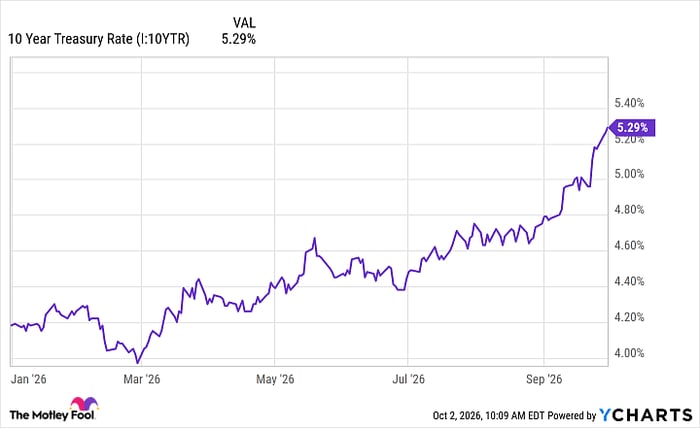
10 Year Treasury Rate data by YCharts
The labor market is also part of the Federal Reserve's dual mandate of maximum employment and stable prices, so weakness in the labor market could change the trajectory of interest rates.
"If upcoming jobs reports continue to reveal weak data, the Fed could reconsider its tightening stance – particularly if there are signs that the labor market is slowing down faster than policymakers anticipated," Jerry Templeman, a vice president at Mutual of America Capital Management, wrote in a research note, according to U.S. News & World Report. "Markets will look closely at whether September's numbers represent a temporary pause or the beginning of more substantive labor market weakening."
According to the CME Group's FedWatch tool, the odds of the Fed holding rates steady at its upcoming October meeting increased to nearly 80%, as of this writing, up from 75.6% yesterday. One week ago, the odds of this happening were less than 36%.
Some much-needed relief
As we've seen all year, economic conditions and market expectations change frequently, and while an economy adding fewer jobs isn't necessarily a good thing, investors definitely needed this relief today, particularly as yields have jumped to uncomfortable levels.
The labor market can be a source of inflation in the U.S., where consumer spending accounts for the majority of gross domestic product, so if the labor market shows signs of slowing, the Fed may hold rates steady at its next meeting.
Now, of course, things could change with the next inflation report later this month. But the market really needed yields to show some signs of easing, and the soft jobs report finally provided the news needed, which is why stocks are rising today.
Where to invest $1,000 right now
When our analyst team has a stock tip, it can pay to listen. After all, Stock Advisor’s total average return is 930%* — a market-crushing outperformance compared to 211% for the S&P 500.
They just revealed what they believe are the 10 best stocks for investors to buy right now, available when you join Stock Advisor.
See the stocks »
*Stock Advisor returns as of October 2, 2026.
Bram Berkowitz has no position in any of the stocks mentioned. The Motley Fool has positions in and recommends CME Group. The Motley Fool has a disclosure policy.
Recommended Articles


