




Nike Stock Forecast: Weak Sales Outlook Overshadows Earnings Beat and Cost Cuts
Nike (NKE) fell 0.71% from the September 30 close to the October 1 close, the day its fiscal first quarter report was made public. The stock closed on October 1 at 35.15, down 0.71%. It dropped to 32.09 in after-hours trading that same day. After-hours trading is not the official close of business, and regular trading on October 2 had not begun when this update was written. The major concern is how quickly Nike can steady demand for its recently released products in order for the new cost control initiatives to have a measurable impact.
Q1 Beat on EPS but Missed on Revenue
Revenue for the quarter ended August 31, 2026 was $11.21 billion, reflecting a decrease of 4% year-over-year and 5% on a currency neutral basis. Diluted EPS was $0.48, net income decreased to $712 million from $727 million in the prior year quarter. Gross margin improved 60 basis points to 42.8%. Selling and administrative expenses declined by 3% to $3.91 billion. Although the bottom line EPS outperformed the estimate, revenue underperformed. A 60 basis point improvement in gross margin is beneficial, but it did not speak to the recovery of consumer demand. Additionally, the cost improvements came from a reduction in warehousing and logistics costs. More cost control initiatives and positive sales movement would add stronger benefits to the turnaround.
Fiscal 2027 Guidance Resets the Recovery Timeline
Nike projects a high-single-digit revenue decline for fiscal 2027. The company expects adjusted diluted EPS in the range of $1.15 to $1.35. The outlook does not include approximately $0.15 of Pace restructuring costs for fiscal 2027. The expected outlook for fiscal 2027 is significantly worse than what the market was expecting. As a result, the after-market move will be more significant than the positive first quarter EPS surprise. Nike appears to be signaling the operating recovery will be longer than many had previously expected. I see the next positive step management leaving the outlook for fiscal 2027 as-is without further reduction. Continued reductions will make it even more difficult to construct an earnings floor.
Greater China Is Still the Largest Regional Problem
Greater China is still one of Nike’s biggest challenges in terms of operations.
Reuters reported currency-neutral sales in Greater China fell 26% and marked a ninth straight quarterly decline.
Nike is adjusting its distribution in the region and plans to pull its right to sell products online from some of the largest retail partners in China, starting in January.
Improving channel is not the same as increasing consumer demand.
Nike still needs to improve its products’ relevance, and its strength in selling at full prices.
Until the above improve, China will continue to be a major drag in its overall performance recovery.
Direct Sales Show the Turnaround Is Uneven
Nike Direct revenue fell 8% and 9% on a currency-neutral basis, and 13% on Nike Brand Digital revenue. Company-owned stores fell 5%. Wholesale revenue fell 1%. Converse lost 28% of its sales.
Those numbers make it hard to paint a positive picture.
A stronger wholesale business can help improve results, but the big decline in Direct is important because Nike previously focused on the direct-to-consumer business.
Whether Nike’s wholesale business is stabilizing is the main question for investors.
Weak demand is not good, but sales at or above full price is better than promotion-supported demand.
Pace Targets a Leaner Operating Model
Nike is implementing Pace, a multi-year supply chain and operating model program. Parts of Pace include changes to the supply chain, leaner organizations, a new campus in India, and a realignment to three operating geographies. Nike expects approximately $2.5 billion in savings by 2031, and approximately $1.0 billion in additional pre-tax charges. Approximately $300 million of the additional charges is expected in fiscal 2027. This distinction is important. The $2.5 billion is the expected cumulative savings through fiscal 2031, and does not represent the earnings impact from the restructuring. There is the risk the savings would not be achieved. There is cost and execution risk with any restructuring. These savings would only be beneficial if Nike preserved its capabilities to develop new product demand.
Liquidity Gives Nike Time
Nike had substantial liquidity at the end of the quarter.
Cash and short-term investments totaled $8.4 billion.
Inventories totaled $7.8 billion, down 3% from the prior year.
A reduction in inventory is a good sign if it signals Nike was better at managing supply with demand.
It is less meaningful if demand was so low that Nike needed to resort to deeper discounts.
Of most concern should be the overall level of inventory, and the quality of products that are sold at full price.
Valuation Still Requires Caution
Using the midpoint of Nike’s revised Adjusted EPS guidance of $1.25, the company’s stock close of $35.15, translates to a multiple of approximately 28.1 times. The $32.09 after-hours quote, translate to approximately 25.7 times. Traditionally, the multiples would seem high for a company projecting a high single digit decline in revenues. However, at the after hours quote, Nike’s stock was trading at a 9.4% discount to the September 30 close, and the multiple was not obviously high for the stock’s valuation. Any positive news on the expectations for earnings, would improve the valuation.
Nike Technical Analysis: Earnings Gap Puts $32 Support in Focus
Nike closed the October 1st regular session at $35.15, but after earnings fell to $32.09. That after hours gap changed the short-term technical outlook. The previous $35.05 support on the 2-hour chart has been lost in the extended trading.
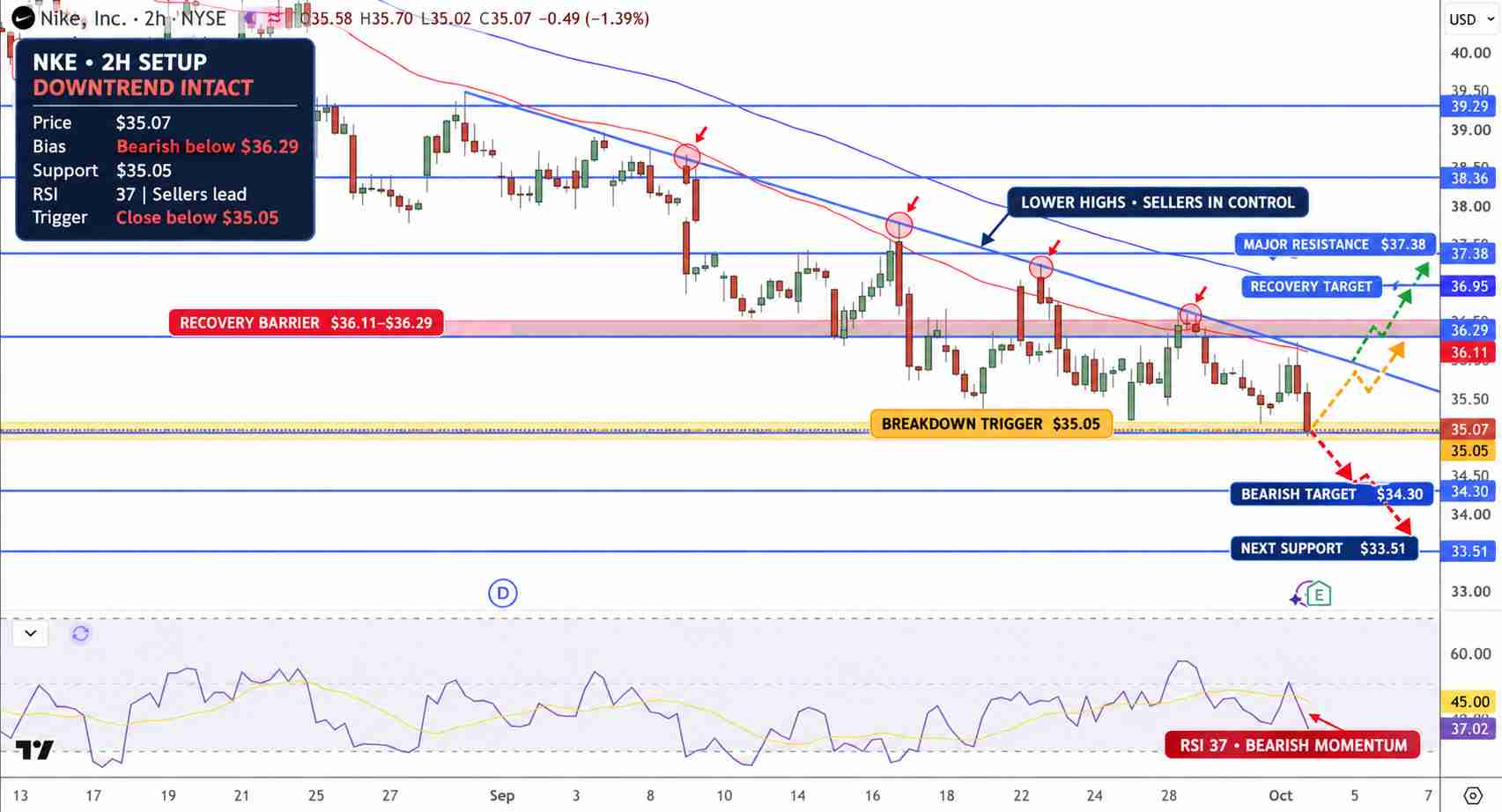
Nike Stock Price Chart - Source: Tradingview
RSI was at 37 prior to earnings, reflecting somewhat weak momentum with RSI below the 50 level, but not yet oversold conditions. The first post-earnings reference will be the psychological $32 area. Because regular Oct 2nd trading has not started, I will consider that an area of reference rather than confirmed support. The next major round number support will be $30.
The first important resistance will be in the 35.02-35.15 area, which is the prior day's low and close. The next important resistance area will be in the $36.11 - $36.29 area, with the next important resistance level being $36.95. My bias is still bearish as long as NKE trades below $35.
Why is Nike stock in focus now?
Nike stock is in focus for a couple of reasons. For starters, the company reported a revenue decline during fiscal Q1. In addition, Nike provided a disappointing forecast for fiscal 2027, and management initiated the Pace restructuring program. Although there are negatives, there are positives as the company showed progress with better gross margin.
What level confirms a stronger NKE recovery?
A recovery above the $35.15 level would confirm a more meaningful recovery, and for now, that level remains the first key recovery trigger.
Bottom Line
Nike's Q1 results reflected better costs, but did not reflect a recovery in demand. Gross margin improved and costs were better controlled. However, direct sales and Converse continued to decline. The new guidance pushed the recovery out and the initiation of the Pace program is an expense event with long term benefits. From a technical perspective, the after hours move below $35.15 significantly weakened the bullish outlook. A reclaim of $35.15 during regular trading hours would improve the outlook. Trading below $32 would likely remain bearish.
Recommended Articles


