




Will the Stock Market Crash? History Gives a 95% Reason to Stay Calm
Key Points
There are some yellow flags that the stock market could crash.
However, history indicates this is unlikely to happen anytime soon.
- 10 stocks we like better than S&P 500 Index ›
There are growing concerns about whether the stock market is about to crash. In fact, the British newspaper The Guardian recently ran an article titled "Are Global Stock Markets Heading for a Crash?" Although worries appear to be mounting, history says there is a 95% chance we won't see a market crash in the next year.
Here's why investors are wary and why a crash probably isn't around the corner.
Missed Nvidia in 2009? This Rare Signal Is Flashing Again. In 2009, a "Double Down" signal flashed for a little-known chipmaker called Nvidia. For the first time in years, that same "Total Conviction" signal is flashing for a company 1/100th the size of Nvidia. Continue »
A weak consumer, rising interest rates, and an AI bubble
The market right now is facing a trio of potential catalysts that could cause a major sell-off. The first is a weak consumer. Consumers are clearly stretched, hurt by high prices coming from tariffs and elevated gasoline prices stemming from the U.S. war with Iran.
Danish economist Henrik Zeberg recently pointed to the long-term U.S. unemployment rate, a weakening housing market, and a collapse in personal saving rates during the past five years as evidence that a recession could be coming next year. With recessions generally come large market pullbacks.
At the same time, the Federal Reserve has just begun a new tightening cycle to curb high inflation. Rate-increase cycles are rarely good for stocks, with the last tightening cycle being a catalyst for the last bear market when the S&P 500 (SNPINDEX: ^GSPC) index sank 25%. Meanwhile, according to RBC Wealth Management, the other five rate-tightening cycles since 1994 saw the S&P 500 drop between 8% and 14%.
And finally, there is the potential of an AI bubble bursting. Spending on AI infrastructure is booming, and any major shift in that spending could send stocks reeling. Meanwhile, a duo of valuation metrics is sending out warning signs that stocks are overvalued.
First among them is the S&P 500 cyclically adjusted price-to-earnings (CAPE) ratio. Developed by Yale economist Robert Shiller, it looks back over the past decade to smooth out boom and bust earnings cycles (adjusted for inflation). The ratio has been trading at roughly 40 times, which has only happened once before, right before the dot-com bubble crash.
Meanwhile, another popular metric called the Buffett Indicator, which divides the market's entire market cap by gross domestic product (GDP), is trading at historically high levels. A favorite valuation metric of Warren Buffett, a level between 70% and 90% is considered reasonable, while more than 120% is considered high. The metric now sits above 235%.
A crash is unlikely
Despite the potential warning signs, history says a crash is unlikely to happen within the next year, and the reason centers around the midterm election. Since 1938, the market has risen from November to November 95% of the time after midterm elections, according to Fidelity Research. Meanwhile, this is also historically when the market puts up its best returns, with the S&P 500 posting a 14.5% average return in the 12 months after the midterms since 1950.
The returns tend to be strong early in the cycle. According to the Carson Group, in the fourth quarter of a midterm election year, the S&P 500 has gone up 84% of the time since 1950 and averaged a 6.6% return during the quarter. The following quarter is even stronger, with stocks showing gains 95% of the time and averaging a 7.4% return. Calendar Q2 in the year after midterms also tends to be good, with stocks up 74% of the time, with an average increase of 5%.
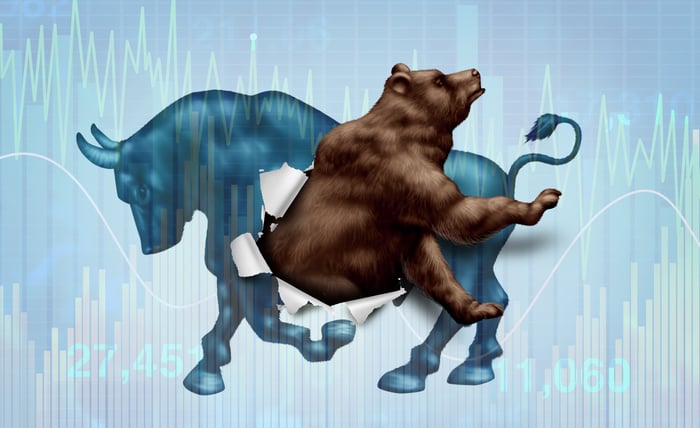
Image source: Getty Images.
How to invest
In my view, any AI bubble is not about to burst, given the strong, fast returns hyperscalers are seeing from their AI investments. Furthermore, as WisdomTree has pointed out, cumulative AI infrastructure spending as a percentage of global GDP is not yet close to the typical 25% danger zone for transformational technologies. As such, I'd try to ride the historical trend of strong stock gains after midterm elections.
However, I still think one of the best investment strategies, whether the market crashes or if the bull run continues, is to consistently dollar-cost average into one or two strong index exchange-traded funds (ETFs) like the broad Vanguard S&P 500 ETF (NYSEMKT: VOO) or Invesco QQQ Trust (NASDAQ: QQQ), which tracks the tech-heavy Nasdaq-100 Index.
Trying to time the market rarely works, and dollar-cost averaging into top index ETFs is a proven long-term strategy to build wealth over time.
Should you buy stock in S&P 500 Index right now?
Before you buy stock in S&P 500 Index, consider this:
The Motley Fool Stock Advisor analyst team just identified what they believe are the 10 best stocks for investors to buy now… and S&P 500 Index wasn’t one of them. The 10 stocks that made the cut could produce monster returns in the coming years.
Consider when Netflix made this list on December 17, 2004... if you invested $1,000 at the time of our recommendation, you’d have $379,123!* Or when Nvidia made this list on April 15, 2005... if you invested $1,000 at the time of our recommendation, you’d have $1,396,103!*
Now, it’s worth noting Stock Advisor’s total average return is 933% — a market-crushing outperformance compared to 212% for the S&P 500. Don't miss the latest top 10 list, available with Stock Advisor, and join an investing community built by individual investors for individual investors.
See the 10 stocks »
*Stock Advisor returns as of October 1, 2026.
Geoffrey Seiler has positions in Invesco QQQ Trust and Vanguard S&P 500 ETF. The Motley Fool has positions in and recommends Vanguard S&P 500 ETF. The Motley Fool recommends WisdomTree. The Motley Fool has a disclosure policy.
Recommended Articles


