




2 Under-the-Radar Auto Stocks Poised to Soar While Nobody Is Looking
Key Points
Carvana has bounced back from its near-bankruptcy, and now it's once again fundamentally shifting its strategy.
Carvana's entry into new-car sales also has the potential to create synergy with its historical businesses.
Rivian's R2 and upcoming mass-market vehicles could give it the scale to attract investors.
- 10 stocks we like better than Rivian Automotive ›
There are hidden-gem stocks in every industry, and uncovering them at the right time could make the difference between a market-thumping portfolio and one that underperforms the broader market. While timing the market is a fool's errand, the following two stocks are at an intriguing point and could offer investors much upside.
Here's why Carvana (NYSE: CVNA) and Rivian Automotive (NASDAQ: RIVN) warrant far more investor attention than they're receiving.
Missed Nvidia in 2009? This Rare Signal Is Flashing Again. In 2009, a "Double Down" signal flashed for a little-known chipmaker called Nvidia. For the first time in years, that same "Total Conviction" signal is flashing for a company 1/100th the size of Nvidia. Continue »
New revenue streams
To say Carvana has been a roller-coaster ride for its investors might be an understatement.
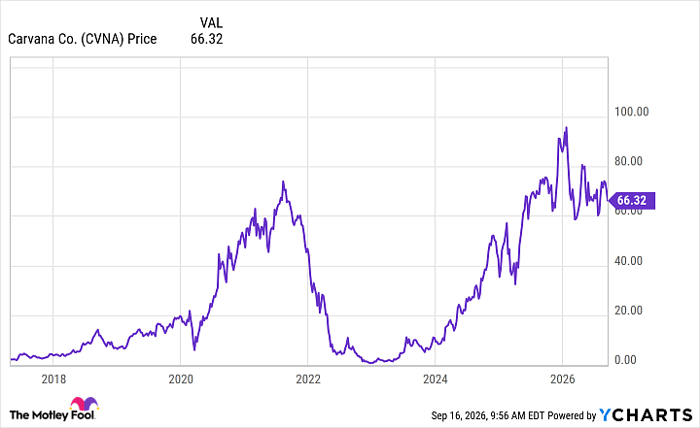
CVNA data by YCharts
After the company thrived during the height of the COVID-19 pandemic, which favored its unique online car-selling business model, a combination of aggressive expansion, a major acquisition, a large and costly debt load, rising interest rates, and plunging used-car prices pushed Carvana to the brink of bankruptcy.
If investors were extremely brave and purchased the stock three years ago, they'd be enjoying a lucrative 530% gain over that short time. That's because the company staged one of the most surprising comebacks by restructuring its expensive debt, which eliminated the immediate threat of bankruptcy, saved it hundreds of millions in annual cash outflows, and bought it time to fix its business model by pulling back on aggressive expansion in favor of calculated and more profitable expansion -- and it worked brilliantly.
Fast forward to today, and Carvana is back to thinking outside the box and opening doors to new business. While Carvana's early years were built on selling and delivering used cars through online purchases and nationwide delivery, the company recently bought a handful of brick-and-mortar dealerships to reshape the new-car retail process -- and it's also working brilliantly.
Consider that the previously underperforming Casa Grande Stellantis dealership, which Carvana took over, was reportedly selling roughly 30 to 50 new vehicles per month; its recent monthly volume under Carvana's control approached nearly 1,000 new-car sales. Here's the kicker: Carvana won't even sell you a car at the dealership, at least currently.
That approach, to essentially use the dealership as a showroom and remove the traditional sales approach while still leveraging its wide network of inventory and distribution, has turned that dealership into the best-performing Stellantis dealership with volume 3 times that of the next highest-volume dealership.
Simply opening the door to new-vehicle sales is incremental business for the former used-car retailer. It also opens the door to potential high-margin service-bay business, additional inventory and auction access, and more vehicles to finance. The synergy this move could create with Carvana's business, in addition to the growth new-car sales offer, could send Carvana's stock soaring if it expands this process successfully.
Despite its rise over the past three years, the company's upside is still flying under the radar until investors better understand the potential this strategic pivot could have on its business, and how it could disrupt the age-old new-car sales process.
Turning the corner
Rivian is another stock that's flying under the radar, but largely for reasons out of its control. The early hype and demand for electric vehicle (EV) companies has faded, and the lucrative U.S. automotive market has transitioned to EVs more slowly than anticipated, costing many companies tens of billions of dollars in charges as they pumped the brakes and pivoted from those plans.
Despite the industry headwinds, Rivian trudged through and made it to its highly anticipated R2 SUV launch earlier this spring. It's now in the process of accelerating production and scale of the R2 to further push its automotive gross profit higher, likely into positive territory soon.
Remember that it's the software segment that turned Rivian's gross profit positive. Rivian has made substantial and consistent progress in gross profitability thanks to its joint venture with Volkswagen, under which the latter pays Rivian to use its in-house software stack in its vehicles and the two will split the costs of current and future developments.

Rivian's R2 is ramping up production. Image source: Rivian.
Rivian has also earned investment from other companies such as Uber Technologies, plus loans from Volkswagen and the Department of Energy, which extend its ability to fund its operations into the distant future without a long list of capital raises that dilute shareholders. That makes it a much more attractive stock for long-term investors to scoop up.
The young EV company has a lot going for it as it continues to scale the R2 and launches the standard variant (most affordable version) next year. Its second factory is in the works, and its product pipeline includes more mass-market vehicles such as the R3 and R3X. It continues to improve its automotive segment and its software and services segment, and its upside could be significant when the U.S. market more rapidly adopts EVs in the future.
What it all means
The automotive industry is notorious for being low-margin and capital-intensive, but these companies are potentially breaking into new, higher-margin businesses with broader upside.
Remember that Rivian's software and services gross profit margin checked in at 42% during the second quarter, far higher than the traditional auto business. Also, remember that Carvana is building synergy among multiple aspects of its business by initiating its unique new-car sales strategy.
Both companies continue to largely fly under the radar, but investors should begin paying more attention, and soon.
Should you buy stock in Rivian Automotive right now?
Before you buy stock in Rivian Automotive, consider this:
The Motley Fool Stock Advisor analyst team just identified what they believe are the 10 best stocks for investors to buy now… and Rivian Automotive wasn’t one of them. The 10 stocks that made the cut could produce monster returns in the coming years.
Consider when Netflix made this list on December 17, 2004... if you invested $1,000 at the time of our recommendation, you’d have $389,154!* Or when Nvidia made this list on April 15, 2005... if you invested $1,000 at the time of our recommendation, you’d have $1,406,303!*
Now, it’s worth noting Stock Advisor’s total average return is 949% — a market-crushing outperformance compared to 214% for the S&P 500. Don't miss the latest top 10 list, available with Stock Advisor, and join an investing community built by individual investors for individual investors.
See the 10 stocks »
*Stock Advisor returns as of September 23, 2026.
Daniel Miller has no position in any of the stocks mentioned. The Motley Fool recommends Uber Technologies. The Motley Fool has a disclosure policy.
Recommended Articles


