




My Prediction: American Stock Ownership Will Drop to 54% by 2030. One Sector Is Driving It.
Key Points
The mania surrounding the then-soaring AI stocks last year pulled many new investors into the market.
The performance they were hoping to plug into, however, may or may not materialize.
The growing realization that stocks could underperform for a while may prompt a handful of investors to look elsewhere for more promising growth opportunities.
- These 10 stocks could mint the next wave of millionaires ›
Assuming you're an adult currently living in the United States, there's a 58% chance you own stocks, one way or another. That's the number from the most recent Gallup poll asking Americans about the matter, anyway. In April of this year, 58% of you said you hold mutual funds and/or individual stocks, down slightly from the previous April's figure of 62%.
It's not too tough to figure out why the number's shrinking, either. Many of the market's must-have artificial intelligence (AI) technology stocks aren't quite as promising now. And inflation has forced at least a few consumers to spend more on groceries and gasoline, leaving less money available for investment.
Missed AI’s "Act 1"? Act 2 Could Be 15x Bigger. Most investors think they missed the AI boat because they didn't buy Nvidia in 2005. But according to our analysts, we’re only at the end of "Act 1"—the R&D phase. "Act 2" is the global rollout. Continue »
This is all cyclical, of course -- except I've got a funny feeling the downcycle of stock ownership led by technology stocks is going to continue to draw a few more people out of the stock market between now and 2030 before it reverses course again.

Image source: Getty Images.
3 reasons a few of you will file out of equities soon
Don't panic. I'm not saying these people are making the right call, nor am I suggesting that stocks are doomed for the foreseeable future. I'm simply saying that reality is unavoidable. And the reality right now is, at least a few more of the 156 million Americans who currently hold equities will be out of the market by 2030, pulling the number down to something on the order of 147 million (accounting for continued population growth of less than 1%) for a trio of reasons.
1. AI technology stocks could struggle to continue performing as well as they have of late
One of these reasons is the obvious one -- the influx of new investors who specifically wanted to capitalize on the AI revolution. J.P. Morgan analysts reported that ordinary retail investors poured roughly $300 billion in new cash into the stock market last year, up more than 50% from 2024's tally, and eclipsing 2021's peak of $270 billion. Almost six out of every 10 investors currently hold at least one stock that's linked to the AI industry, too, with Gen Z and millennials -- a wide swath of the market's newcomers -- owning a measurably higher proportion.
And who could blame them? These stocks were soaring amid AI mania.
Now that mania is cooling off. Not only are many of these once-hot AI stocks now lagging -- shares of Nvidia (NASDAQ: NVDA) and Alphabet (NASDAQ: GOOG) (NASDAQ: GOOGL) haven't budged since May -- the crowd's becoming legitimately worried that all the planned spending on AI infrastructure isn't going to be able to pay for itself.
2. Margin calls will shell-shock some overconfident investors right out of the market, and for a while
It's also worth noting that as of August, margin balances -- money borrowed from brokerage firms for their clients to buy more stock -- have soared to a record-breaking $1.4 trillion.
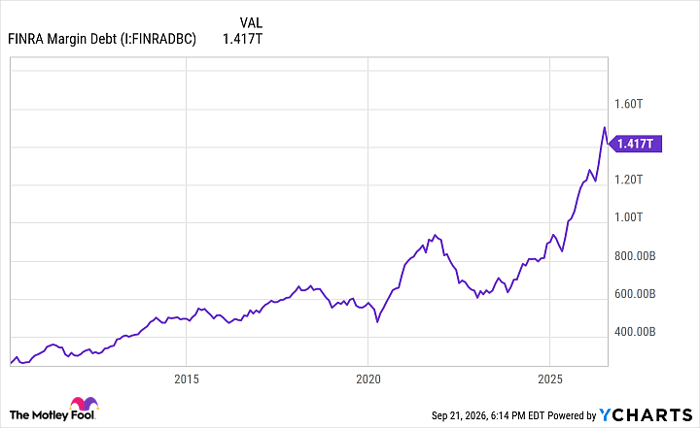
FINRA Margin Debt data by YCharts
This, in and of itself, doesn't inherently mean a huge number of people are going to get out of the stock market altogether. As someone who was in the industry back in 2007 and even all the way back in the 1990s, I'd say this sort of unquestionable confidence can and eventually does come back to haunt investors, and particularly newcomers who don't fully appreciate just how devastating an ill-timed margin call can be. Such a reckoning will run a bunch of investors off for a while, and at this point, I think that reckoning is inevitably going to materialize sooner rather than later.
3. Better risk-versus-reward propositions
Perhaps more than anything, though, I believe the number of U.S. residents exposed to the stock market will ease back to a multiyear low of 54% -- last seen in 2017, on the way up from 2016's figure of 52% -- largely because many investors recognize the broad market's valuation problem at this time and for the likely foreseeable future. By some inflation-adjusted measures, the S&P 500 (SNPINDEX: ^GSPC) is now nearly valued at a three-decade high, which is part of the reason both Vanguard and J.P. Morgan expect the S&P 500 to only earn a subpar average annualized return of between 6% and 7% for the next 10-plus years.
These investors aren't simply giving up on growing their money, though. They're just likely to find more promising prospects, perhaps like private investments, real estate, cryptocurrency, and others.
Seen it before, much like this
Again, none of this is to suggest a post-AI-boom lull, likely to be led by technology stocks, will be catastrophic (if one materializes at all). There's always a chance that the proliferation of AI could keep these stocks moving or rekindle those that recently stagnated.
The market's and investors' behavior is pretty predictable, even if it's not precisely so. This debt-driven boom has produced a great deal of fear of missing out, as we saw in 1999 and 2007. Interest rates are rising to combat inflation, as we also saw in those same pre-pullback years. This time around might be an exception. Even if we don't suffer a full-blown recession or bear market, the stage is certainly set for the lingering underperformance that Vanguard and J.P. Morgan anticipate for the foreseeable future.
So I'll say it again -- with the AI trades that have been setting the tone and the pace for so many other corners of the market now losing their luster, I think the ripple effect of this cooling is going to dial back the nation's participation in the stock market from 58% of its residents now to 54% by 2030, when only about 147 million American adults, versus 156 million at this time, will still own stocks and/or stock mutual funds.
Where to invest $1,000 right now
When our analyst team has a stock tip, it can pay to listen. After all, Stock Advisor’s total average return is 951%* — a market-crushing outperformance compared to 214% for the S&P 500.
They just revealed what they believe are the 10 best stocks for investors to buy right now, available when you join Stock Advisor.
See the stocks »
*Stock Advisor returns as of September 23, 2026.
JPMorgan Chase is an advertising partner of Motley Fool Money. James Brumley has positions in Alphabet. The Motley Fool has positions in and recommends Alphabet, JPMorgan Chase, and Nvidia. The Motley Fool has a disclosure policy.
Recommended Articles


