




Cisco Stock Price Forecast: Piper Sandler Price Target Cut Triggers Sell-Off, Can CSCO Stock Still Rise?
TradingKey - At the close on September 22, Eastern Time, Cisco (CSCO) stock suffered a notable sell-off, falling 4.52% on the day to an intraday low of $104.48 before closing at $106.41. Notably, the Nasdaq and the broader tech sector performed relatively stably that day, and networking equipment stocks such as Arista Networks (ANET) and Ciena (CIEN) did not experience a concurrent sharp decline, indicating that this adjustment was driven more by Cisco-specific factors rather than a systemic sell-off across the tech sector.
Why Did Cisco Stock Fall?
On the news front, the core reason for the decline in Cisco's stock price lies in Piper Sandler lowering Cisco's price target. The firm maintained a "Neutral" rating on Cisco but cut the price target from $132 to $125. Although $125 remains significantly above the current stock price, this downgrade further reinforced market concerns over Cisco's short-term upside potential and a possible slowdown in the growth rate of the networking equipment industry.
In addition to the analyst price target cut, previous substantial gains in the stock price and rising valuations may have also amplified profit-taking pressure. Following its year-to-date rally, Cisco's maximum gain exceeded 50%, indicating that investors had already priced in high expectations for the growth of Cisco's AI networking business. Therefore, even though the company's recent fundamentals remain strong, any marginal slowdown in growth expectations makes the stock price more susceptible to a correction.
Can Cisco Stock Still Rise?
According to the latest earnings report, Cisco's fourth-quarter revenue for fiscal 2026 reached $17.3 billion, up 18% year-over-year, while non-GAAP earnings per share (EPS) was $1.22, up 23% year-over-year. Full-year revenue reached $63.3 billion, up 12% year-over-year, with non-GAAP EPS at $4.33, up 14% year-over-year.
AI remains one of Cisco's most important growth drivers. In the fourth quarter, the company's product orders grew 35% year-over-year, with networking product orders rising 40%, marking the eighth consecutive quarter of double-digit growth. AI infrastructure orders from hyperscale cloud customers reached approximately $4 billion in the fourth quarter, bringing total AI infrastructure orders for fiscal 2026 to $9.3 billion; the company expects related revenue to reach approximately $7.5 billion in fiscal 2027.
Meanwhile, the company's guidance for fiscal 2027 remains relatively positive. Cisco expects full-year revenue of $72.2 billion to $73.4 billion and non-GAAP EPS of $5.05 to $5.11; first-quarter revenue is projected at $18 billion to $18.2 billion, with non-GAAP EPS of $1.32 to $1.34.
From a medium- to long-term stock price perspective, investors need to focus on two aspects: first, whether AI infrastructure revenue can increase from approximately $4 billion in fiscal 2026 to $7.5 billion in fiscal 2027 in line with company expectations; second, whether the rapidly growing AI hardware business can maintain an overall gross margin of around 65% while expanding revenue. If AI orders continue to grow and margins stabilize, the stock price may receive support to continue rising.
Cisco Stock Price Technical Analysis
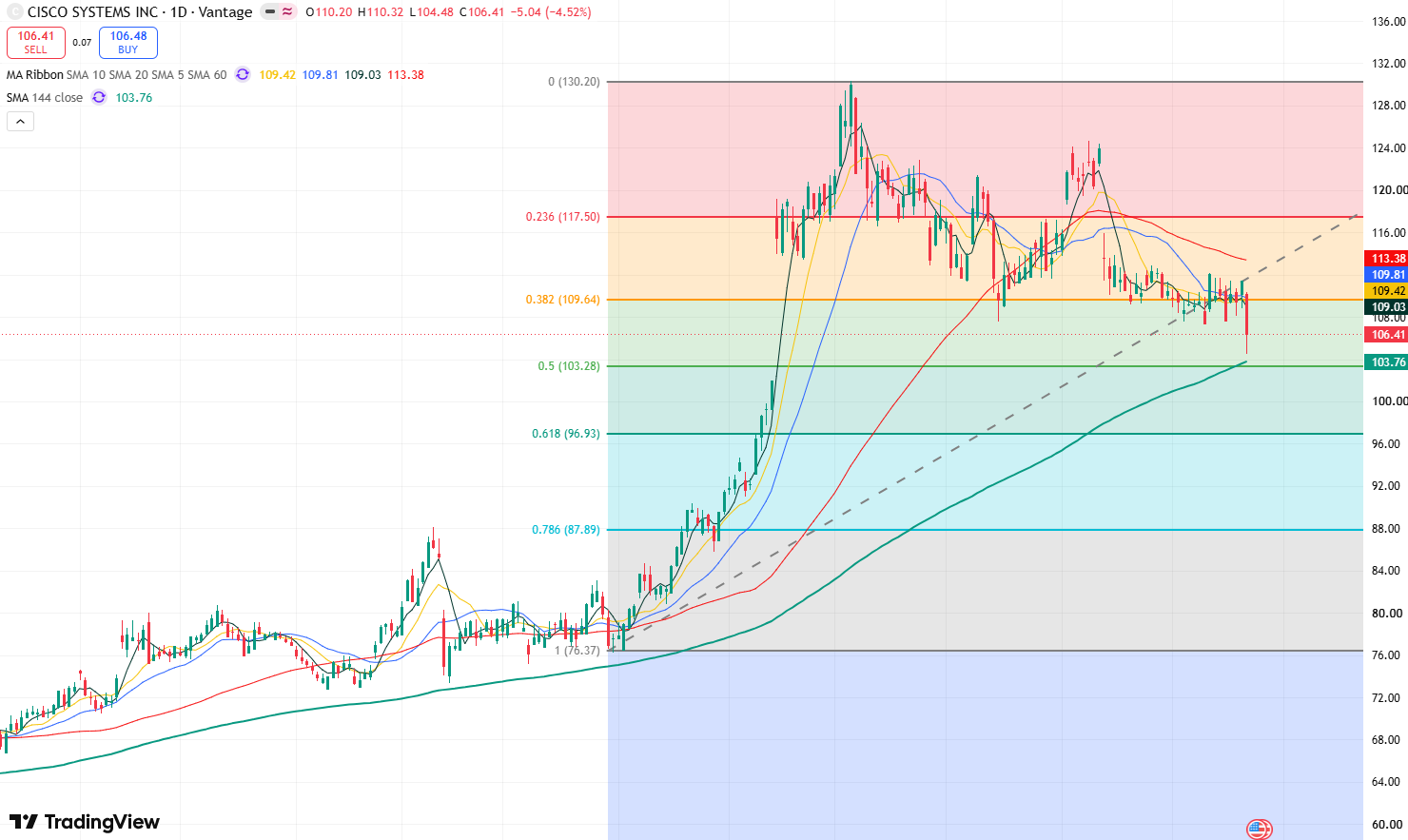
Cisco daily stock price chart, Source: TradingView
Looking at Cisco's daily stock price chart, the stock fell on Tuesday, breaking below the 5-day, 10-day, and 20-day moving averages consecutively. The candlestick structure may have weakened, and the stock price could continue to pull back in the short term.
Currently, the stock price is approaching the 144-day moving average ($103) and the $103-$100 support zone, where confluent support may form. If the stock price stabilizes above $103, it may experience a short-term technical rebound, with the primary target testing the $107-$110 range. A strong breakout and holding above $110 would open up upside room toward $120.
Conversely, if the stock price falls below $100, it may decline further toward around $97. If this level fails to hold, the stock could pull back deeper toward the $88-$90 range.
Recommended Articles


