




End of an Era: 3 Investment Lessons from Warren Buffett That Every Investor Should Follow
Key Points
He's one of the greatest investors of all time and leaves behind some great investment lessons.
Despite being a stock picker, the Oracle of Omaha was a big proponent of index investing.
- 10 stocks we like better than Vanguard S&P 500 ETF ›
The Warren Buffett era at Berkshire Hathaway (NYSE: BRKA) (NYSE: BRKB) has officially come to a close. After relinquishing the CEO spot at the start of the year, Buffett has also decided to step down as chairman. His son, Howard Buffett, who has been a director of the insurance conglomerate since 1993, will take over as chairman.
Nicknamed the Oracle of Omaha, Buffett is regarded as one of the world's top investors. Let's look at three lessons investors can take from him and apply to their investing strategy.
Missed AI’s "Act 1"? Act 2 Could Be 15x Bigger. Most investors think they missed the AI boat because they didn't buy Nvidia in 2005. But according to our analysts, we’re only at the end of "Act 1"—the R&D phase. "Act 2" is the global rollout. Continue »
Make an S&P 500 ETF a core holding
Despite being a great stock picker, Buffett is also a big fan of index investing. In fact, in 2007, he famously issued an open challenge that an investment in an S&P 500 (SNPINDEX: ^GSPC) index fund would beat a group of handpicked hedge funds over the next decade. Ted Seides of Protégé Partners took the $1 million bet, investing in five funds-of-funds, which are funds that invest in other funds.
The bet spanned from 2008 to the end of 2017. The hedge funds got off to a good start, as the S&P 500 index fell 37% in the first year, which was the start of the housing collapse. However, by the end of the 10 years, the S&P 500 had returned more than 125% versus a roughly 36% return for the hedge funds.
One of the big reasons Buffett was confident in his bet was fees. Actively managed funds eat up a lot of investor returns with high fees, while S&P 500 index funds generally have minuscule fees. This gives index funds a big advantage over time.
The other great thing about market-cap-weighted index funds is that they let their long-term winners ride, which is something Buffett is also famous for. For example, he's held Coca-Cola (NYSE: KO) stock since 1988 and never sold a share. This flies in the face of how most professional investors operate, quickly selling winners and adding to losers.
My favorite S&P 500 index exchange-traded fund (ETF) to invest in is the Vanguard S&P 500 ETF (NYSEMKT: VOO), which has a slim 0.03% expense ratio and is easily traded.
Buy durable businesses with wide moats
Another great lesson from Warren Buffett is to buy stocks in companies with durable businesses and wide moats. These are the companies that compound their earnings over long periods of time and see their intrinsic values consistently rise.
These aren't always the sexiest businesses with rapid revenue growth or companies riding the latest trend. Instead, these are companies that have captured clear advantages in the market and steadily compound their earnings over time.
Buffett's top holdings are all great examples of these types of businesses. Coca-Cola has created a huge moat through its brand recognition and unmatched global distribution network, while its asset-light business model, in which it sells syrup to bottlers, lets it continue to invest in advertising to keep its brand front and center.
Apple's (NASDAQ: AAPL) walled-garden ecosystem, meanwhile, locks in its affluent customer base, which provides a strong stream of high-margin services revenue that continues to grow year after year. Finally, Alphabet's (NASDAQ: GOOGL) (NASDAQ: GOOG) distribution and two-sided ad network give it a huge moat in search/AI discovery, while its custom chip business provides it with a big economic edge in its cloud computing business.
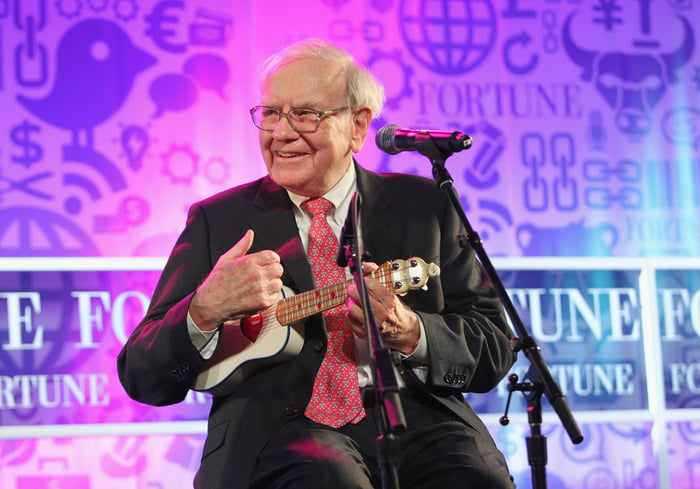
Image source: Getty Images.
Buy low, sell high
Buffett famously said, "Be fearful when others are greedy and greedy when others are fearful." This is great investing advice that largely centers on valuation and emotions.
Simply put, don't chase stocks when their valuations are high and trim stakes when valuations get stretched. Instead, buy stocks with good businesses when they go on sale, and look for bargains during bear markets and market pullbacks.
Should you buy stock in Vanguard S&P 500 ETF right now?
Before you buy stock in Vanguard S&P 500 ETF, consider this:
The Motley Fool Stock Advisor analyst team just identified what they believe are the 10 best stocks for investors to buy now… and Vanguard S&P 500 ETF wasn’t one of them. The 10 stocks that made the cut could produce monster returns in the coming years.
Consider when Netflix made this list on December 17, 2004... if you invested $1,000 at the time of our recommendation, you’d have $387,158!* Or when Nvidia made this list on April 15, 2005... if you invested $1,000 at the time of our recommendation, you’d have $1,365,749!*
Now, it’s worth noting Stock Advisor’s total average return is 932% — a market-crushing outperformance compared to 211% for the S&P 500. Don't miss the latest top 10 list, available with Stock Advisor, and join an investing community built by individual investors for individual investors.
See the 10 stocks »
*Stock Advisor returns as of September 21, 2026.
Geoffrey Seiler has positions in Alphabet and Vanguard S&P 500 ETF. The Motley Fool has positions in and recommends Alphabet, Apple, Berkshire Hathaway, and Vanguard S&P 500 ETF. The Motley Fool has a disclosure policy.
Recommended Articles


