




SanDisk Stock Forecast: S&P 100 Entry Meets AI NAND Boom at $1,805 Resistance
TradingKey - SanDisk (NASDAQ: SNDK) closed last week at $1,791.82, a 10.99% gain. SNDK joins the S&P 100 effective prior to the market open on September 21. The inclusion can create index-tracking demand as passive funds rebalance to match the index. Recent trends indicate that SNDK is greatly benefitting from improved NAND prices and increases in data center demand. Prices are likely to pull back from current levels given the overbought condition of SNDK.
S&P 100 Inclusion Adds a Fresh Catalyst
Operating businesses are not typically impacted by index additions or deletions. Sandisk’s underlying business does not change because of the S&P 100 addition, although the share-price impact is uncertain. What is likely to occur is that funds tracking the S&P 100 will need to add SNDK shares in order to keep their portfolios in line with the index.
This is more of an opportunistic, short-term Catalyst for me, as I view Sandisk’s (SNDK) current catalyst potential more favorably. Sandisk rallied almost 11% on Friday. I see the bigger picture question here being, can Sandisk’s earnings justify its current valuation?
NAND Pricing Has Transformed SanDisk's Earnings
For the company’s fourth quarter, ended July 3, 2026, Sandisk reported revenue of $8.97 billion, which was up 51% from the previous quarter. Management attributed approximately two-thirds of the sequential revenue growth to higher NAND pricing and one-third to higher volume. Sandisk reported GAAP net income of $6.90 billion, or $43.97 per diluted share, while non-GAAP EPS was $39.25. Gross margin for the quarter was 84.6%.
For the full year, Sandisk reported revenue of $20.25 billion, with non-GAAP earnings of $70.88 per share.
While Sandisk benefitted from higher prices and a more favorable NAND supply mix, it created significant operating leverage for the business, and higher earnings for Sandisk. However, higher prices can mean that earnings are more negatively correlated to lower, average NAND prices.
Data Center Growth Is Becoming the Core Story
Q4 Data Center revenue more than doubled sequentially to $2.98 billion. Revenue for the full year more than tripled to $5.15 billion. These numbers highlight that SanDisk has moved beyond its traditional storage device business for PCs and other consumer electronic devices.
Inference processing of AI models requires the storage of large datasets and model parameters. It also requires the storage of Retrieval Workloads and other datasets. SanDisk further projects that by 2030, the total addressable market for enterprise data-center flash could reach over 1.2 zettabytes. SanDisk has also stated that it expects favorable trend in the business mix, due to the increasing adoption of AI.
Q1 Guidance Keeps the Bar Extremely High
SanDisk projects that for the first quarter of fiscal 2027, it would generate revenue in the range of $10.3 to $10.8 billion and report non-GAAP EPS in the range of $44 to $46. Based on the guidance, the Company expects revenue would grow by approximately 18% from the previous quarter. Management also expects that favorable conditions in the NAND market would continue, resulting in non-GAAP gross margins of 83-85% in the quarter.
As a stock owner, I am also focused on the non-GAAP gross margins. In the current environment of expansion in NAND prices, if margins continue to be in the mid-80% range, SanDisk would be able to deliver earnings well above the historical norms. Declining gross margins would indicate an adverse change in the industry conditions and a potential threat to the long-term growth.
Long-Term Agreements Could Reduce Cyclicality
During its most recent Investor Day, SanDisk revealed details about its New Business Model (NBM) agreements. The company has 10 NBM agreements across eight customers, representing more than 50% of SanDisk’s anticipated bit shipments for FY2027 and approximately 66% of its bit shipments for FY2028. Previously, the company announced it had signed or amended 10 NBM agreements; however, these do not represent 10 different customers.
These NBM contracts include committed volume, minimum financial guarantees, and pricing that includes fixed and variable elements with floors and ceilings. The company has provided its model for FY2028, FY2029 and FY2030, highlighting revenue growth in the mid-to-high teens, approximately 80% non-GAAP gross margin and approximately 50% adjusted FCF margin. Management believes broader adoption of these type of contracts would diminish the volatility in the company’s cash flows.
HBF Adds AI Optionality, While Supply Remains the Main Risk
New details on high bandwidth flash (HBF) have emerged from the Open Compute Project. Sandisk and SK hynix released the first HBF technical specification through the Open Compute Project in August. HBF creates an opportunity to architect AI systems with larger flash memory capacity. Before HBF becomes a major revenue stream, I will view it as optionality. Traditionally, the view on optionality is that it has a negligible impact on EPS, whereas I believe HBF has emerging, but real, potential to positively impact EPS in the future.
Returning cash to shareholders via buybacks is another way SanDisk creates value. SanDisk had $15.5 billion of remaining share-repurchase authorization after spending about $4.5 billion under the $20 billion authorized since separation.
The major risk to SanDisk remains NAND supply. Chinese company CXMT has plans to enter the NAND market and may ease memory constraints. With lower average costs, marginal cost producers of memory may incentivize additional capacity to normalize pricing in the memory market.
SanDisk Technical Analysis: SNDK Tests $1,805 Resistance as Harmonic Target Completes
SanDisk's latest close is at $1,791.82, almost at the chart per at $1,792.67. The 1 hour trend is bullish after the bounce from $1,503.58. However, price is currently challenging the $1,805.30 to $1,820.00 area which is the projected top of the D-wave of a Harmonic pattern.
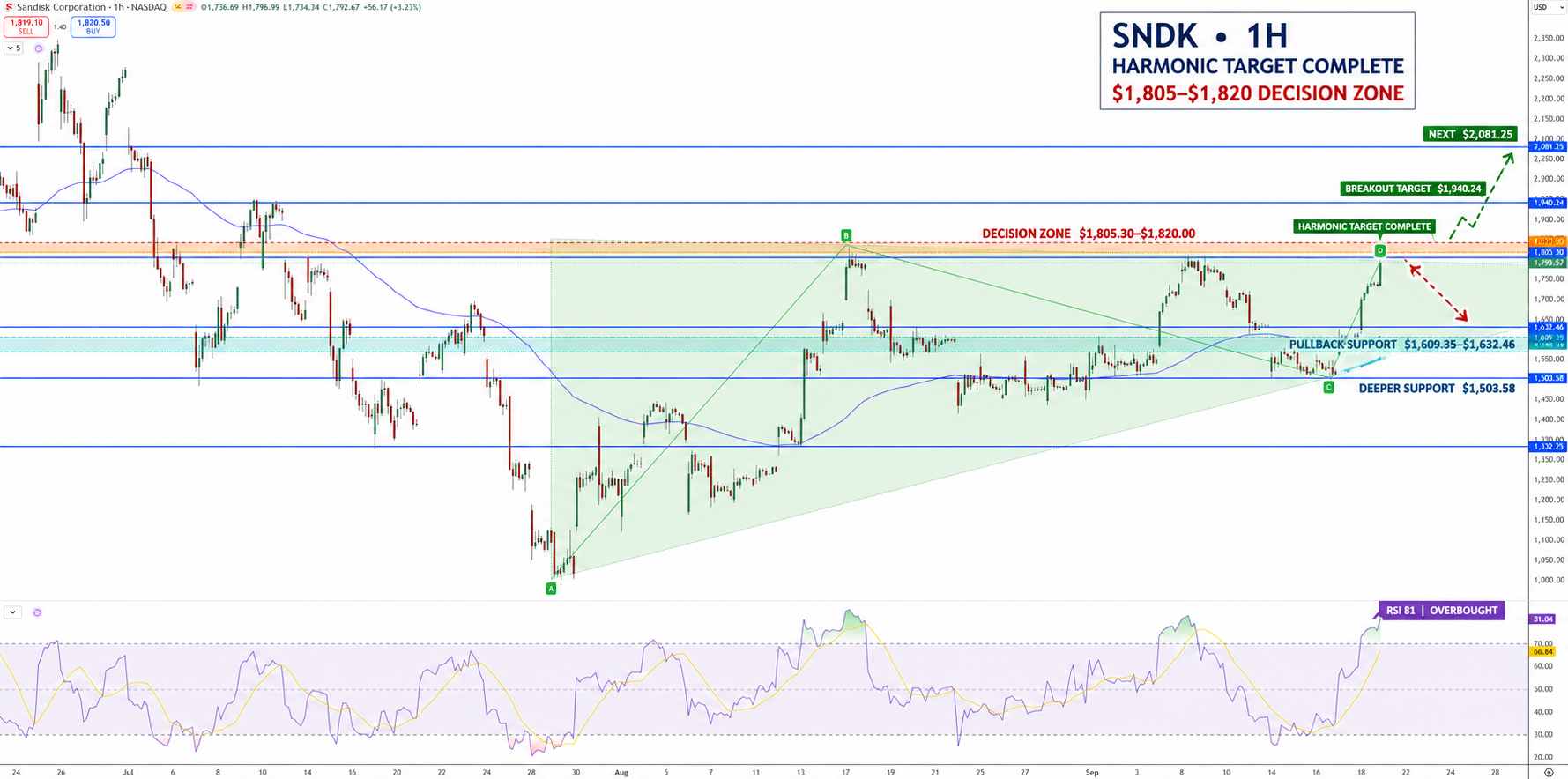
SanDisk Stock Price Chart - Source: Tradingview
RSI is at 81. A reading at this level is firmly overbought. That increases the risk of a reversal or profit taking, although an overbought RSI by itself does not confirm that the uptrend has ended.
Until the $1,805.30 to $1,820.00 area closes on the upside, the breakout should be considered unconfirmed. If the area does close on the upside, the next target area should be in the $1,940.24 to $2,081.25 area. If resistance holds, support should first be looking at $1,632.46 to $1,609.35 area.
Regardless of this analysis, my bias is still bullish. However, with RSI this high and above 80, traders should look to take profits if stop loss orders are not in place. A decisive break below the $1,632.46-$1,609.35 support area would materially weaken this bullish analysis.
Key Levels
• Latest completed close: $1,791.82
• Major support levels: $1,632.46 to $1,609.35, then $1,503.58
• Major resistance levels: $1,805.30 to $1,820.00
• RSI: approximately 81, firmly overbought
• Breakout targets: $1,940.24, then $2,081.25
Why is SanDisk stock in focus now?
Strong NAND pricing, Data Center demand and the addition to the S&P 100 are the main catalysts for SanDisk. Data Center revenue more than doubled in Q4, and management expects revenue to continue to rise in Q1 of fiscal 2027.
What level confirms a stronger SNDK breakout?
A sustained hourly close above $1,805.30 to $1,820.00 would confirm that buyers are absorbing the harmonic completion zone and could open the path toward $1,940.24. Failure there, especially with RSI above 80, would keep pullback risk elevated.
Bottom Line
Recent bullishness in SNDK is supported by several fundamental and technical factors. AI and HPC centered datacenter demand is bullish, while the recent addition of SanDisk to the S&P 100 provides a separate index-related catalyst. A highly bullish case could be built by considering the recent customer contracts, recent bullishness in the NAND industry, and a sizable buyback. The bears cite NAND supply-cycle risk because current margins depend heavily on tight supply and high pricing, which could normalize if industry capacity expands. Long SNDK as long as it trades above $1,632.46-$1,609.35. The harmonic completion zone is at $1,805.30 to $1,820.00. The upside price objective is $1,940.24.
Recommended Articles


