




Costco Stock Price Forecast: Drops to $895 Ahead of Earnings, Is COST a Buy Now?
TradingKey - Costco (COST) will report its fourth-quarter fiscal 2026 financial results after the U.S. market close on September 24. FactSet expects the company's revenue for the quarter to be $94.86 billion and earnings per share to be $6.53. In addition to earnings performance, membership numbers, renewal rates, and whether management signals a special dividend will also be key factors influencing the stock price.
Ahead of the earnings release, Costco's stock performance has been weak. As of September 18, the company's stock closed at $895.31, down more than 2% over the past five trading days and pulling back about 18% from its record high set in May.
What to Watch in Costco's Earnings Report
Costco has already disclosed its fourth-quarter sales data in advance, so the main suspense of this earnings report is not revenue, but whether these sales can be translated into higher profits.
The company's fourth-quarter net sales reached $93.9 billion, up 11.3% year-over-year, while US same-store sales grew 10.7%. Excluding the impact of gasoline prices and exchange rates, overall comparable sales rose 6.7%, and digital channel sales grew 19.8%. Full-year net sales for fiscal 2026 reached $297.3 billion, up 10.2% year-over-year. Costco's official sales figures show that customer traffic and online demand continue to grow.
Because the market revenue consensus of $94.86 billion is close to the reported net sales of $93.9 billion, the final result will depend largely on membership fee revenue. Investors need to focus on paid member counts, renewal rates in the US and Canadian markets, and whether the proportion of higher-tier Executive Members continues to rise.
Membership fees are an important source of Costco's earnings quality. The company attracts customers through low product markups and then generates stable profits by leveraging high renewal rates and member scale. This model not only strengthens customer retention, but also enables Costco to negotiate lower prices from suppliers based on its massive purchasing volume.
Will Special Dividends Be a Potential Growth Catalyst?
Beyond earnings reports, a special dividend may be a more direct potential growth catalyst for Costco's stock price.
Costco indeed has a history of periodically distributing large special dividends to shareholders. The company paid a special dividend of $5 per share in 2015, raised it to $7 in 2017, and further increased it to $10 in 2020; most recently, it announced a $15 per share special dividend in December 2023, which was paid in January 2024.
Therefore, nearly three years will have elapsed by 2026 since the last special dividend. Market participants are now beginning to bet once again on the next substantial payout.
Bank of America believes that Costco may announce a special dividend in the coming quarters and estimates the company's fiscal fourth-quarter cash balance at around $20.4 billion. Meanwhile, Barron's cited market perspectives noting that, if extrapolated from the growth pattern of previous special dividends, this round could reach approximately $22 per share.
In addition, historical timing suggests that Costco's past special dividends were not distributed on a strictly fixed cycle; thus, one cannot simply assume that 'a payout is guaranteed after three years.' However, if the company indicates in its earnings report or conference call that its cash reserves continue to grow, the market may interpret this as a signal of greater potential for future capital returns.
Is Costco Worth Buying Now?
Costco's core competitive advantages remain solid. Its membership model generates highly recurring revenue, its limited product selection enhances purchasing scale and inventory efficiency, and its Kirkland private label further boosts pricing power. During economic slowdowns, consumers typically prioritize value for money, which also gives Costco certain defensive attributes.
The main issue lies in its valuation. Even though the stock price has pulled back about 18% from its peak, Costco's current P/E ratio remains near 45 times, significantly above the S&P 500 Index level of about 23 times. Such a high valuation implies that the company must not only deliver solid performance, but also maintain simultaneous improvements in membership growth, same-store sales, and profit margins. Should renewal rates decline or earnings fall slightly short of expectations, the stock price could remain under pressure.
According to data from TipRanks, among the 20 analysts covering Costco in the past three months, 15 rate it a Buy, 4 recommend Hold, and 1 recommends Sell. The average 12-month price target is $1,088.89, with a high of $1,275 and a low of $781.
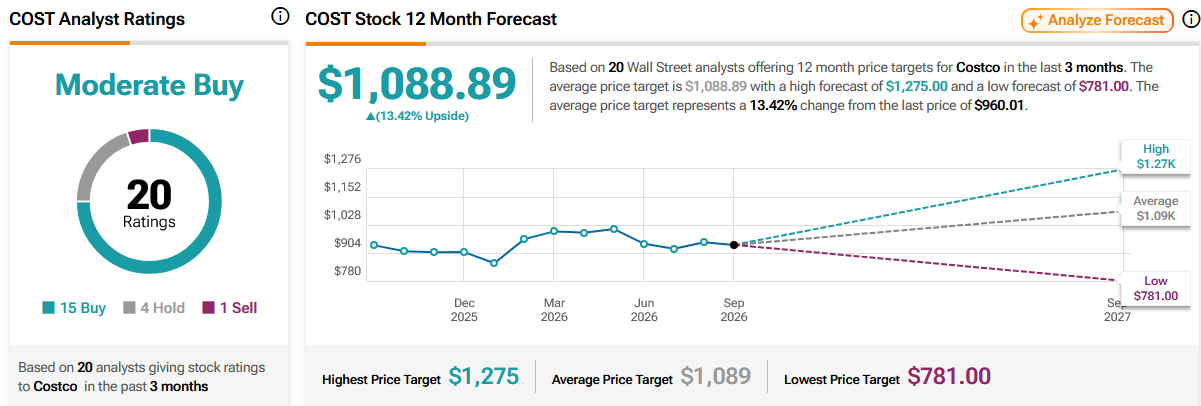
Source: TipRanks
Costco remains a high-quality retailer worthy of long-term attention, but a price around $895 cannot be considered significantly undervalued. For investors focused on a margin of safety, taking a heavy position all at once prior to earnings carries high risk; a more reasonable approach is to await confirmation from earnings and membership data, or to build positions in tranches.
Recommended Articles


