




Portfolio Diversification Will Matter More Than Stock Picking by 2030: Here's Why I'm Spreading Across 11 Sectors Now
Key Points
It's not been too difficult to be a stock picker of late, with most of the best-known names being led higher by rising artificial intelligence stocks.
As has been observed so often in the past, however, these stocks are getting ahead of themselves, setting the stage for a chaotic reset.
Investors would be wise to begin mentally preparing for this impending change now, even if the gradual shift is at least a while down the road.
- 10 stocks we like better than S&P 500 Index ›
The past few years have been fantastic for investors willing to hold artificial intelligence stocks through their inherent volatility.
Since the end of 2022 (shortly after the launch of ChatGPT sparked an AI arms race of sorts), the so-called "Magnificent Seven" stocks like Nvidia and Alphabet have gained an average of nearly 250%, largely spurred by these companies' AI-driven growth. For comparison, the S&P 500 (SNPINDEX: ^GSPC) is only up a little less than 100% for this time frame, while removing the Magnificent Seven's stocks from the index dials the S&P 500's gain for this stretch down to only 60%.
Missed AI’s "Act 1"? Act 2 Could Be 15x Bigger. Most investors think they missed the AI boat because they didn't buy Nvidia in 2005. But according to our analysts, we’re only at the end of "Act 1"—the R&D phase. "Act 2" is the global rollout. Continue »
In other words, a small number of stocks are responsible for a huge part of the overall market's recent gains. You just needed to own some of them long enough during this time frame to benefit. Don't be surprised if this narrow leadership remains the case for a while longer, either, as the artificial intelligence revolution continues to mature.
Just understand that the way things are right now is relatively unusual, and not the way things usually work for the market. I've got a funny feeling that once the AI-driven dust settles and these tickers aren't dragging the broad market higher, the return to normalcy will reward smart portfolio management more than individual stock picking. It wouldn't be wrong to begin mentally preparing for that shift now.
What is portfolio diversification?
If you've been in and around the stock market for any length of time, then you've likely heard the term. However, what exactly is portfolio diversification?
In simplest terms, diversifying your portfolio just means holding several different stocks -- and even several different kinds of investments -- as a means of reducing your overall risk. While owning more stocks doesn't circumvent the impact of a sweeping, marketwide sell-off, it does reduce the risk of a setback from one of your holdings devastating your entire portfolio's value. For reference, The Motley Fool suggests owning no less than 50 individual stocks. That's a lot!
Sure, it also limits your net upside should one or more of your stock picks soar. Bigger bets make bigger bucks, after all.

Image source: Getty Images.
You don't diversify to play aggressive offense, though. You diversify to defend your portfolio from the unknown, or more specifically, the unknowable. Most stumbles are never predicted. You have to plan for them before they happen, in case they happen (which they always will, eventually).
Change is so normal it's (sort of) predictable
So what's apt to change so much between now and 2030 that diversifying by then rather than continuing to prioritize stock-picking is the smart-money move?
It's not intuition nearly as much as it's observation; over nearly three decades in this business, I've seen a handful of patterns play out over and over again. One of the big ones is the rapid rise of a particular industry's stocks that leads the whole market higher, followed by a reset that results in relatively uneven and uncorrelated corrections of all 11 of the market's major sectors.
The two top-of-mind resets are 2000's crash of most of the then-hot dot-com names, and the implosion of a bunch of banking and real estate-related stocks following 2008's subprime mortgage meltdown. These certainly aren't the only times we've seen this action, though.
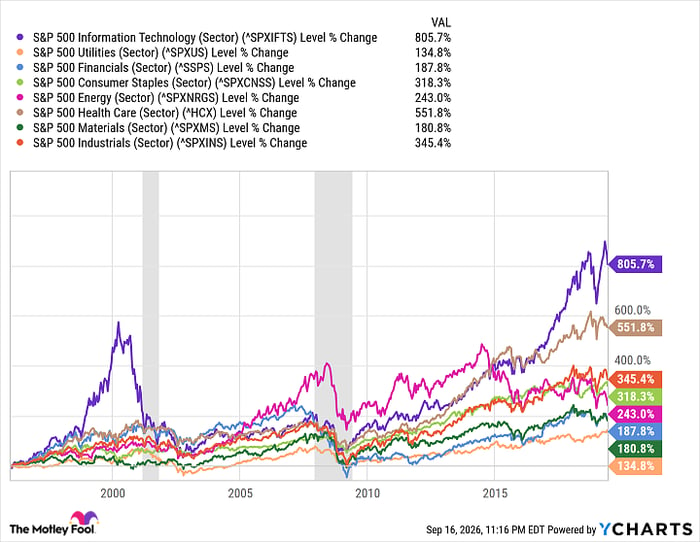
^SPXIFTS data by YCharts
Most of the market's imbalance this time around is, of course, being driven by the technology sector, and artificial intelligence stocks in particular. Nearly 40% of the value of the Vanguard S&P 500 ETF (NYSEMKT: VOO) and SPDR S&P 500 ETF Trust (NYSEMKT: SPY) meant to mirror the S&P 500 comes from technology holdings.
At the other end of the spectrum, utility stocks currently make up less than 2% of these two funds' current values, while energy stocks -- despite sky-high crude prices -- account for less than 4% of the S&P 500's value at this time. These allocations are never perfectly even, but this is wildly uneven. If you were looking for simple and adequate diversification, S&P 500 index-based funds just don't offer it right now.
And like I said, I've seen this before, with the same basic outcome each time. The big rally led by one sector is relatively uniform. The next stage is a bit chaotic. The technology industry's brewing headwind will work against other sectors as well, but won't impact all of them. Indeed, a few groups may even benefit from this shift. The only catch is that we don't yet know which is which. We have to prepare for all contingencies by owning better-balanced exposure to all sectors.
I also don't know that 2030 is the exact pivot date either, by the way. It could be sooner or later. I'm just giving the artificial intelligence mania bit more time to run its course before reaching the less-exciting maturity phase of its lifecycle. I'm also assuming increasingly higher interest rates will increasingly prove to be a drag on the economy. That's why it's also likely to be more of a gradual shift than a decisive pivot... which is OK. You'll want to ease your way into your new portfolio over time anyway. Just make sure you're mentally preparing now for this impending change in how the overall market works.
And don't worry about this ho-hum period on the longer-term radar. It will eventually cede back to a stock-picking-driven one as well.
Should you buy stock in S&P 500 Index right now?
Before you buy stock in S&P 500 Index, consider this:
The Motley Fool Stock Advisor analyst team just identified what they believe are the 10 best stocks for investors to buy now… and S&P 500 Index wasn’t one of them. The 10 stocks that made the cut could produce monster returns in the coming years.
Consider when Netflix made this list on December 17, 2004... if you invested $1,000 at the time of our recommendation, you’d have $387,158!* Or when Nvidia made this list on April 15, 2005... if you invested $1,000 at the time of our recommendation, you’d have $1,365,749!*
Now, it’s worth noting Stock Advisor’s total average return is 932% — a market-crushing outperformance compared to 211% for the S&P 500. Don't miss the latest top 10 list, available with Stock Advisor, and join an investing community built by individual investors for individual investors.
See the 10 stocks »
*Stock Advisor returns as of September 20, 2026.
James Brumley has positions in Alphabet. The Motley Fool has positions in and recommends Alphabet, Nvidia, and Vanguard S&P 500 ETF. The Motley Fool has a disclosure policy.
Recommended Articles


