




2 Uranium Stocks to Buy Before the Next Nuclear Supercycle
Key Points
Cameco, the world’s second-largest uranium miner, is finally growing again.
Uranium Energy’s cleaner, cheaper extraction methods are becoming more popular.
- 10 stocks we like better than Cameco ›
Uranium's price has always been pegged to the nuclear energy market. That's why many uranium stocks crumbled in the decade after the Fukushima disaster in 2011, which drove many countries to throttle the expansion of their nuclear programs.
From June 2007 to Nov. 2016, uranium's spot price plummeted from its peak of $136 per pound to a 12-year low of $18 per pound. That decline forced many uranium miners and companies to downsize their operations to stay solvent.
Missed Nvidia in 2009? This Rare Signal Is Flashing Again. In 2009, a "Double Down" signal flashed for a little-known chipmaker called Nvidia. For the first time in years, that same "Total Conviction" signal is flashing for a company 1/100th the size of Nvidia. Continue »
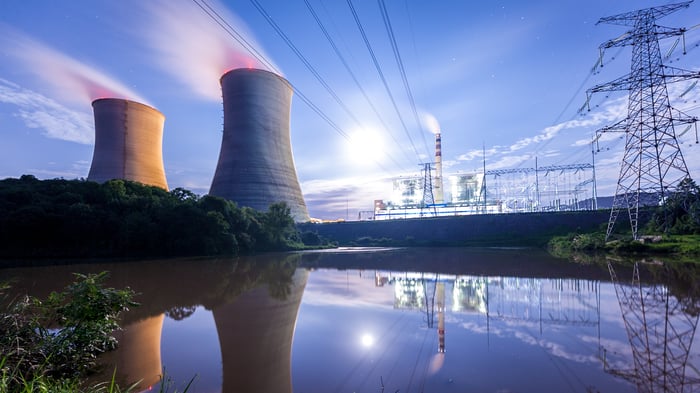
Image source: Getty Images.
But by the end of this July, uranium's spot price had risen back to $86.38 per pound. The rapid growth of the power-hungry cloud and AI markets, new decarbonization initiatives, and the adoption of safer nuclear technologies drove that recovery. If you want to profit from that trend, you should buy Cameco (NYSE: CCJ) and Uranium Energy (NYSEMKT: UEC).
Why will Cameco and Uranium Energy keep growing?
Cameco, a Canadian company, mined 15% of the world's uranium in 2025. It's the second-largest uranium miner after Kazakhstan's Kazatomprom (OTC:NATK.Y), and operates uranium mines and mills in Canada, the U.S., and Kazakhstan.
Cameco also partnered with Brookfield Asset Management (NYSE: BAM) to acquire Westinghouse Electric, one of the world's largest nuclear technology companies, in 2023. That takeover reduced Cameco's direct exposure to volatile uranium prices and made it a more diversified play on the nuclear energy infrastructure market.
Uranium Energy is a smaller Texas-based miner that pumps an oxygen-enriched solution into the earth to dissolve and extract uranium as a cheaper, greener alternative to underground and open-pit mining. It primarily operates in the U.S., Canada, and Paraguay.
Unlike Cameco, which locks its customers into long-term, fixed-price contracts as a hedge against uranium's volatile price swings, Uranium Energy sells its output entirely at prevailing spot prices. The bold strategy enables Uranium Energy to benefit more from soaring uranium prices than Cameco, but it also causes it greater pain when uranium prices decline.
Why are both stocks still worth buying?
Bank of America expects uranium's spot price to rise to $130 per pound in 2027 as the nuclear supercycle heats up. The AI market's expansion, production bottlenecks, and the U.S. ban on Russian uranium could all drive that acceleration.
Cameco and Uranium Energy aren't cheap at 16 times and 52 times next year's sales, respectively. But if you expect uranium's spot price to soar and set new record highs over the next few years, it might be smart to buy these two best-in-breed uranium stocks today.
Should you buy stock in Cameco right now?
Before you buy stock in Cameco, consider this:
The Motley Fool Stock Advisor analyst team just identified what they believe are the 10 best stocks for investors to buy now… and Cameco wasn’t one of them. The 10 stocks that made the cut could produce monster returns in the coming years.
Consider when Netflix made this list on December 17, 2004... if you invested $1,000 at the time of our recommendation, you’d have $443,461!* Or when Nvidia made this list on April 15, 2005... if you invested $1,000 at the time of our recommendation, you’d have $1,307,633!*
Now, it’s worth noting Stock Advisor’s total average return is 973% — a market-crushing outperformance compared to 213% for the S&P 500. Don't miss the latest top 10 list, available with Stock Advisor, and join an investing community built by individual investors for individual investors.
See the 10 stocks »
*Stock Advisor returns as of August 26, 2026.
Bank of America is an advertising partner of Motley Fool Money. Leo Sun has no position in any of the stocks mentioned. The Motley Fool has positions in and recommends Brookfield Asset Management and Cameco. The Motley Fool has a disclosure policy.
Recommended Articles


