




Oil Is Below $70, but the Federal Reserve's June Inflation Forecast Has an Unpleasant Surprise in Store for Wall Street
Key Points
The effects of the Iran war pushed the U.S. inflation rate to a three-year high in May.
U.S. crude oil prices have tumbled in recent weeks, leading the Cleveland Fed to forecast a tamer trailing 12-month inflation rate in June.
However, Core Personal Consumption Expenditures (CPE), a favorite inflationary measure of the Fed, continues to climb, which is terrible news for an expensive stock market.
- 10 stocks we like better than S&P 500 Index ›
Roughly four weeks ago, the iconic Dow Jones Industrial Average (DJINDICES: ^DJI), broad-based S&P 500 (SNPINDEX: ^GSPC), and innovation-powered Nasdaq Composite (NASDAQINDEX: ^IXIC) all exploded to new highs. However, this rally doesn't tell the complete story on Wall Street at the moment.
Aside from the artificial intelligence (AI) infrastructure build-out, no topic is garnering more attention than inflation. Although crude oil prices have come down in a big way over the last six weeks, the Federal Reserve's latest June inflation update has an unpleasant surprise in store for Wall Street.
Where to invest $1,000 right now? Our analyst team just revealed what they believe are the 10 best stocks to buy right now, when you join Stock Advisor. See the stocks »

Image source: Getty Images.
A historic energy supply disruption has lifted U.S. inflation to a three-year high
While President Donald Trump's tariffs are still providing modest upward pressure on select goods, the bulk of the inflationary pressure felt by consumers and businesses this year has come from the Trump-led Iran war.
Four months ago, Trump gave the U.S. military the green light to attack Iran. The latter responded by effectively shutting down the Strait of Hormuz to commercial vessels, thereby halting the daily flow of roughly 20 million barrels of petroleum liquids. This represents the largest energy supply disruption in modern history.
BREAKING: May CPI inflation rises to 4.2%, the highest level since April 2023.
-- The Kobeissi Letter (@KobeissiLetter) June 10, 2026
Core CPI inflation also rises to 2.9%, the highest since September 2025.
Inflation in the US is officially back above 4% and more than double the Fed's target.
Odds of Fed rate hikes are rising.
The subsequent reaction in energy markets was violent. West Texas Intermediate (WTI) crude oil surged from $67/barrel to more than $112/barrel in under six weeks. In turn, gas prices rose at the fastest pace in more than three decades.
In February, U.S. trailing 12-month (TTM) inflation clocked in at just 2.4%. By May, soaring energy prices pushed TTM inflation to 4.2%, the highest level since April 2023.
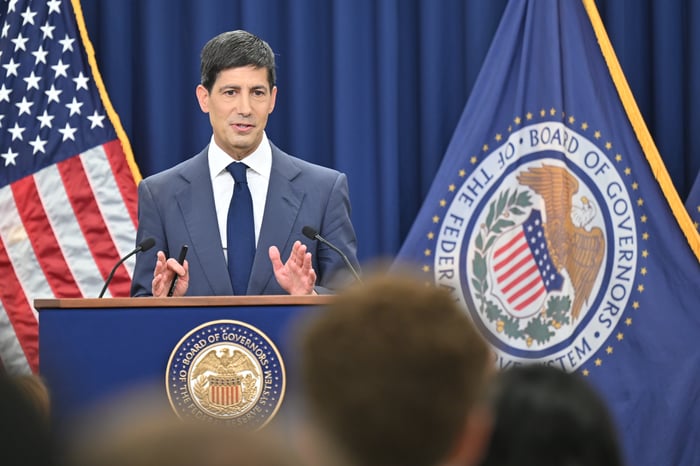
Fed Chair Kevin Warsh delivering remarks. Image source: Official Federal Reserve Photo.
WTI crude is below $70, but Core PCE continues to climb
The silver lining for consumers is that crude oil prices have tumbled in recent weeks. The first close below $70/barrel for WTI crude since the start of the Iran war has Wall Street and investors excited about the prospect of lower inflation.
According to the June 26 update from the Federal Reserve Bank of Cleveland's Inflation Nowcasting tool, the Consumer Price Index is expected to retrace slightly to 3.96% (over the TTM) in June. But this doesn't mean inflation is yesterday's news or that the Fed can take interest rate-hike talk off the table.
The Cleveland Fed's forecasting tool points to Core Personal Consumption Expenditures (PCE), one of the central bank's favorite inflationary measures, rising even further to 3.43% in June. While WTI crude oil trading below $70 definitely helps, the argument in favor of interest rate hikes remains sound.
Very hawkish dot plot.
-- Nick Timiraos (@NickTimiraos) June 17, 2026
Nine out of 18 officials have at least one hike this year (and six of those 9 have *multiple hikes*).
Only one person has a cut this year, and one participant (presumably Warsh) didn't submit an SEP
The statement gets a complete writethru from top to... pic.twitter.com/KRwatpTFOP
The latest Summary of Economic Projections, more commonly known as the dot plot, also points to higher interest rates. Out of the 18 Federal Open Market Committee (FOMC) members who submitted a federal funds target rate forecast, nine foresaw rates moving higher before the year ends.
In addition to the FOMC foreshadowing a possible shift to monetary tightening, Fed Chair Kevin Warsh's voting record lumps him firmly in the monetary hawk camp. As an FOMC member during the financial crisis, Warsh repeatedly cautioned his peers against lowering interest rates, fearing that doing so would ignite inflation.
Interest rate hikes remain firmly on the table, which is terrible news for a historically expensive stock market whose growth has been driven by the partially debt-financed AI build-out.
Should you buy stock in S&P 500 Index right now?
Before you buy stock in S&P 500 Index, consider this:
The Motley Fool Stock Advisor analyst team just identified what they believe are the 10 best stocks for investors to buy now… and S&P 500 Index wasn’t one of them. The 10 stocks that made the cut could produce monster returns in the coming years.
Consider when Netflix made this list on December 17, 2004... if you invested $1,000 at the time of our recommendation, you’d have $398,052!* Or when Nvidia made this list on April 15, 2005... if you invested $1,000 at the time of our recommendation, you’d have $1,181,688!*
Now, it’s worth noting Stock Advisor’s total average return is 892% — a market-crushing outperformance compared to 205% for the S&P 500. Don't miss the latest top 10 list, available with Stock Advisor, and join an investing community built by individual investors for individual investors.
See the 10 stocks »
*Stock Advisor returns as of June 30, 2026.
Sean Williams has no position in any of the stocks mentioned. The Motley Fool has no position in any of the stocks mentioned. The Motley Fool has a disclosure policy.
Recommended Articles


