




Quantinuum Once Rose 17%. Trump Doubles Down Again on Quantum Industry, Quantum Technology Has Become the Core Bargaining Chip in Great Power Rivalry
TradingKey - Following the Trump administration's previously announced plans to allocate $2 billion to nine quantum computing companies in exchange for equity stakes.
According to the latest reports, U.S. President Donald Trump has signed two major executive orders in the field of quantum computing.
Boosted by the policy news, quantum concept stocks rallied today against the broader market. Arqit Quantum ( ARQQ) surged 36.32%, Quantinuum ( QNT) gained 14.91%, Infleqtion ( INFQ) climbed 12.20%, SEALSQ Corp ( LAES) rose 6.13%, IBM Corp ( IBM) advanced 4.37%.
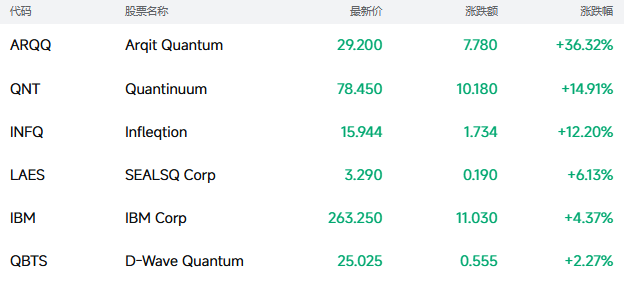
[Source: FutuBull]
It is worth noting that, despite the clear direction of policy benefits and capital injections, the commercialization timeline for general-purpose quantum computers remains lengthy.
Currently, multiple technical pathways coexist within the industry, and unified industry standards have yet to be established. Most pure-play quantum stocks are still in a high R&D investment phase and remain unprofitable, making their stock prices highly susceptible to news-driven volatility.
Key highlights of this Executive Order
In terms of tackling core technology bottlenecks, this executive order directs the White House Office of Science and Technology Policy to spearhead a multi-agency effort—collaborating with the Departments of Energy, Defense, Commerce, Intelligence, and NASA, alongside domestic companies and research institutes—to iteratively upgrade the national top-level quantum strategy and encourage collaborative innovation in industrial technology.
Concurrently, it launches a national-level quantum computer research and development initiative to complete computing power assessments, resource estimations, and technical standards formulation, striving to usher in a brand-new scientific research paradigm relying on self-developed quantum hardware and accelerate the commercialization of quantum technology. On the infrastructure front, a clear five-year timeline is set, requiring the full implementation of large-scale commercial deployments of quantum sensing and quantum communication networks, empowering sectors such as defense, industry, and energy.
To secure talent, the U.S. will expand its domestic technical talent pool through three main channels: vocational skills training, professional certifications, and a national quantum talent research institute. Furthermore, the Trump administration is simultaneously rolling out industrial chain support policies to build full-chain domestic manufacturing capabilities for quantum technology, leveraging dedicated fiscal funding to mitigate overseas supply chain risks.
What are the advantages of quantum computing?
The core advantage of quantum computing lies in its ability to perform tasks that classical computers cannot. Google's Willow quantum processor proved this in 2024: it solved a complex problem in five minutes that would have taken the world's top supercomputers, running continuously since the birth of the universe, to complete. This computational advantage is fundamentally suited for complex scenarios featuring massive variables and dynamically interacting units.
Its commercial value is primarily concentrated in the modeling of complex systems. Among these, simulating molecular structures to accelerate drug discovery, and modeling the decision-making behaviors of economic and financial agents to improve market forecasting accuracy, are currently the two most closely watched areas of real-world application.
Notably, quantum computers are not a replacement for general-purpose computing power. The high-volume, sequential, and low-complexity routine computational tasks handled by today's mainstream computers do not align with the technical characteristics of quantum computing, making it difficult for the latter to establish a competitive advantage in these scenarios.
Quantum technology has become a core bargaining chip in great power competition.
Quantum technology has become a strategic high ground in global technological competition, with the multinational race led by China, the United States, and Europe escalating rapidly. Countries are making comprehensive deployments across top-level policy design, R&D funding, and industrial implementation, extending the dimension of competition from the industrial economy into core areas of national defense and security.
China relies on its tens-of-billions-yuan National Laboratory for Quantum Information Sciences to drive systematic R&D, aiming for breakthroughs across the entire quantum technology chain. Meanwhile, the U.S. is employing a dual-track strategy of policy guidance and specialized projects; the Trump administration signed two executive orders in June to accelerate technology implementation while building a quantum cybersecurity defense. Within the sector, leading company Quantinuum has completed a $1.7 billion IPO, further accelerating the pace of industrialization.
Europe leads in overall public investment, with regional public funding—including the UK's—reaching nearly three times that of the U.S. Although the EU established a €5 billion dedicated fund in an attempt to retain local startups, top quantum unicorns such as IQM and Pasqal have still opted to list in the U.S., exposing Europe's shortcomings in commercializing and implementing these technologies.
Notably, because of its ultra-high-precision measurement capabilities, quantum computing could significantly impact national defense and security capabilities, becoming a core bargaining chip in the current technological rivalry among major powers.
Recommended Articles


