




The AI Trade Is Wobbling. Berkshire Hathaway Was Built for a Market Like This.
Key Points
Most of the market's top artificial intelligence stocks are suddenly struggling.
This weakness could trigger a shift away from riskier growth prospects to more proven, resilient, and reliable holdings.
Berkshire Hathaway offers this defensiveness, largely by offering access to a kind of holding that's typically inaccessible to average investors.
- 10 stocks we like better than Berkshire Hathaway ›
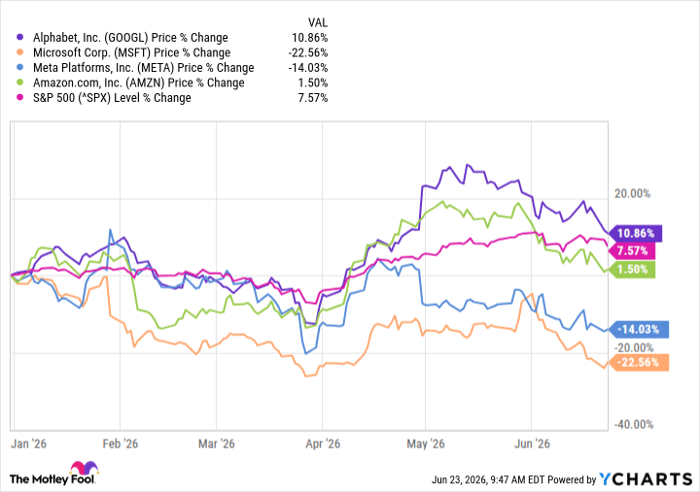
After months of stellar performances, artificial intelligence (AI) stocks like Alphabet and Amazon are finally starting to struggle. Alphabet shares are down 15% from their mid-May peak, in fact, with a big chunk of that setback stemming from the loss of two key AI executives to rivals OpenAI and Anthropic, respectively. Meanwhile, concerns regarding their AI spending plans have recently rekindled lingering weakness in Microsoft and Facebook parent Meta.
Where to invest $1,000 right now? Our analyst team just revealed what they believe are the 10 best stocks to buy right now, when you join Stock Advisor. See the stocks »
GOOGL data by YCharts
Broader talk of an artificial intelligence bubble is of course also circulating again. And sooner or later, these worries will be merited. Maybe that time is now.
For investors who diversify their portfolios with several different kinds of holdings, though, the risk of such setbacks is no big deal. One of the highest-quality investments at the other end of this spectrum is (still) Berkshire Hathaway (NYSE: BRKA) (NYSE: BRKB). And it's not too late to get in.
What Berkshire Hathaway offers
You know it as Warren Buffett's portfolio of hand-picked value stocks, which it largely still is. But this description understates what Berkshire Hathaway brings to the table regardless of the market's condition.
For instance, you may know Berkshire Hathaway holds several slow-moving but resilient defensive names like consumer goods powerhouse Coca-Cola and banking giant Bank of America, both of which are apt to continue paying their dividends no matter what the future holds. But did you also know $339.3 billion worth of the $397.4 billion in liquidity that Berkshire currently holds is actually parked in U.S. Treasury bills yielding just under 4%? That's not huge compared to the sort of returns stocks typically offer. If the current weakness from artificial intelligence stocks launches a more sweeping collapse of the rest of the market, though, a modest yield certainly beats capital losses.
Perhaps the most under-appreciated aspect of Berkshire Hathaway, however, which becomes monumentally important in the midst of market weakness, is the fact that roughly one-third of the conglomerate's current value consists of privately owned cash cows like Geico Insurance, Pilot Travel Centers, chemical company OxyChem, Duracell Batteries, and more. These are companies with clear cash-generating value, but because they're not publicly traded, they reduce rather than contribute to Berkshire Hathaway stock's price volatility when the market turns bearish.
Of course, having nearly $400 billion worth of deployable liquidity when the market is down adds value, as the selling that's frustrating most everyone else in the short run is actually a fantastic long-term buying opportunity, if you have the capital available.
Smart regardless
None of this guarantees Berkshire Hathaway shares will log gains should artificial intelligence stocks lead the market lower.
You don't diversify for the known, though. You diversify to defend yourself from the unknown. And while we've believed for a while that most AI stocks were likely to be great bets, that belief is eroding now. It wouldn't be wrong to start thinking -- and acting -- a bit more defensively with a stake in Berkshire Hathaway. Even if the broad market sidesteps a sell-off, you'd still own a high-quality value holding with plenty of upside.
Should you buy stock in Berkshire Hathaway right now?
Before you buy stock in Berkshire Hathaway, consider this:
The Motley Fool Stock Advisor analyst team just identified what they believe are the 10 best stocks for investors to buy now… and Berkshire Hathaway wasn’t one of them. The 10 stocks that made the cut could produce monster returns in the coming years.
Consider when Netflix made this list on December 17, 2004... if you invested $1,000 at the time of our recommendation, you’d have $393,037!* Or when Nvidia made this list on April 15, 2005... if you invested $1,000 at the time of our recommendation, you’d have $1,280,627!*
Now, it’s worth noting Stock Advisor’s total average return is 913% — a market-crushing outperformance compared to 208% for the S&P 500. Don't miss the latest top 10 list, available with Stock Advisor, and join an investing community built by individual investors for individual investors.
See the 10 stocks »
*Stock Advisor returns as of June 23, 2026.
Bank of America is an advertising partner of Motley Fool Money. James Brumley has positions in Alphabet and Coca-Cola. The Motley Fool has positions in and recommends Alphabet, Amazon, Berkshire Hathaway, Meta Platforms, and Microsoft. The Motley Fool has a disclosure policy.
Recommended Articles


