




Big Tech's AI Spending Is on Track to Top $700 Billion This Year. Here's Who May Cash In Next.
Key Points
The four largest hyperscalers have guided to as much as $725 billion in capital spending this year.
American Electric Power's incremental contracted load expected by 2030 has jumped to 63 gigawatts, with 89% of it data centers.
The utility raised its five-year investment plan to $78 billion and expects operating earnings to compound at more than 9% annually.
- 10 stocks we like better than American Electric Power ›
The numbers coming out of big tech this year are hard to fathom. Amazon plans to spend about $200 billion on capital expenditures in 2026. Microsoft now expects roughly $190 billion. Alphabet has guided to as much as $190 billion, and Meta Platforms recently raised its range to $125 billion to $145 billion. Together, the four are on track to spend more than $700 billion in a single year, the vast majority of it on the data centers and chips behind artificial intelligence (AI). The bills have grown so large that even these cash-rich companies are now leaning on debt and equity markets to help fund them.
All that computing power has to be plugged in somewhere. And that is where a quieter set of beneficiaries comes in: the electric utilities that generate and deliver the electricity these data centers consume. One of the most exposed is American Electric Power (NASDAQ: AEP), which operates the largest electricity transmission network in the U.S.
Will AI create the world's first trillionaire? Our team just released a report on the one little-known company, called an "Indispensable Monopoly" providing the critical technology Nvidia and Intel both need. Continue »
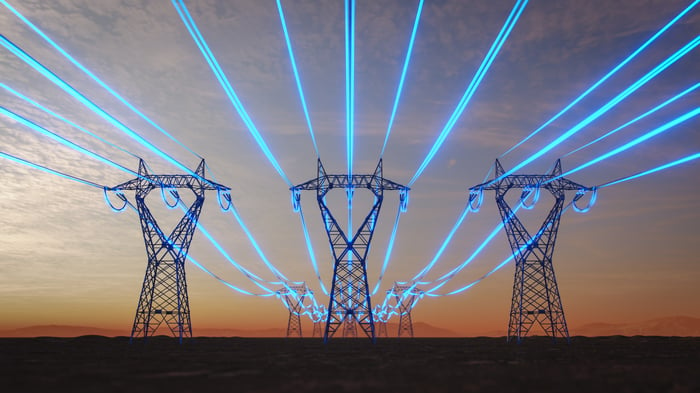
Image source: Getty Images.
A surge in contracted demand
In the first quarter of 2026, AEP signed up another 7 gigawatts of future load, bringing its total contracted load expected by 2030 to 63 gigawatts -- up from 56 gigawatts just one quarter earlier. Nearly 90% of that is data centers, including the same hyperscalers behind that $700 billion in spending, with the rest mostly industrial customers. A single gigawatt can power hundreds of thousands of homes, so this is an enormous block of contracted future demand landing on one utility.
The demand is concentrated in AEP's fastest-growing states -- Indiana, Ohio, Oklahoma, and Texas -- and it is reshaping the company's spending. AEP raised its five-year capital plan to $78 billion, up from $72 billion a quarter earlier, with most of the increase going toward new transmission and generation. Management expects that investment to grow its rate base at nearly an 11% compound annual rate and to lift its long-term operating earnings compound annual growth rate above 9% a year through 2030 -- a brisk pace for a regulated utility.
The build-out is already showing up in the utility's financials. AEP's first-quarter revenue rose about 10% year over year to $6.0 billion, and its operating earnings per share rose to $1.64 from $1.54 in the same quarter of 2025. Management reaffirmed its 2026 operating earnings guidance of $6.15 to $6.45 per share. And to soften the impact on existing customers, AEP said its large-load contracts could generate up to $16 billion in cost offsets over the life of the agreements.
The risks and the valuation
The growth case for AEP, of course, rests on the build-out actually getting built -- and that is not guaranteed. The biggest constraint is the slow pace at which the regional operators that run the grid connect new power plants.
"[I]f something is not done now, I expect we could still be having these same conversations in 10 years," said AEP CEO Bill Fehrman in the company's first-quarter 2026 earnings call.
Funding the plan carries its own risk.
AEP is leaning on both debt and fresh stock, including a $2.6 billion common stock offering in May and about $7 billion in growth equity planned through 2030. Issuing shares to build, however, dilutes existing shareholders. And as a regulated utility, AEP needs state regulators to sign off on the rates it charges and the returns it earns -- decisions ultimately out of its control.
There is also the question of whether the AI spending boom underpinning all this demand holds up. AEP says its take-or-pay contracts, which require customers to pay minimum demand charges whether or not they use the full capacity, limit the downside. But a sustained cut to hyperscaler AI spending could still leave it with plants and lines built for demand that never arrives.
Then there is the price. At about $126 as of this writing, up about 10% year to date, AEP trades at a forward price-to-earnings ratio of about 20. That is a robust valuation multiple for a utility, and it shows the market already paying up for years of data center-driven growth. With that said, the stock boasts a meaningful dividend yield of about 3%.
For investors who believe the AI build-out has years left to run, AEP offers something the tech giants spending the cash do not: a regulated, contracted, and somewhat predictable way to profit from it, with an attractive dividend attached.
Should you buy stock in American Electric Power right now?
Before you buy stock in American Electric Power, consider this:
The Motley Fool Stock Advisor analyst team just identified what they believe are the 10 best stocks for investors to buy now… and American Electric Power wasn’t one of them. The 10 stocks that made the cut could produce monster returns in the coming years.
Consider when Netflix made this list on December 17, 2004... if you invested $1,000 at the time of our recommendation, you’d have $449,393!* Or when Nvidia made this list on April 15, 2005... if you invested $1,000 at the time of our recommendation, you’d have $1,366,006!*
Now, it’s worth noting Stock Advisor’s total average return is 983% — a market-crushing outperformance compared to 212% for the S&P 500. Don't miss the latest top 10 list, available with Stock Advisor, and join an investing community built by individual investors for individual investors.
See the 10 stocks »
*Stock Advisor returns as of June 3, 2026.
Daniel Sparks and his clients have no position in any of the stocks mentioned. The Motley Fool has positions in and recommends Alphabet, Amazon, Meta Platforms, and Microsoft. The Motley Fool has a disclosure policy.
Recommended Articles


