




VYM vs. FDVV: Which U.S. Dividend ETF Is a Better Choice?
Key Points
The Vanguard High Dividend ETF ranks among the best dividend index funds, with a yield of 2.24%.
The Fidelity High Dividend ETF has delivered a higher dividend yield, but with a larger concentration of tech stocks -- about 27% of the fund.
The Fidelity ETF might be too tech-heavy to be the right fit for dividend-focused investors.
- 10 stocks we like better than Vanguard High Dividend Yield ETF ›
If you want to invest in high-yield dividend stocks, buying a dividend exchange-traded fund (ETF) can be an easy, low-cost way to do that. But not all dividend ETFs offer the same high yields or the same stock mix. If you're not careful, you might end up investing in a fund that's not the right fit for your goals.
Why do people buy dividend stocks? I personally don't own any dividend funds. But if I were going to buy dividend ETFs, I would want broad diversification to protect against a possible tech downturn. I would want to own shares of companies that are not closely linked to the artificial intelligence (AI) boom.
Will AI create the world's first trillionaire? Our team just released a report on the one little-known company, called an "Indispensable Monopoly" providing the critical technology Nvidia and Intel both need. Continue »
Many of the best dividend stocks are in so-called "boring" industries. They usually don't grow as fast as major tech names, but they are steady. Their balance sheets are strong. They keep cranking out solid profits and paying good dividends.
Two popular U.S. dividend stock ETFs, the Vanguard High Dividend ETF (NYSEMKT: VYM) and the Fidelity High Dividend ETF (NYSEMKT: FDVV), offer different approaches. Both have underperformed the S&P 500 index in the past year and over the past five years.
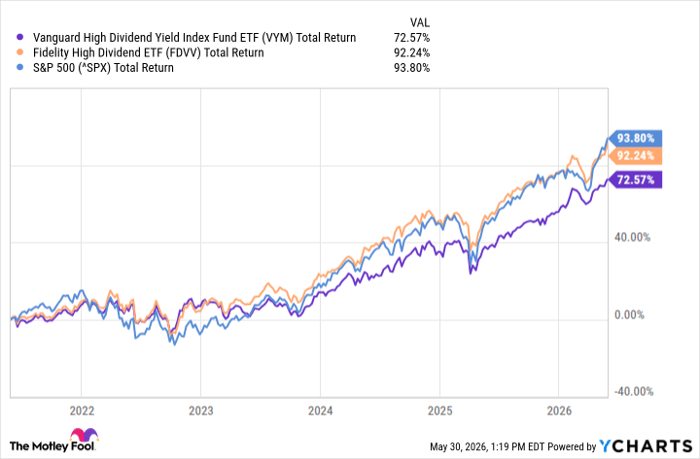
VYM Total Return Level data by YCharts
That's a big reason why I don't buy dividend stock ETFs -- they often fail to beat the market. But depending on your goals, dividend funds might offer steady income and lower volatility than other stock ETFs.
Let's see which of these two U.S. dividend funds could be the better choice.

Image source: Getty Images.
Vanguard High Dividend ETF (VYM): 608 stocks, five years of 11.5% annualized returns
The Vanguard High Dividend ETF is a passively managed, low-cost index fund that invests in large U.S. value-oriented stocks that are expected to deliver higher-than-average dividend yields. The fund's holdings (as of April 30) include 608 stocks.
This ETF has delivered annualized returns (by net asset value) of 11.5% for the past five years and 26.5% last year. Its trailing 12-month dividend yield is 2.24%, and the fund's expense ratio is an ultra-low 0.04%.
One strength of this Vanguard ETF is its diversification across a wide range of sectors. Its top holdings by sector are financial stocks (20.2% of the fund's assets), technology (14.8%), industrials (14.2%), healthcare (11.8%), and energy (9.7%).
This fund is much less tech-heavy than the S&P 500, which was made up of about 38% information technology stocks as of May 28. If you're concerned that S&P 500 ETFs have gotten too top-heavy with major tech names, the Vanguard High Dividend ETF might help manage that risk.
Fidelity High Dividend ETF (FDVV): 110 stocks, five years of 13.6% annualized returns
The Fidelity High Dividend ETF is less diversified than the Vanguard fund, holding only 110 stocks (plus two short positions). Its trailing 12-month dividend yield is 2.81%, which is higher than the Vanguard ETF. And its expense ratio is 0.15% -- more expensive than the Vanguard fund, but still low-cost.
As of April 30, the Fidelity ETF has delivered annualized returns (by net asset value) of 13.6% for the past five years and 26.9% last year. It has outperformed the Vanguard High Dividend ETF during those time periods.
However, stronger past performance doesn't mean this ETF is a better choice. This fund is oddly tech-heavy for a dividend ETF. In fact, 26.7% of the Fidelity High Dividend ETF assets are invested in the information technology sector -- much more than the Vanguard fund's tech exposure.
And the Fidelity High Dividend ETF's top four stock holdings are all major tech names: Nvidia (6.8% of the fund), Apple (5.7%), Microsoft (4.5%), and Broadcom (3.5%).
These aren't the usual "value stocks" that dividend ETFs offer -- they're growth stocks. In the event of an AI bust or prolonged tech downturn, this fund's investors will likely suffer those same types of losses.
This high level of exposure to the tech sector is, to my mind, the biggest reason not to buy this Fidelity ETF. If you want to invest in tech stocks and are willing to bear those risks, buy a tech-focused growth ETF. But if you want relatively "safe" and steady dividend stocks, this ETF doesn't seem like the best choice.
Why buy VYM instead of FDVV?
I don't own either of these ETFs. But if I had a stronger reason to buy dividend ETFs -- if I wanted steady income with lower volatility -- I would want to buy a dividend ETF that's diversified across sectors.
Even though the Fidelity High Dividend ETF has outperformed the Vanguard fund over the past five years, the Fidelity ETF feels too concentrated in major tech names. I believe that making such a heavy bet on tech stocks defeats the purpose of buying a dividend ETF in the first place.
The Vanguard High Dividend ETF feels like a better choice for this strategy. That's one reason why it ranks among the best dividend index funds.
Should you buy stock in Vanguard High Dividend Yield ETF right now?
Before you buy stock in Vanguard High Dividend Yield ETF, consider this:
The Motley Fool Stock Advisor analyst team just identified what they believe are the 10 best stocks for investors to buy now… and Vanguard High Dividend Yield ETF wasn’t one of them. The 10 stocks that made the cut could produce monster returns in the coming years.
Consider when Netflix made this list on December 17, 2004... if you invested $1,000 at the time of our recommendation, you’d have $449,393!* Or when Nvidia made this list on April 15, 2005... if you invested $1,000 at the time of our recommendation, you’d have $1,366,006!*
Now, it’s worth noting Stock Advisor’s total average return is 983% — a market-crushing outperformance compared to 212% for the S&P 500. Don't miss the latest top 10 list, available with Stock Advisor, and join an investing community built by individual investors for individual investors.
See the 10 stocks »
*Stock Advisor returns as of June 3, 2026.
Ben Gran has no position in any of the stocks mentioned. The Motley Fool has positions in and recommends Apple, Broadcom, Microsoft, Nvidia, and Vanguard High Dividend Yield ETF. The Motley Fool has a disclosure policy.
Recommended Articles


