




Which Vanguard Growth ETF Is a Better Buy?
Key Points
The Vanguard S&P Growth ETF and Vanguard Growth ETF have almost the same name and long-term returns.
Both funds are low-cost and have outperformed the S&P 500 index over the past several years.
The Vanguard Growth ETF is more tech heavy, and so could underperform during a future tech downturn.
- 10 stocks we like better than Vanguard Admiral Funds - Vanguard S&P 500 Growth ETF ›
Sometimes, two exchange-traded funds (ETFs) are so much alike that it's hard to tell them apart, let alone decide which one is better. The best Vanguard ETFs tend to have some good things in common, like low fees and broad diversification. And some Vanguard funds are almost identical, in name and in performance.
If you want to invest in growth stocks, two of Vanguard's ETFs can fit that strategy. The Vanguard S&P 500 Growth ETF (NYSEMKT: VOOG) and the Vanguard Growth ETF (NYSEMKT: VUG) both offer portfolios of U.S. growth stocks. Their top holdings of major tech names are only slightly different, and over the long run, these two different funds have delivered almost exactly the same returns.
Will AI create the world's first trillionaire? Our team just released a report on the one little-known company, called an "Indispensable Monopoly" providing the critical technology Nvidia and Intel both need. Continue »
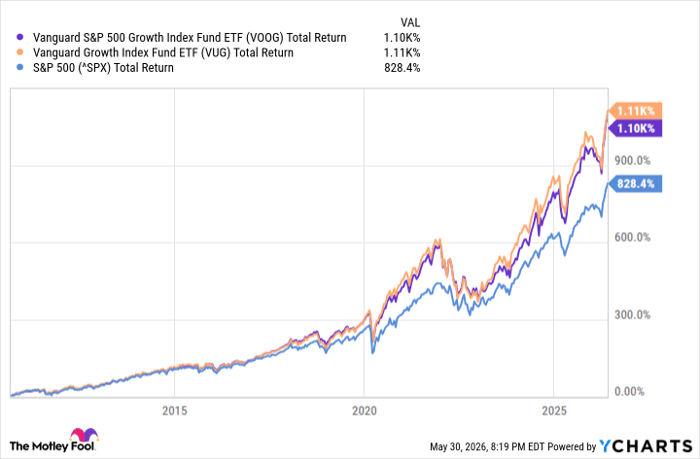
VOOG Total Return Level data by YCharts.
So far this year, one fund is doing a bit better than the other. The Vanguard S&P 500 Growth ETF is up 13.8% year to date, outperforming the S&P 500 index, while the Vanguard Growth ETF is up only 10.2%, slightly underperforming the stock market benchmark.
Despite their similarities, one of these Vanguard growth ETFs might be a clear favorite for your portfolio. Let's see which one stands out.

Image source: Getty Images.
Vanguard S&P 500 Growth ETF (VOOG): 145 stocks, 15 years of 17.2% annualized returns
The Vanguard S&P 500 Growth ETF holds 145 stocks that are focused on U.S. companies with high potential for investment growth. Its expense ratio is 0.07%, making this a low-cost index fund, even if its fees are not quite as low as some other Vanguard funds.
This fund has delivered annualized returns of 17.2% for more than 15 years since its inception in September 2010. That includes average annual returns of 16.2% for the past five years, 29.2% for the past three years, and almost 36% last year.
As a U.S. growth ETF, it's no surprise to see that this fund is heavily invested in tech stocks. As of April 30, 49.2% of the fund's top five holdings by sector are in technology, followed by communication services (17.6%), consumer discretionary (9.3%), financial stocks (8.9%), and industrials (6.7%). The fund's top five stock holdings (as of April 30) are familiar tech names:
- Nvidia: 14.6% of the fund
- Alphabet: 12.1% combining Class A and Class C shares
- Microsoft: 9.1%
- Apple: 5.98%
- Broadcom: 5.94%
This is a low-cost tech stock ETF that is slightly less tech-heavy than the Invesco QQQ Trust (NASDAQ: QQQ) -- which had a sector weighting of about 64% tech stocks as of April 30.
Vanguard Growth ETF (VUG): 153 stocks, 22 years of 12.3% annualized returns
The Vanguard Growth ETF consists of 153 stocks, but its holdings are even more tech-heavy than the Vanguard fund listed above. Its tech sector weighting is 67.8% of the portfolio, making it even more of a concentrated bet on tech than the S&P 500 ETF.
Most of the time, having more assets in tech stocks is not a bad thing. This fund has delivered annualized returns of 12.3% for more than 22 years since its inception in January 2004. This includes average annual returns (by net asset value) of 15.3% for the past five years, 27.3% in the past three years, and 30.6% last year.
The fund's top five stock holdings are the same names -- in almost the same order -- as the other Vanguard ETF:
- Nvidia: 13.33% of the fund
- Alphabet: 11.6%, combining Class A and Class C shares
- Apple: 11.5%
- Microsoft: 8.8%
- Broadcom: 5.2%
The Vanguard Growth ETF has an ultra-low expense ratio of 0.03%.This fund ranks among the best Vanguard ETFs and is an easy way to own some of the fastest-growing tech stocks. So why am I not recommending it?
Why buy one instead of the other
Both of these Vanguard growth ETFs are good choices in many ways. I don't own either fund, but if I were going to buy one, it would be the Vanguard S&P 500 Growth ETF. That's because it's a little more diversified across sectors, and less tech heavy. In case there is a tech downturn, this fund might perform better than the Vanguard Growth ETF, which is almost 68% tech stocks.
Looking at these funds' performance in 2022, the last time there was a big bear market in tech stocks, both delivered about the same losses as the tech-heavy Nasdaq 100 index, which lost about 29% that year.
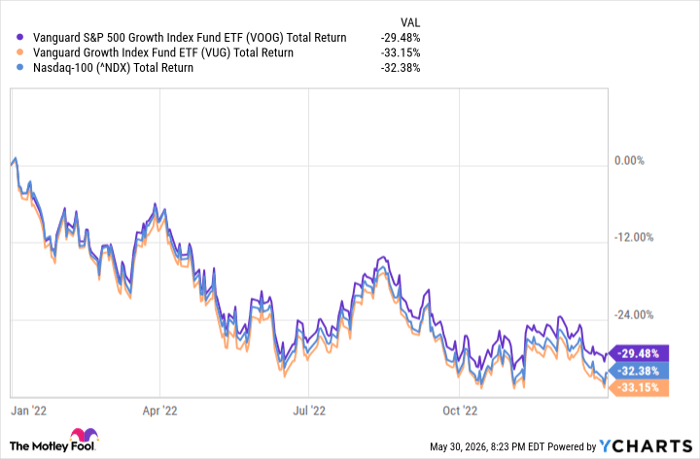
VOOG Total Return Level data by YCharts.
But the Vanguard S&P Growth ETF outperformed the other Vanguard ETF by about 3.7% percentage points. This could be a sign that the fund will hold up a bit better in case of future drawdowns in the tech sector.
Also, the Vanguard S&P Growth ETF has a slightly cheaper price-to-earnings ratio: 33.5, compared to 36.8 for the Vanguard Growth ETF. If you're going to buy almost the same mix of stocks, you might as well choose the undervalued version.
Should you buy stock in Vanguard Admiral Funds - Vanguard S&P 500 Growth ETF right now?
Before you buy stock in Vanguard Admiral Funds - Vanguard S&P 500 Growth ETF, consider this:
The Motley Fool Stock Advisor analyst team just identified what they believe are the 10 best stocks for investors to buy now… and Vanguard Admiral Funds - Vanguard S&P 500 Growth ETF wasn’t one of them. The 10 stocks that made the cut could produce monster returns in the coming years.
Consider when Netflix made this list on December 17, 2004... if you invested $1,000 at the time of our recommendation, you’d have $462,983!* Or when Nvidia made this list on April 15, 2005... if you invested $1,000 at the time of our recommendation, you’d have $1,375,447!*
Now, it’s worth noting Stock Advisor’s total average return is 995% — a market-crushing outperformance compared to 212% for the S&P 500. Don't miss the latest top 10 list, available with Stock Advisor, and join an investing community built by individual investors for individual investors.
See the 10 stocks »
*Stock Advisor returns as of June 3, 2026.
Ben Gran has no position in any of the stocks mentioned. The Motley Fool has positions in and recommends Alphabet, Apple, Broadcom, Microsoft, Nvidia, and Vanguard Growth ETF. The Motley Fool has a disclosure policy.
Recommended Articles


