




Should an Aging America Make You Buy More Bonds or Fewer? Here Is What the Research Says.
Key Points
Research from the IMF and Society of Actuaries says that aging populations should lead to lower bond yields.
Fidelity research warns that aging populations could drive up interest rates (and lower bond prices).
The Vanguard Total Bond Market ETF is a low-cost way to invest in more than 11,000 bonds.
- 10 stocks we like better than Vanguard Total Bond Market ETF ›
America's population is getting older. According to Census data, as of 2030, 1 in every 5 Americans will be of retirement age. Most of the baby boomers will soon be retired, to be joined by a growing cohort of age 60-plus Gen Xers.
As aging Americans leave the workforce, what does that mean for bond investors, interest rates, and the price of money? Will a larger population of older, retired people lead to lower inflation (and lower bond yields) or higher inflation (and higher bond yields)? No one knows for sure, but recent research offers some intriguing clues.
Will AI create the world's first trillionaire? Our team just released a report on the one little-known company, called an "Indispensable Monopoly" providing the critical technology Nvidia and Intel both need. Continue »
Let's look at the latest research on what happens to interest rates as populations get older -- and how you might want to invest your money today.

Image source: Getty Images.
Bull case: Older population buys more bonds
First, here's the optimistic "bull case" for bonds. Research from the International Monetary Fund (IMF) 2025 Economic Outlook says that aging populations might be good news for bond investors. As people get older, they tend to save more money and reduce their risk appetite. They spend less money and buy fewer stocks in their retirement portfolios.
As America's population gets older, this could bring lower demand for loans and higher demand for bond exchange-traded funds (ETFs). That would drive down interest rates, would reduce inflation, and would be good news for investors who own bonds -- because bond prices go up as interest rates go down.
A report from 2020 by the Society of Actuaries supports this theory that aging populations will lead to lower yields on bonds. It predicts that in the next 45 to 50 years, U.S. 10-year Treasury bond yields will be 0.4% lower, and 20-year Treasury yields will be 0.3% lower because of America's aging population.
That might be too optimistic. So far in 2026, investors are already acting worried about U.S. government borrowing, the Iran war, and other inflation risks. Yields for 10-year and 20-year Treasuries have recently reached levels close to their 10-year highs:
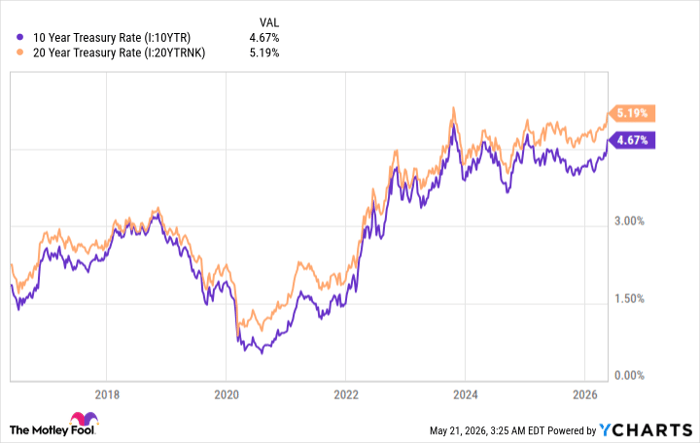
10 Year Treasury Rate data by YCharts
Bear case: Older population demands more government spending
Now, let's consider the pessimistic "bear case" for bonds. Fidelity recently published its Quarterly Market Update with top trends affecting the investment world. One theme that Fidelity highlighted is "unprecedented debt levels amid aging demographics." Governments borrowed massively during the pandemic, and the ratio of working adults to retirees is dropping -- which makes it harder to pay for retirement benefit programs like Social Security and Medicare.
If an older population, with fewer young people working to pay taxes to support them, leads to higher government spending on healthcare and pensions, this could prompt more government borrowing. That means issuing more government bonds, which would drive up bond yields and drive down bond prices. This would be bad news for bond investors.
How to invest in bonds in aging America? Buy BND.
No one knows for sure what's going to happen next with government borrowing, interest rates, or inflation. Those things drive the price of bonds and the value of money over time. But most people saving for retirement, especially as they get closer to retirement age, should own some bonds based on their age, time horizon, and risk tolerance. The Vanguard Total Bond Market ETF (NASDAQ: BND) is a good way to diversify your portfolio with bonds.
This bond ETF holds more than 11,000 bonds with a broad mix of U.S. Treasuries, other government bonds, and investment-grade corporate bonds. It's delivered average annual returns (by net asset value) of 3.46% for the past three years. And the fund's expense ratio is ultra-low: only 0.03%. No matter what happens in the future, the Vanguard Total Bond Market ETF ranks as one of the best bond ETFs to include in your portfolio.
Should you buy stock in Vanguard Total Bond Market ETF right now?
Before you buy stock in Vanguard Total Bond Market ETF, consider this:
The Motley Fool Stock Advisor analyst team just identified what they believe are the 10 best stocks for investors to buy now… and Vanguard Total Bond Market ETF wasn’t one of them. The 10 stocks that made the cut could produce monster returns in the coming years.
Consider when Netflix made this list on December 17, 2004... if you invested $1,000 at the time of our recommendation, you’d have $477,813!* Or when Nvidia made this list on April 15, 2005... if you invested $1,000 at the time of our recommendation, you’d have $1,320,088!*
Now, it’s worth noting Stock Advisor’s total average return is 986% — a market-crushing outperformance compared to 208% for the S&P 500. Don't miss the latest top 10 list, available with Stock Advisor, and join an investing community built by individual investors for individual investors.
See the 10 stocks »
*Stock Advisor returns as of May 25, 2026.
Ben Gran has positions in Vanguard Total Bond Market ETF. The Motley Fool has positions in and recommends Vanguard Total Bond Market ETF. The Motley Fool has a disclosure policy.
Recommended Articles


