




The 1 Chart Every AI Investor Needs to See Before Buying Anything Right Now
Key Points
Despite high liquidity, this metric has sparked investor concerns.
The metric significantly reduced free cash flows for one "Magnificent Seven" company.
Despite the concerns, this metric appears to yield higher returns for these companies.
- 10 stocks we like better than Alphabet ›
Massive stock price appreciation has often defined artificial intelligence (AI) investing in recent years. A considerable amount of investor dollars has flowed into such companies, particularly for some top tech stocks.
The added attention has some investors focused on returns or, in some cases, valuation. However, one chart shows a different, perhaps surprising, metric that may actually signal future gains for a few "Magnificent Seven" stocks.
Will AI create the world's first trillionaire? Our team just released a report on the one little-known company, called an "Indispensable Monopoly" providing the critical technology Nvidia and Intel both need. Continue »

Image source: Getty Images.
The critical metric
The metric that is raising concerns is capital expenditures (capex). And the chart below shows how much they have grown in the past few years.
In reality, this is four charts in one that shows capex spending for four of the top hyperscalers: Meta Platforms (NASDAQ: META), Microsoft (NASDAQ: MSFT), Google parent Alphabet (NASDAQ: GOOGL) (NASDAQ: GOOG), and Amazon (NASDAQ: AMZN). These companies plan to spend a combined $725 billion in capex in 2026 alone.
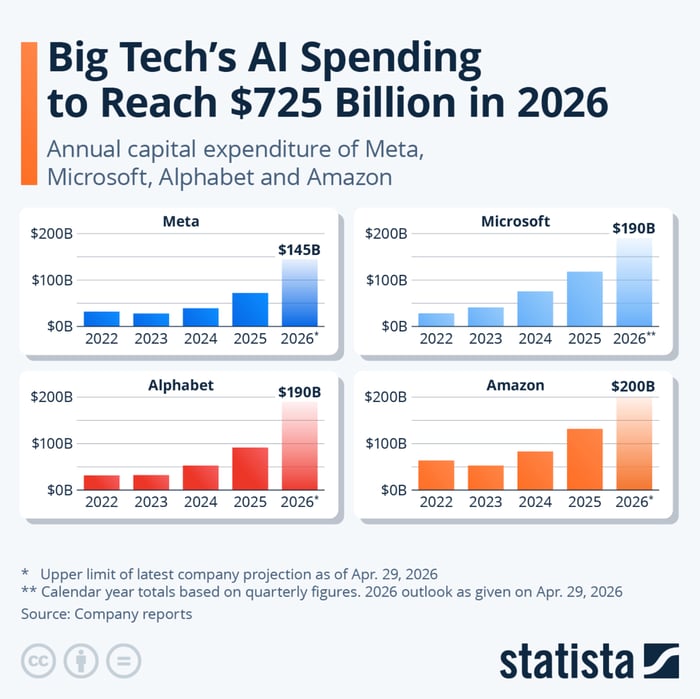
Data source: Statista.
The sheer volume of investment dollars may lead investors to question the wisdom of such spending, even among the companies best able to afford it. However, these companies represent some of the largest cash hoards in the tech industry. That gives them an advantage in what has become a capex arms race.
Moreover, they continue to generate positive free cash flows despite the added spending. This is an amazing feat considering that free cash flow is a figure that subtracts capex spending. Still, Amazon's free cash flow fell to just $1.2 billion over the trailing 12 months, down from $26 billion in the previous 12-month period, a decline that could spark concerns about future cash flow.
| Company Name |
Q1 Revenue Growth (YOY) |
2025 Revenue Growth |
Company Liquidity |
TTM Free Cash Flow |
|---|---|---|---|---|
| Google Cloud (Alphabet) | 62% | 35% | $127 billion | $64 billion |
| AWS (Amazon) | 28% | 20% | $143 billion | $1.2 billion |
| Meta Platforms | 33% | 22% | $81 billion | $46 billion |
| Azure (Microsoft)* | 40%* | 34%* | $78 billion* | $73 billion* |
Data source: Company earnings reports.YOY = Year over year. Note: Microsoft figures are for fiscal 2026's Q3 (ended March 31, 2026), except for 2025 revenue growth, which is for fiscal 2025 (ended June 30, 2025).
More importantly, all four have experienced improved revenue growth related to AI. Due to Microsoft's different fiscal year, its growth appears more muted. Azure revenue grew by 40% in both the third quarter of fiscal 2026 (ended March 31) and the first nine months of fiscal 2026, up from 34% in fiscal 2025.
Even though Microsoft did not progress as rapidly as its Magnificent Seven peers, the numbers show accelerated growth in its AI-related businesses. That makes the massive outlays not only more understandable but also more likely to pay off for the company and its investors.
Big tech and capex
Before buying another share of an AI stock, investors need to analyze the capex charts for the four Magnificent Seven companies to better understand their rapidly increasing capex spending and its effects.
Indeed, the $725 billion in capex spending appears alarming, even for many of the top AI companies in the Magnificent Seven. Should these initiatives fail, it could strain each company's financials for a time, a possibility few analysts would have considered realistic before the increases in capex spending.
Nonetheless, all four companies have benefited from accelerated growth in their AI-related businesses. Investors should confirm that this trend continues in each of these companies' upcoming earnings reports, but as long as more capex drives faster growth, they should welcome increased spending rather than sell their AI stocks because of it.
Should you buy stock in Alphabet right now?
Before you buy stock in Alphabet, consider this:
The Motley Fool Stock Advisor analyst team just identified what they believe are the 10 best stocks for investors to buy now… and Alphabet wasn’t one of them. The 10 stocks that made the cut could produce monster returns in the coming years.
Consider when Netflix made this list on December 17, 2004... if you invested $1,000 at the time of our recommendation, you’d have $481,589!* Or when Nvidia made this list on April 15, 2005... if you invested $1,000 at the time of our recommendation, you’d have $1,345,714!*
Now, it’s worth noting Stock Advisor’s total average return is 993% — a market-crushing outperformance compared to 208% for the S&P 500. Don't miss the latest top 10 list, available with Stock Advisor, and join an investing community built by individual investors for individual investors.
See the 10 stocks »
*Stock Advisor returns as of May 22, 2026.
Will Healy has no position in any of the stocks mentioned. The Motley Fool has positions in and recommends Alphabet, Amazon, Meta Platforms, and Microsoft. The Motley Fool has a disclosure policy.
Recommended Articles


