




Why I'm Switching My Savings Strategy After Years of Maxing Out My 401(k)
Key Points
The minimum you should contribute to a 401(k) is the maximum your employer will match.
IRAs come with unique benefits that you don't receive with a 401(k).
Choosing between a traditional and Roth IRA comes down to when you want to pay taxes.
- The $23,760 Social Security bonus most retirees completely overlook ›
When it comes to retirement accounts, there's the 401(k), and then everyone else. It's by far the most used retirement account in the country, with a large number of working-age Americans having one. It's a win-win: you proactively save and invest for retirement and get a tax break for doing it.
I have always thought the goal was to max out your 401(k) and set aside as much money for retirement as possible. And although that's well-intentioned, it's not feasible for most people -- nor is it always a smart move for those who can afford it. After doing it for years, here's a strategy I wish I had adopted sooner.
Will AI create the world's first trillionaire? Our team just released a report on the one little-known company, called an "Indispensable Monopoly" providing the critical technology Nvidia and Intel both need. Continue »
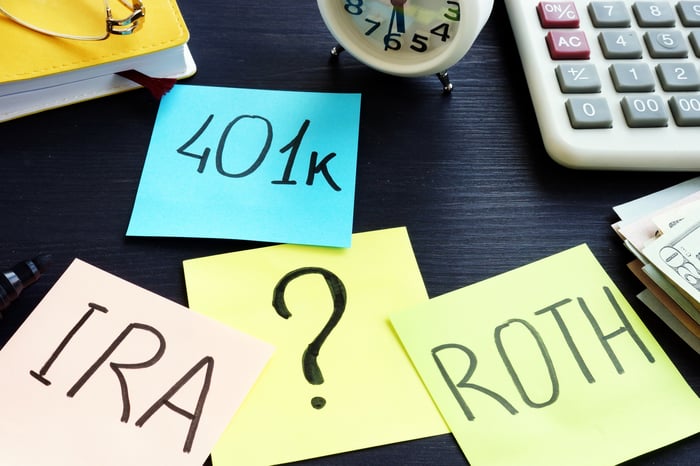
Image source: Getty Images.
The three-step strategy I follow
When I first started my career, an IRA was somewhat of an afterthought for me. My approach was always to contribute as much as I could to my 401(k) and worry about an IRA later. However, IRAs -- both traditional and Roth -- are among the best retirement savings tools, and I wish I had taken advantage of their benefits sooner.
In retrospect, here is the route I would have taken with my retirement savings strategy:
- Contribute as much to my 401(k) as my employer will match. If they match 3%, contribute 3%. If they match 5%, contribute 5%.
- Focus on maxing out an IRA.
- Once the IRA is maxed out, increase my 401(k) contribution to a sustainable amount.
IRAs have much lower contribution limits than 401(k)s, so maxing them out isn't as tall an order.
| Account Type | Contribution Limit Under 50 Years Old | Contribution Limit Age 50 and Older | Special Contribution Limit for Ages 60 to 63 |
|---|---|---|---|
| 401(k) | $24,500 | $32,500 | $35,750 |
| IRA (Traditional and Roth) | $7,500 | $8,600 | N/A |
Data source: IRS. Table by author.
Going this route lets you take advantage of the benefits of both instead of relying solely on a 401(k).
What are the benefits of using an IRA?
Traditional IRAs and Roth IRAs have two distinct benefits. With a traditional IRA, your contributions are deductible from your taxable income for the year (assuming you meet income criteria). Still, you'll owe taxes on withdrawals in retirement, just as with a 401(k).
You contribute after-tax money to your Roth IRA, so you're not required to pay taxes on withdrawals in retirement. Your money gets to (ideally) grow and compound with tax-free withdrawals at the finish line. You can also withdraw contributions -- but not earnings -- at any time without facing the typical 10% early withdrawal penalty.
You can begin withdrawing from your IRA at age 59 1/2 penalty-free, as long as you've had your account for at least five years.

Image source: Getty Images.
What separates IRAs from 401(k)s?
The first difference between 401(k)s and IRAs is that 401(k)s can only be opened through an employer, while anyone of age can open an IRA and contribute earned income into it.
IRAs are also closer to standard brokerage accounts because you can invest in virtually any stock or ETF you want in the account. With a 401(k), your plan administrator provides you with investing options, and you choose from those. Some people prefer set options; others prefer freedom to choose whatever they please.
Although not recommended in most cases, there are also more exceptions to the usual early withdrawal penalty. You can make penalty-free withdrawals from an IRA for things like higher education, your first home, and health insurance premiums while unemployed. These exceptions don't apply to your 401(k).
Deciding between a traditional and Roth IRA
Choosing between a traditional and a Roth IRA mostly comes down to when you want to pay taxes and your current versus projected tax bracket, both near and in retirement.
If you're in your peak earning years and your tax bracket is likely to be lower near retirement, a traditional IRA makes sense because you get your tax break when your taxes are higher and then pay taxes in retirement when your bracket is lower.
If you expect to be in a higher tax bracket near retirement, going with a Roth IRA is beneficial because you pay taxes up front while you're in a lower bracket and then have tax-free withdrawals when you're in a higher bracket.
There are some exceptions -- like someone above the Roth IRA income limit or someone who wants to limit required minimum distributions -- but that's a good rule of thumb to follow.
The $23,760 Social Security bonus most retirees completely overlook
If you're like most Americans, you're a few years (or more) behind on your retirement savings. But a handful of little-known "Social Security secrets" could help ensure a boost in your retirement income.
One easy trick could pay you as much as $23,760 more... each year! Once you learn how to maximize your Social Security benefits, we think you could retire confidently with the peace of mind we're all after. Join Stock Advisor to learn more about these strategies.
View the "Social Security secrets" »
The Motley Fool has a disclosure policy.
Recommended Articles


