




Greg Abel Just Bought Delta Airlines for Berkshire Hathaway's Portfolio. Here's the Big Reason Why.
Key Points
An oil price shock rocked the airline industry in the first quarter.
However, Berkshire's Greg Abel swooped in to buy Delta stock.
Delta has one big competitive advantage over peers in a high fuel price environment.
- 10 stocks we like better than Delta Air Lines ›
The first quarter of 2026 was the first in which Warren Buffett no longer made the big investment decisions at Berkshire Hathaway (NYSE: BRKA) (NYSE: BRKB). Rather, Buffett handed the reins to Greg Abel, who is not only in charge of Berkshire's operating businesses but will also make investment decisions over stock picks.
Amid just two new purchases in the first quarter, the largest was Delta Air Lines (NYSE: DAL), for which Abel established a $2.65 billion position, or roughly a 1% allocation to Berkshire's portfolio.
Will AI create the world's first trillionaire? Our team just released a report on the one little-known company, called an "Indispensable Monopoly" providing the critical technology Nvidia and Intel both need. Continue »
The first quarter of 2026 saw the U.S. go to war with Iran, triggering an oil price spike, which doesn't exactly seem like a good environment in which to buy airline stocks. However, high jet fuel prices were ironically likely the very reason Abel bought Delta. Here's why.
Why Delta traded at a discount in Q1
The Iran war began on Feb. 28, and shortly thereafter, Iran threatened the traffic going through the Strait of Hormuz, through which 20% of the world's oil and gas flows. In response, jet fuel prices nearly doubled in the quarter.
Higher fuel prices are very problematic for airlines. Planes have to fly no matter what, so higher fuel prices increase costs. If an airline increases prices to offset those costs, it risks destroying demand. But flights have to fly anyway, even if they aren't full, and less-full planes can destroy margins.
Unsurprisingly, the outbreak of war led to a decline in airline stocks, starting in February during the lead-up to the war, and then through March following the outbreak of hostilities. Berkshire likely scooped up shares of Delta amid these declines.
Delta has a competitive advantage in trying times
While all major airline stocks have fallen this year, Delta has declined less than its peers. This is likely because Delta has a not-so-secret weapon against higher jet fuel prices over its competitors: an oil refinery.
In 2012, Delta surprised the market by announcing it had purchased an idled oil refinery in Trainer, Pennsylvania. Delta paid $150 million for the facility and then invested another $120 million to reopen it and get the refinery up to speed.
While the move was panned at the time by many analysts, the Trainer facility has usually posted mild profits for Delta and allows it to offset higher jet fuel prices by keeping a margin it would normally pay a refinery within the company, provided Delta can operate the refinery profitably. In 2024 and 2025, Delta's refining segment reported operating income of $38 million and $157 million, respectively, offsetting a small portion of overall fuel costs.
The refinery's financial metrics fluctuate yearly and are usually not material to the company's overall operating profits, which totaled $5.8 billion last year amid benign fuel prices.
However, on the first-quarter conference call, Delta management noted that the refinery will help offset a massive $300 million increase in jet fuel prices this quarter alone. Thus, the quarterly benefit for Q2 will be more than Delta paid for the entire refinery, including upgrades, back in 2012!
But of course, this is only partial comfort for Delta, which will still see a $2 billion increase in fuel costs in the current quarter compared with what it paid at the beginning of the year. As a result, management is predicting earnings per share to fall to between $1.00 and $1.50 in the second quarter, down from $2.10 in adjusted EPS in the second quarter of 2025.
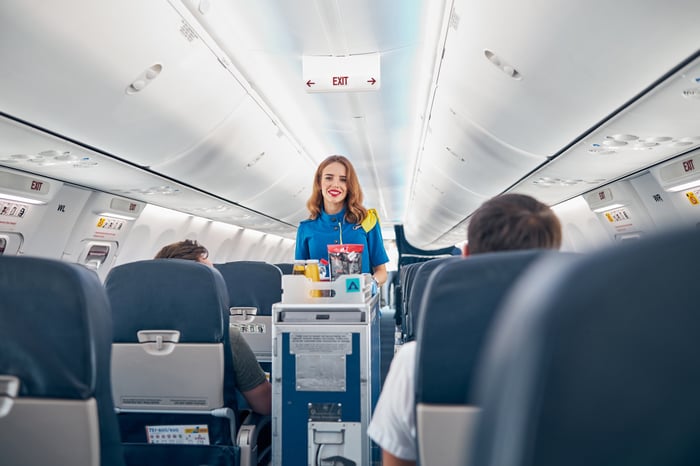
Image source: Getty Images.
This near-term advantage can turn into a long-term one
While earnings are expected to decline year over year amid high fuel prices, Delta remains profitable and, thanks to its refinery, is likely to be more profitable than its peers in 2026.
And while the current oil spike may prove temporary, it could have longer-term repercussions in the airline industry. This is because, due to high fixed costs, airlines only have so much time in an adverse environment before they are forced to scale back unprofitable routes or even go bankrupt.
On the first-quarter call, CEO Ed Bastian noted:
... going back over the last decade, when we saw consolidation, we forget what drove it. What drove consolidation was higher fuel prices back in 2009, 2010, 2011, and we were the leaders in that with the acquisition of Northwest in 2008. So I anticipate that higher fuel prices will lead to much more significant structural reform than we've seen over this period. COVID, I think, was a different animal, where no one was strong enough to engage in the type of rationalization that was necessary. And as we look forward to building a healthier business for the future, there are several business models that I think their owners will start questioning whether they should continue to commit capital to. And however that plays out, it's going to be a benefit to Delta.
Bastian's prediction has already come to pass to some extent. On May 2, Spirit Airlines ceased operations amid the oil price spike. Spirit had been through two bankruptcies in the past year but was still trying to operate up until the current oil price shock. So, at least one competitor has already left the market in this environment.
If Delta remains stronger than competitors in an adverse environment as other weaker competitors pull back or drop out of the market entirely, that's a recipe for Delta emerging as an even stronger market leader with greater market share after the oil crisis passes.
This is why Abel, who likely takes the same long-term investing mindset as Buffett, picked up shares amid the downturn.
Should you buy stock in Delta Air Lines right now?
Before you buy stock in Delta Air Lines, consider this:
The Motley Fool Stock Advisor analyst team just identified what they believe are the 10 best stocks for investors to buy now… and Delta Air Lines wasn’t one of them. The 10 stocks that made the cut could produce monster returns in the coming years.
Consider when Netflix made this list on December 17, 2004... if you invested $1,000 at the time of our recommendation, you’d have $475,063!* Or when Nvidia made this list on April 15, 2005... if you invested $1,000 at the time of our recommendation, you’d have $1,369,991!*
Now, it’s worth noting Stock Advisor’s total average return is 994% — a market-crushing outperformance compared to 207% for the S&P 500. Don't miss the latest top 10 list, available with Stock Advisor, and join an investing community built by individual investors for individual investors.
See the 10 stocks »
*Stock Advisor returns as of May 22, 2026.
Billy Duberstein and/or his clients have positions in Berkshire Hathaway. The Motley Fool has positions in and recommends Berkshire Hathaway. The Motley Fool recommends Delta Air Lines. The Motley Fool has a disclosure policy.
Recommended Articles


