




SpaceX May Be a Generational Company, But Its Financials Are Not Very Impressive Right Now
Key Points
For a company preparing the largest IPO ever, SpaceX's financials aren't anything to write home about.
The company is losing money, not growing revenue all that meaningfully, and spending a ton on growth.
The company has a potentially massive addressable market, but investors will have to try to understand how much is baked in at a $1.5 to $2 trillion valuation.
- These 10 stocks could mint the next wave of millionaires ›
SpaceX has finally released its highly anticipated preliminary prospectus ahead of a massive initial public offering expected in June.
SpaceX may be a generational company run by a generational founder in Elon Musk, but its financials leave much to be desired.
Will AI create the world's first trillionaire? Our team just released a report on the one little-known company, called an "Indispensable Monopoly" providing the critical technology Nvidia and Intel both need. Continue »
What makes them even harder to get behind is that SpaceX, according to various media reports, is looking to raise $75 to $80 billion at a valuation of $1.5 trillion to $2 trillion, making it the largest IPO of all time.
There's a lot to unpack, but let's take a look at some of its high-level financials.
Losing money with revenue growth that's nothing special
On a consolidated basis, SpaceX generated nearly $18.7 billion in revenue in 2025, a 33% increase from 2024. Revenue in the first quarter of 2026 of nearly $4.7 billion increased about 15% year over year.
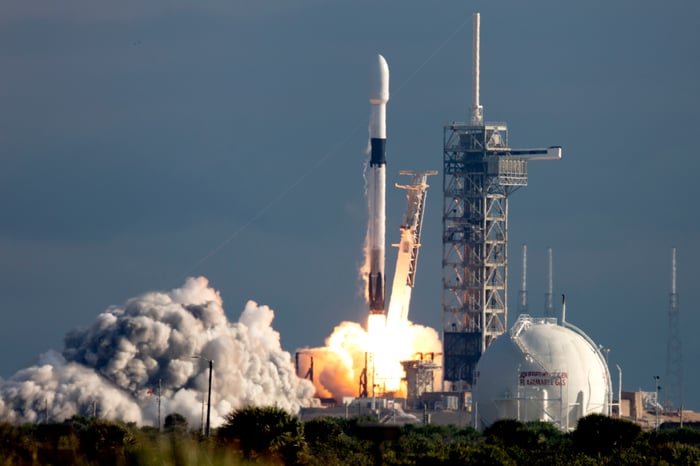
Image source: Getty Images.
SpaceX lost over $4.9 billion in 2025 and $4.3 billion in the first quarter of 2026, during which the company acquired xAI, the owner of the digital artificial intelligence assistant Grok. Adjusted EBITDA in these periods was nearly $6.6 billion and $1.13 billion, respectively.
The company has three key segments: space operations, which include launching crewed missions for clients such as NASA in a cost-efficient manner; Starlink satellite internet; and artificial intelligence.
SpaceX's best-performing business
The company's strongest segment right now is by far Starlink, which generated an operating profit of $4.4 billion in 2025 and adjusted EBITDA of nearly $7.2 billion, including the add-back of nearly $2.4 billion of depreciation and amortization.
In the first quarter of 2026, Starlink generated an operating profit of nearly $1.2 billion and adjusted EBITDA of over $2 billion.
Starlink is a capital-intensive business because it requires establishing a low-Earth-orbit satellite network. The network had 9,600 broadband and mobile satellites as of March 31 of this year.
At the end of the first quarter of this year, Starlink had also grown to an impressive 10.3 million subscribers across 164 countries, territories, and markets, up from 8.9 million at the end of 2025.
However, monthly average revenue per user (ARPU) had declined from $86 in the first quarter of 2025 to $66 in the first quarter of 2026, as the company introduced lower-priced plans internationally.
Satellites used for Starlink's network have a useful life of three to five years, according to the company, so this is a business the company will have to continually invest in to replenish the network with new satellites.
SpaceX's worst-performing business
The company's worst-performing business right now is AI, which houses its Grok intelligence and data centers that it owns and operates.
In 2025, the AI division posted an operating loss of nearly $6.4 billion and an adjusted EBITDA loss of $1.2 billion. In the first quarter of 2026, those numbers improved to a $936 million operating loss and $112 million adjusted EBITDA loss.
This division is a heavy capital spender, with significant research and development (R&D) costs.
The AI division had $12.7 billion of capital expenditures in 2025 and over $7.7 billion in the first quarter of 2026. The company says most of its capex is for expanding its data center footprint and supporting associated AI infrastructure.
The AI segment also has high R&D costs of over $5 billion in 2025 and nearly $2.4 billion in the first quarter of 2026, primarily due to higher depreciation expenses associated with chips and higher infrastructure and cloud expenses.
This suggests that SpaceX is in an aggressive growth mode right now.
The future opportunity vs. where the company is now
The big draw of SpaceX is its status as a pioneer in the space economy, which could give it a significant first-mover advantage.
The opportunity could undeniably be enormous. SpaceX sees a total addressable market of $28.5 trillion, with the bulk of that coming from AI-related services such as AI infrastructure, consumer subscriptions, digital advertising, and enterprise applications.
SpaceX may also eventually achieve sovereign AI, controlling the full AI stack from infrastructure to intelligence. The company expects to have data centers operating in space in 2028, and Musk's pay package is partly tied to colonizing Mars.
But right now, the company is conducting the largest IPO ever, asking for a massive valuation, and the numbers simply aren't that impressive.
That's why I am advising caution right now regarding the IPO. Once it goes public, any near-term appreciation in the stock will be built on hype rather than fundamentals.
Where to invest $1,000 right now
When our analyst team has a stock tip, it can pay to listen. After all, Stock Advisor’s total average return is 996%* — a market-crushing outperformance compared to 208% for the S&P 500.
They just revealed what they believe are the 10 best stocks for investors to buy right now, available when you join Stock Advisor.
See the stocks »
*Stock Advisor returns as of May 21, 2026.
The Motley Fool has a disclosure policy.
Recommended Articles


