




Why Would Anyone Buy SCHB Instead of MAGS?
Key Points
The Schwab U.S. Broad Market ETF has outperformed the Roundhill Magnificent Seven ETF year to date.
Three Mag 7 stocks have underperformed the Schwab U.S. Broad Market ETF for the past year.
The Schwab U.S. Broad Market ETF has delivered annualized returns of 14.7% for the past 10 years.
- 10 stocks we like better than Schwab Strategic Trust - Schwab U.s. Broad Market ETF ›
The "Magnificent Seven" have been some of the hottest tech stocks in the world for the past several years. Alphabet, Apple, Amazon, Meta Platforms, Microsoft, Nvidia and Tesla are household-name companies that are widely known for innovation and constantly being in the news.
Although the "Magnificent Seven" stocks have driven a large share of stock market growth in the past few years, they might be losing their luster. An exchange-traded fund (ETF) that tracks the Magnificent Seven, the Roundhill Magnificent Seven ETF (NYSEMKT: MAGS), has underperformed the S&P 500 index year to date. The past few years' high returns from the Magnificent Seven might look tempting, but there's no guarantee those seven stocks will keep beating the market in the long run.
Will AI create the world's first trillionaire? Our team just released a report on the one little-known company, called an "Indispensable Monopoly" providing the critical technology Nvidia and Intel both need. Continue »
Instead of buying the Magnificent Seven ETF, many long-term investors might be better off buying a diversified stock market index fund like the Schwab U.S. Broad Market ETF (NYSEMKT: SCHB). This low-cost index fund tracks the Dow Jones U.S. Broad Stock Market Index, and it's up 8.4% year to date, which is also outperforming the Magnificent Seven ETF (which is up 5.9%).
Let's look at a few reasons to buy SCHB instead of MAGS.

Image source: Getty Images.
SCHB: 2,414 stocks with 10 years of 14.7% returns
The Schwab U.S. Broad Market ETF is intended to give you exposure to the 2,500 largest publicly traded companies in the U.S. market. As of May 14, the fund owns 2,414 stocks, which include large-cap, mid-cap, and small-cap companies. For the past 10 years, this ETF has delivered annualized returns (by net asset value) of 14.7%. And it charges one of the lowest expense ratios: 0.03%. There are reasons this ETF ranks among the best low-cost index funds.
The top five holdings in the Schwab U.S. Broad Market ETF are all major tech names -- in fact, they're all members of the Magnificent Seven:
- Nvidia (7.9% of the fund)
- Apple (6.1%)
- Alphabet (5.8%) (including Class A and Class C shares)
- Microsoft (4.2%)
- Amazon (3.6%)
However, SCHB is broadly diversified. Information technology stocks make up only 31.1% of the portfolio. The fund also holds solid percentages of financial stocks (12.9% of the fund), industrials (10.3%), healthcare (9.9%), consumer discretionary (9.9%), and other sectors.
Owning the Schwab U.S. Broad Market ETF doesn't mean you have to stop owning tech stocks. This fund gives you access to some tech stock upside, without putting too many eggs in a tech-loaded basket. And if other parts of the U.S. economy start to outperform tech stocks, this fund will automatically shift and rebalance, as new winners get chosen by the market.
MAGS: 7 tech names, 34.2% annualized returns since April 2023
Indeed, the Magnificent Seven tech stocks have strongly outperformed the rest of the market for the past few years. The Roundhill Magnificent Seven ETF was established in April 2023, and since then, the fund has delivered annualized returns of 34.2% for almost the past three years (as of March 31).
This ETF does just what its name promises: it holds seven stocks. The Magnificent Seven names in this ETF are rebalanced to an equal weight on a quarterly basis, so each company makes up about 14.2%-14.3% of the fund. The Roundhill Magnificent Seven ETF charges an expense ratio of 0.30%, which is not the most expensive fee in the world, but is 10 times the fee charged by the Schwab U.S. Broad Market ETF. That fee seems a little high for seven stocks that you could buy yourself with fractional shares in a brokerage account.
Here's another problem with buying the Magnificent Seven ETF: not all seven stocks have been winners lately. For the past year, Alphabet, Nvidia, and Apple have strongly outperformed SCHB, but Tesla, Meta, and Microsoft have underperformed. (Meta and Microsoft have delivered negative returns in the past year.)
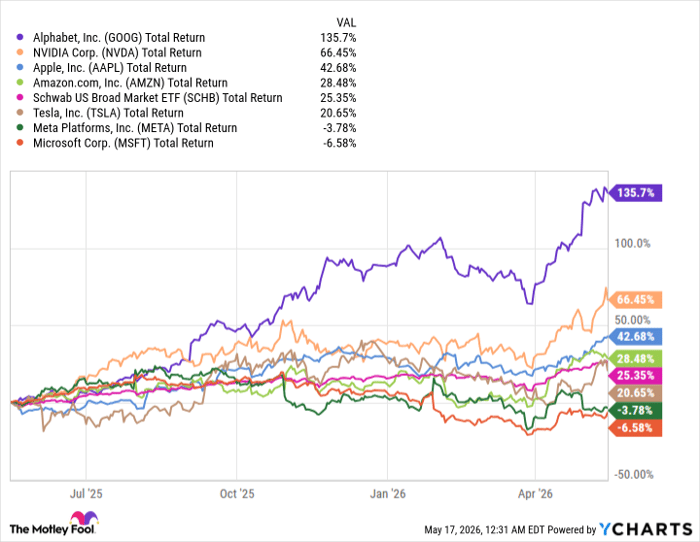
GOOG Total Return Level data by YCharts
If this divergence in performance continues, the Magnificent Seven might not be a winning team anymore. If you're going to take such a concentrated risk on a single-digit number of tech stocks, you might as well just buy individual shares of companies like Alphabet, Apple, and Nvidia, and ignore the rest. Or, if you want to go long tech stocks, consider buying the Invesco QQQ ETF instead of MAGS. Just buying the Nasdaq-100 could give you plenty of tech-driven upside without risking too much on only seven stocks.
Why buy SCHB instead of MAGS?
Investment fads come and go. Last year's hottest stock trend might become tomorrow's big loser. There's no guarantee that the same seven tech stocks will keep beating the market for long -- in fact, three of them have underperformed for the past year.
Instead of betting too heavily on seven stocks, most long-term investors are likely going to be better off with diversification -- owning thousands of stocks instead of just seven. And that strategy makes the U.S. Broad Market ETF a better buy for most investors than the Magnificent Seven ETF.
Should you buy stock in Schwab Strategic Trust - Schwab U.s. Broad Market ETF right now?
Before you buy stock in Schwab Strategic Trust - Schwab U.s. Broad Market ETF, consider this:
The Motley Fool Stock Advisor analyst team just identified what they believe are the 10 best stocks for investors to buy now… and Schwab Strategic Trust - Schwab U.s. Broad Market ETF wasn’t one of them. The 10 stocks that made the cut could produce monster returns in the coming years.
Consider when Netflix made this list on December 17, 2004... if you invested $1,000 at the time of our recommendation, you’d have $483,476!* Or when Nvidia made this list on April 15, 2005... if you invested $1,000 at the time of our recommendation, you’d have $1,362,941!*
Now, it’s worth noting Stock Advisor’s total average return is 998% — a market-crushing outperformance compared to 207% for the S&P 500. Don't miss the latest top 10 list, available with Stock Advisor, and join an investing community built by individual investors for individual investors.
See the 10 stocks »
*Stock Advisor returns as of May 19, 2026.
Ben Gran has no position in any of the stocks mentioned. The Motley Fool has positions in and recommends Alphabet, Amazon, Apple, Meta Platforms, Microsoft, Nvidia, and Tesla. The Motley Fool has a disclosure policy.
Recommended Articles


